• Welcome to the Internet Infidels Discussion Board.

“Revolution in Thought: A new look at determinism and free will"

I have made a tremendous revolutionary discovery. Science has the senses wrong.

We actually see with our noses, hear with our eyes, and smell with our ears.

Once this is realized war and crime will end.
I know you're trying to be funny, but this is a serious conversation. As far as war and crime coming to an end, I never got that far. I have said over and over that his discovery regarding the eyes, although related to the elimination of hurt in human relations, isn't directly related to the end of war and crime. His first discovery is. I started posting Chapter 6, The New Economic World (which is pivotal), but that is when Pood turned this discussion back to the eyes.
 
Last edited:
I know you are trying to be serious, but you make it hard to take you seriously.

The idea that the Sun and Moon appearing to have the same size means distance has noting to do with it is about as bad as it can get,

As we all know photons shrink as they travel making distant objects look small.

Or are they?

If I go up on the roof and hold a ruler up to Mt Rainier in the distance it is measured at about1 2 feet high. It shouid be easy to climb.
 
I have made a tremendous revolutionary discovery. Science has the senses wrong.

We actually see with our noses, hear with our eyes, and smell with our ears.

Once this is realized war and crime will end.
I know you're trying to be funny, but this is a serious conversation.

No, it’s not. There is nothing serious about the Great Bloviator’s idiotic claims, which are demonstrably false.
As far as war and crime coming to an end, I never got that far.

Oh, dear. 😭
I have said over and over

What you say over and over is irrelevant. If the things you stay are false, and they are, then you can say them until the end of time and they will still be false,
that his discovery regarding the eyes, although related to the elimination of hurt in human relations, isn't directly related to the end of war and crime. His first discovery is. I started posting Chapter 6, The New Economic World (which is pivotal), but that is when Pood turned this discussion back to the eyes.

I have no power to control what anyone else wants to talk about, nor any desire to use that power even if I were able to wield it.
 
No DBT, you are still thinking in terms of afferent vision. I am not disputing the speed of light, which you keep going back to.

That’s because the optic nerve is entirely afferent, as has been demonstrated to you again and again,
He didn't say the optic nerve wasn't afferent. This in itself doesn't prove what the brain is doing.

Quoth the Great Bloviator (did you forget you posted this just three pages back?):

Sight takes place for the first time when a sufficient accumulation of sense experience, such as hearing, taste, touch, and smell — these are doorways in — awakens the brain so that the child can look through them at what exists around him. He then desires to see the source of the experience by focusing his eyes, as binoculars. The eyes are the windows of the brain, through which experience is gained, not by what comes in on the waves of light as a result of striking the optic nerve, but by what is looked at in relation to the afferent experience of the senses. What is seen through the eyes is an efferent experience. If a lion roared in that room, a newborn baby would hear the sound and react because this impinges on the eardrum and is then transmitted to the brain. The same holds true for anything that makes direct contact with an afferent nerve ending, but this is far from the case with the eyes because there is no similar afferent nerve ending in this organ.
Exactly. There is no similar afferent nerve ending like the other senses. It doesn't work the same way, but that doesn't mean it's not afferent.

And how did the Great Bloviator determine this? Did he dissect eyes? Did he conduct a systematic study of optics, biology, astronomy, and so on?

Of course he didn’t. He was utterly ignorant of science. All he knew was how to bloviate, to flap his gums in print.

So now you are saying there ARE afferent nerves in the eyes, but they are not SIMILAR to afferent nerves in the other senses?

Yet the optic nerve is entirely afferent. That is the end of efferent seeing, whatever that is even supposed to mean.
 
That is why he purposely gave the example regarding the Sun being turned on at noon. We would be unable to see each other because light would not be here for another 8.5 minutes, but we would see the Sun even though it's 93 million miles away due to the fact that it's not the distance that counts here. It's luminosity and size. Because the Sun would meet the conditions for sight, we would see it instantly, but again, we would not see each other because the conditions for sight would not have been met, even though we may be only ten feet from each other.

Yet again, @bilby gave you simple way to test this claim. Just watch the sun come up in the morning with a neighbor next to you. The sun rising is functionally indistinguishable from the sun being turned at noon. If your writer were correct, we would see the sun rising above the horizon for nearly 8.5 minutes before we would see the ground light up and see the neighbor next to us. This is not what we observe. Hence your writer is wrong Q.E.D.

Have you tried this experiment for yourself yet? If not, why not? :unsure:
It cannot be proven by experiment.

Why not? @bilby gave you the precise experiment to prove it! Of course there are hundreds of others, but this one even you can carry out!
I will leave it at that


Of course you will, because you got nothing and you know it
because anything I say will be used against Lessans, not because he was wrong, but because of preconceived ideas.

Ad hom.
This is not an ad hom. If this is an ad hom, you deserve to be expelled from this thread. I will report you if you keep this up.
This is problematic and puts Lessans as viewed as someone who doesn't know what he's talking about. :picking_a_fight:.

That’s because he doesn’t.
You are not the last word, Pood. Stop placing yourself above reproach.

Once again, ad hom. I am dealing entirely in observed facts. It has nothing to do with me, and it is nothing personal.
 

Why not? @bilby gave you the precise experiment to prove it! Of course there are hundreds of others, but this one even you can carry out!
Bilby gave me nothing of the sort. This is the kind of subject matter that can't easily be proven directly, but it can be proven indirectly. I'm still waiting for proof that dogs can recognize their masters from sight alone. Or your claim that bees can recognize their beekeepers from sight alone, without other

Look at how peacegirl changes the subject. WHY did @bilby not give you an experiment to test your father’s claims about light and sight? OBVIOUSLY he did.. You can’t stand that, so you try to change the subject back to dogs and bees.

But as it happens, we HAVE given you scientific demonstrations that dogs and bees and many other animals can recognize humans by sight alone, even in the case of at least dogs by photos and videos. You ignore it all because you just can’t stand to face the fact that your father was full of shit.
 
I know you are trying to be serious, but you make it hard to take you seriously.

The idea that the Sun and Moon appearing to have the same size means distance has noting to do with it is about as bad as it can get,
He didn't say that the Sun and Moon had nothing to do with distance.

The actual reason we are able to see the moon is because there is enough light present, and it is large enough to be seen. The explanation as to why the sun looks to be the size of the moon, although much larger, is because it is much much farther away, which is the reason it would look like a star to someone living on a planet at the distance of Rigel. This proves conclusively that the distance between someone looking and the object seen has no relation to time because the images are not traveling toward the optic nerve on waves of light; therefore, it takes no time to see the moon, the sun, and the distant stars.

IOW, we are able to see the moon, the sun, the distant stars, etc., not because one is 3 seconds away, the other 8 minutes away, and the last many light-years away, but simply because these objects are large enough to be seen at their great distance when enough light is present.
As we all know photons shrink as they travel making distant objects look small.

Or are they?

If I go up on the roof and hold a ruler up to Mt Rainier in the distance it is measured at about1 2 feet high. It shouid be easy to climb.
I know you said this as a joke. Obviously, there is a great distance between the Sun and our eyes versus a lightbulb and our eyes, and if he is correct, distance is not a factor in this version of sight (I have explained that brightness and size are). We are able to interpret what we are seeing, knowing that the distance of the Sun is a lot farther away than a lightbulb. Further, we can measure actual distance by using the speed of light. A sidenote: When my son was a toddler, he looked up at the moon and reached for it, saying: Ball ball. I felt bad that I couldn't give it to him. :sadcheer:
 
Last edited:
I have made a tremendous revolutionary discovery. Science has the senses wrong.

We actually see with our noses, hear with our eyes, and smell with our ears.

Once this is realized war and crime will end.
I know you're trying to be funny, but this is a serious conversation.

No, it’s not. There is nothing serious about the Great Bloviator’s idiotic claims, which are demonstrably false.
No, they are not demonstrably false, and you will feel terrible for saying these things when it turns out he was right all along.
As far as war and crime coming to an end, I never got that far.

Oh, dear. 😭
Why the sarcasm?
I have said over and over

What you say over and over is irrelevant. If the things you stay are false, and they are, then you can say them until the end of time and they will still be false,
The same about you. If the things you say are false, and they are, then you can say them until the end of time, and they will still be false. Unfortunately, what people have concluded is false can impede progress when that progress is dependent on knowing the truth.
that his discovery regarding the eyes, although related to the elimination of hurt in human relations, isn't directly related to the end of war and crime. His first discovery is. I started posting Chapter 6, The New Economic World (which is pivotal), but that is when Pood turned this discussion back to the eyes.

I have no power to control what anyone else wants to talk about, nor any desire to use that power even if I were able to wield it.
You don't have that power, that is true. Maybe I should ignore you altogether.
 
No DBT, you are still thinking in terms of afferent vision. I am not disputing the speed of light, which you keep going back to.

That’s because the optic nerve is entirely afferent, as has been demonstrated to you again and again,
He didn't say the optic nerve wasn't afferent. This in itself doesn't prove what the brain is doing.

Quoth the Great Bloviator (did you forget you posted this just three pages back?):

Sight takes place for the first time when a sufficient accumulation of sense experience, such as hearing, taste, touch, and smell — these are doorways in — awakens the brain so that the child can look through them at what exists around him. He then desires to see the source of the experience by focusing his eyes, as binoculars. The eyes are the windows of the brain, through which experience is gained, not by what comes in on the waves of light as a result of striking the optic nerve, but by what is looked at in relation to the afferent experience of the senses. What is seen through the eyes is an efferent experience. If a lion roared in that room, a newborn baby would hear the sound and react because this impinges on the eardrum and is then transmitted to the brain. The same holds true for anything that makes direct contact with an afferent nerve ending, but this is far from the case with the eyes because there is no similar afferent nerve ending in this organ.
Exactly. There is no similar afferent nerve ending like the other senses. It doesn't work the same way, but that doesn't mean it's not afferent.

And how did the Great Bloviator determine this? Did he dissect eyes? Did he conduct a systematic study of optics, biology, astronomy, and so on?
He didn't have to. He saw this coming from a different angle. Why can't you see this? This claim didn't come out of thin air.
Of course he didn’t. He was utterly ignorant of science. All he knew was how to bloviate, to flap his gums in print.
If you keep calling him names and belittling him, I will report you to the moderator.
So now you are saying there ARE afferent nerves in the eyes, but they are not SIMILAR to afferent nerves in the other senses?
No, because, according to his definition of sense organ, the eyes don't fit the description since the optic nerve does not transduce nerve impulses into electrical signals that the brain then interprets as an image, which is the present theory.
Yet the optic nerve is entirely afferent. That is the end of efferent seeing, whatever that is even supposed to mean.
No, it is not. Just because the optic nerve is afferent does not mean you've got it all figured out. Far from it.
 
I know you are trying to be serious, but you make it hard to take you seriously.

The idea that the Sun and Moon appearing to have the same size means distance has noting to do with it is about as bad as it can get,
He didn't say that the Sun and Moon had nothing to do with distance.

The actual reason we are able to see the moon is because there is enough light present, and it is large enough to be seen. The explanation as to why the sun looks to be the size of the moon, although much larger, is because it is much much farther away, which is the reason it would look like a star to someone living on a planet at the distance of Rigel. This proves conclusively that the distance between someone looking and the object seen has no relation to time because the images are not traveling toward the optic nerve on waves of light; therefore, it takes no time to see the moon, the sun, and the distant stars.

IOW, we are able to see the moon, the sun, the distant stars, etc., not because one is 3 seconds away, the other 8 minutes away, and the last many light-years away, but simply because these objects are large enough to be seen at their great distance when enough light is present.
As we all know photons shrink as they travel making distant objects look small.

Or are they?

If I go up on the roof and hold a ruler up to Mt Rainier in the distance it is measured at about1 2 feet high. It shouid be easy to climb.
I know you said this as a joke. Obviously, there is a great distance between the Sun and our eyes versus a lightbulb and our eyes, and if he is correct, distance is not a factor in this version of sight (I have explained that brightness and size are). We are able to interpret what we are seeing, knowing that the distance of the Sun is a lot farther away than a lightbulb. Further, we can measure actual distance by using the speed of light. A sidenote: When my son was a toddler, he looked up at the moon and reached for it, saying: Ball ball. I felt bad that I couldn't give it to him. :sadcheer:

I am serious. The first part of my great discovery is that science has the senses wrong. We see with our nose.

The second part is that photons shrink as they travel making things look smaller.

I set emails to MIT, but they rejected my theory. What do they know anyway. Right?


You said if the Sun is switched on there is a delay before we see things on the Earth form the light, but we see the Sun in real tine, IOW instantly. Distance does not matter in seeing the Moon and Sun.


Geometric optical ray tracing shows how image formation makes distant objects look smaller.
 
I know you are trying to be serious, but you make it hard to take you seriously.

The idea that the Sun and Moon appearing to have the same size means distance has noting to do with it is about as bad as it can get,
He didn't say that the Sun and Moon had nothing to do with distance.

The actual reason we are able to see the moon is because there is enough light present, and it is large enough to be seen. The explanation as to why the sun looks to be the size of the moon, although much larger, is because it is much much farther away, which is the reason it would look like a star to someone living on a planet at the distance of Rigel. This proves conclusively that the distance between someone looking and the object seen has no relation to time because the images are not traveling toward the optic nerve on waves of light; therefore, it takes no time to see the moon, the sun, and the distant stars.

IOW, we are able to see the moon, the sun, the distant stars, etc., not because one is 3 seconds away, the other 8 minutes away, and the last many light-years away, but simply because these objects are large enough to be seen at their great distance when enough light is present.
As we all know photons shrink as they travel making distant objects look small.

Or are they?

If I go up on the roof and hold a ruler up to Mt Rainier in the distance it is measured at about1 2 feet high. It shouid be easy to climb.
I know you said this as a joke. Obviously, there is a great distance between the Sun and our eyes versus a lightbulb and our eyes, and if he is correct, distance is not a factor in this version of sight (I have explained that brightness and size are). We are able to interpret what we are seeing, knowing that the distance of the Sun is a lot farther away than a lightbulb. Further, we can measure actual distance by using the speed of light. A sidenote: When my son was a toddler, he looked up at the moon and reached for it, saying: Ball ball. I felt bad that I couldn't give it to him. :sadcheer:
I am serious. The first part of my great discovery is that science has the senses wrong. We see with our nose.

The second part is that photons shrink as they travel making things look smaller.

I set emails to MIT, but they rejected my theory. What do they know anyway. Right?
You are obviously using this thread for entertainment. Unless you have a real question, I will just pass you by.
You said if the Sun is switched on there is a delay before we see things on the Earth form the light, but we see the Sun in real tine, IOW instantly. Distance does not matter in seeing the Moon and Sun.
He used that as a hypothetical example, Steve.
Geometric optical ray tracing shows how image formation makes distant objects look smaller.
Whatever works for delayed sight works for non-delayed.
 
No DBT, you are still thinking in terms of afferent vision. I am not disputing the speed of light, which you keep going back to.

That’s because the optic nerve is entirely afferent, as has been demonstrated to you again and again,
He didn't say the optic nerve wasn't afferent. This in itself doesn't prove what the brain is doing.

Quoth the Great Bloviator (did you forget you posted this just three pages back?):

Sight takes place for the first time when a sufficient accumulation of sense experience, such as hearing, taste, touch, and smell — these are doorways in — awakens the brain so that the child can look through them at what exists around him. He then desires to see the source of the experience by focusing his eyes, as binoculars. The eyes are the windows of the brain, through which experience is gained, not by what comes in on the waves of light as a result of striking the optic nerve, but by what is looked at in relation to the afferent experience of the senses. What is seen through the eyes is an efferent experience. If a lion roared in that room, a newborn baby would hear the sound and react because this impinges on the eardrum and is then transmitted to the brain. The same holds true for anything that makes direct contact with an afferent nerve ending, but this is far from the case with the eyes because there is no similar afferent nerve ending in this organ.
Exactly. There is no similar afferent nerve ending like the other senses. It doesn't work the same way, but that doesn't mean it's not afferent.

And how did the Great Bloviator determine this? Did he dissect eyes? Did he conduct a systematic study of optics, biology, astronomy, and so on?
He didn't have to.

He didn’t have to?? So he just pulls his claims out of his rectal orifice and expects to people accept them because … why?
He saw this coming from a different angle.

What angle was that? The moron angle?
Why can't you see this? This claim didn't come out of thin air.

Right. It came out of his posterior.
Of course he didn’t. He was utterly ignorant of science. All he knew was how to bloviate, to flap his gums in print.
If you keep calling him names and belittling him, I will report you to the moderator.

Go right ahead! You don’t even understand the rules here, still less anything else in the world.

And if you ad hom any of us one more time I will report you to the moderators
So now you are saying there ARE afferent nerves in the eyes, but they are not SIMILAR to afferent nerves in the other senses?
No, because, according to his definition of sense organ, the eyes don't fit the description since the optic nerve does not transduce nerve impulses into electrical signals that the brain then interprets as an image, which is the present theory.

:ROFLMAO:

So you tell us that the Great Bloviator never said that there were no afferent nerves in the eyes, when clearly that is exactly what he said, and this crap is the best you can come up with in response to being called out on your ridiculous error?

Yet the optic nerve is entirely afferent. That is the end of efferent seeing, whatever that is even supposed to mean.
No, it is not. Just because the optic nerve is afferent does not mean you've got it all figured out. Far from it.

So just because the optic nerve is afferent doesn’t mean it’s afferent?

What the hell are you talking about??
 
That wasn't his full explanation.
Then why did he say that points 1 and 2 together "proves"? Why did he say points 1 and 2 together "proves" if those points are not sufficient for serving as proof?

This is true, but only if the brain works the way he claimed, or it would not make sense.
If "the brain works the way he claimed," then light emitted and reflected by objects external to a seeing being is not necessary for there to be vision.

If "the brain works the way he claimed", then what he means by "light" is some thing emitted or projected by the brain because, as he says, "nothing from the external world strikes her optic nerve to allow her to see these various objects. She simply sees these things because she looks at them."

If "the brain works the way he claimed", then the brain does not process light; rather, the brain is the source emitter of "light".

If the brain is the source emitter of "light", then by what means does the brain distinguish between seeing (or imaging) and imagining? How can the brain determine that its seeing corresponds to what is seen if light emitted from or reflected by the thing seen has no pathway to the brain?
 
What happens when you enter a perfectly dark room, where you see nothing, and then you switch the light on?
What are you getting at DBT? You would see what is in the room. Light travels so fast, there is no way someone could prove that we see in real time. It is assumed that light brings us the image which takes a nanosecond or less to reach our eyes. This goes right back to the belief in delayed vision. This question doesn't answer anything more than what is believed to be happening.

The speed of light has been measured. Now if you consider what happens when you enter a dark room and switch the light on, understanding that light has travel time, you'd understand that "real time/instant vision' is impossible.
I just explained that the conclusion that we see in delayed time cannot be determined by your example because it is assumed that because light travels, and light brings the image to the eye, it follows that we see in delayed time. But this is the very theory that is being challenged. It doesn't prove this version of vision is correct, and it certainly doesn't prove that "real time" vision is impossible. Real time vision is impossible the way you're looking at it, is all, not that it's actually impossible.

It's not about the way I am looking at it, but the way the world works.
Obviously not.
It's the physics of light, the evolutionary role of the eyes, brain, mind and consciousness. It's not magic. It's not some inexplicable real time vision, nor some modified form of determinism.
The role of the eyes is to detect light. This does not change, because light is at the eye in both versions. Real-time vision is not magic if you understand how it works. As far as the role of the brain, you cannot state your premise is sound when it is the very thing being challenged. And what does consciousness have to do with either delayed or real-time vision? There has to be consciousness, regardless, or there is no conversation.

It's when you deviate from 'light is necessary' to real time/instant vision where it all goes wrong.
 
What happens when you enter a perfectly dark room, where you see nothing, and then you switch the light on?
What are you getting at DBT? You would see what is in the room. Light travels so fast, there is no way someone could prove that we see in real time. It is assumed that light brings us the image which takes a nanosecond or less to reach our eyes. This goes right back to the belief in delayed vision. This question doesn't answer anything more than what is believed to be happening.

The speed of light has been measured. Now if you consider what happens when you enter a dark room and switch the light on, understanding that light has travel time, you'd understand that "real time/instant vision' is impossible.
I just explained that the conclusion that we see in delayed time cannot be determined by your example because it is assumed that because light travels, and light brings the image to the eye, it follows that we see in delayed time. But this is the very theory that is being challenged. It doesn't prove this version of vision is correct, and it certainly doesn't prove that "real time" vision is impossible. Real time vision is impossible the way you're looking at it, is all, not that it's actually impossible.

It's not about the way I am looking at it, but the way the world works.
Obviously not.
It's the physics of light, the evolutionary role of the eyes, brain, mind and consciousness. It's not magic. It's not some inexplicable real time vision, nor some modified form of determinism.
The role of the eyes is to detect light. This does not change, because light is at the eye in both versions. Real-time vision is not magic if you understand how it works. As far as the role of the brain, you cannot state your premise is sound when it is the very thing being challenged. And what does consciousness have to do with either delayed or real-time vision? There has to be consciousness, regardless, or there is no conversation.

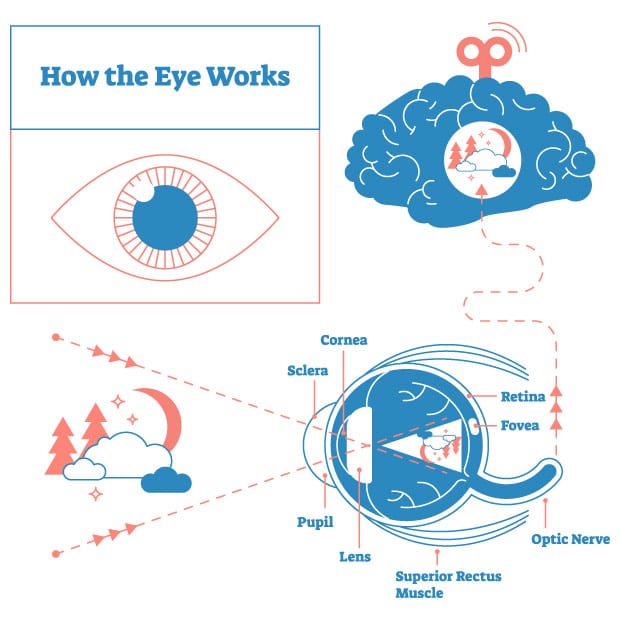
"Fundamentally, the brain analyzes the information your eye gathers"

how-the-eye-works_620a.jpg


What happens when you enter a perfectly dark room, where you see nothing, and then you switch the light on?
What are you getting at DBT? You would see what is in the room. Light travels so fast, there is no way someone could prove that we see in real time. It is assumed that light brings us the image which takes a nanosecond or less to reach our eyes. This goes right back to the belief in delayed vision. This question doesn't answer anything more than what is believed to be happening.

The speed of light has been measured. Now if you consider what happens when you enter a dark room and switch the light on, understanding that light has travel time, you'd understand that "real time/instant vision' is impossible.
I just explained that the conclusion that we see in delayed time cannot be determined by your example because it is assumed that because light travels, and light brings the image to the eye, it follows that we see in delayed time. But this is the very theory that is being challenged. It doesn't prove this version of vision is correct, and it certainly doesn't prove that "real time" vision is impossible. Real time vision is impossible the way you're looking at it, is all, not that it's actually impossible.

It's not about the way I am looking at it, but the way the world works.
Obviously not.
It's the physics of light, the evolutionary role of the eyes, brain, mind and consciousness. It's not magic. It's not some inexplicable real time vision, nor some modified form of determinism.
The role of the eyes is to detect light. This does not change, because light is at the eye in both versions. Real-time vision is not magic if you understand how it works. As far as the role of the brain, you cannot state your premise is sound when it is the very thing being challenged. And what does consciousness have to do with either delayed or real-time vision? There has to be consciousness, regardless, or there is no conversation.

"Fundamentally, the brain analyzes the information your eye gathers"

how-the-eye-works_620a.jpg


She has been given a shit ton of info on how the eye works for years, and she is impervious to it. Peacegirl has no connection with reality. Her only reality is her father’s ridiculous book, which to her is holy writ, like the bible is to fundy Christians.
 
What happens when you enter a perfectly dark room, where you see nothing, and then you switch the light on?
What are you getting at DBT? You would see what is in the room. Light travels so fast, there is no way someone could prove that we see in real time. It is assumed that light brings us the image which takes a nanosecond or less to reach our eyes. This goes right back to the belief in delayed vision. This question doesn't answer anything more than what is believed to be happening.

The speed of light has been measured. Now if you consider what happens when you enter a dark room and switch the light on, understanding that light has travel time, you'd understand that "real time/instant vision' is impossible.
I just explained that the conclusion that we see in delayed time cannot be determined by your example because it is assumed that because light travels, and light brings the image to the eye, it follows that we see in delayed time. But this is the very theory that is being challenged. It doesn't prove this version of vision is correct, and it certainly doesn't prove that "real time" vision is impossible. Real time vision is impossible the way you're looking at it, is all, not that it's actually impossible.

It's not about the way I am looking at it, but the way the world works.
Obviously not.
It's the physics of light, the evolutionary role of the eyes, brain, mind and consciousness. It's not magic. It's not some inexplicable real time vision, nor some modified form of determinism.
The role of the eyes is to detect light. This does not change, because light is at the eye in both versions. Real-time vision is not magic if you understand how it works. As far as the role of the brain, you cannot state your premise is sound when it is the very thing being challenged. And what does consciousness have to do with either delayed or real-time vision? There has to be consciousness, regardless, or there is no conversation.

"Fundamentally, the brain analyzes the information your eye gathers"

how-the-eye-works_620a.jpg


She has been given a shit ton of info on how the eye works for years, and she is impervious to it. Peacegirl has no connection with reality. Her only reality is her father’s ridiculous book, which to her is holy writ, like the bible is to fundy Christians.
Pood is very threatened by this news for whatever reason. When we are threatened we stop being rational. We close our ears as if doing this saves us from the truth. I’m sorry Pood, but this isn’t going to work. The good news is there is more to gain than to lose but you won’t allow yourself to see it. 🫤
 
They are not discoveries. There is no threat.
How very unfortunate coming from someone who believes man’s will is not free! 🫩
 
Pg
When we are threatened we stop being rational.

Some people are not rational to begin with. You are afraid to consider Lessans may be wrong, your life appears to be built around how your view Lessans,. On the other hand science has always been in a state of change. No absolutes. What becomes science is what remains after everything else that was proposed failed to be demonstrated.

Maxwell's Equations became mainstream science because i twas demonstrated and congestion theories did not work.

To get attention Lessans would have had to write a paper wihout all the rhetoric simply dtreilng the hypothesis and an experiment that others can do for themselves.

You do not just approach a university and expect a response.

The religious debates prepared me to debate and understand you.
 
Back
Top Bottom