To repeat: It is not a contradiction because light is constantly traveling with individual packets of photons, but it does not bounce off the object taking the frequency/wavelength with it through space/time. It is not so out the door as you claim, that it is impossible to be true.
"light is constantly traveling with individual packets of photons, but it does not bounce off the object taking the frequency/wavelength with it through space/time" says nothing about whether anything is or is not a contradiction. In fact, it really doesn't say anything at all - I don't care much what you claim is NOT happening; I want to know what you claim IS happening.
All that sentence claims is "light is constantly traveling with individual packets of photons", which is not a very elegant way to phrase the concept that light travels at lightspeed, as photons. But it's not in dispute, so so far you have added ZERO to your case. The above is valueless preamble.
Let's see if you actually have something to say:
The reason we see an object is that the light is at the eye,
OK. Again, we agree. Photons arrive at the eye, and until they do, we cannot see an object.
as long as the object is within our field of view.
Photons generally travel in straight lines, so again, it is not in dispute that we see only those objects that are in our field of view.
Again, this is just "filler"; You need to cut out the parts of your argument on which there is agreement by everyone on both sides, because those parts are valueless - they either do nothing, or they obscure your actual argument.
If it is too far away, we won't see it because there is no light at our eyes.
Well, insufficient light, yes. Eyes don't detect very small numbers of photons, there's a minimum number that must impinge on the retina to evoke a response.
We can see nothing without light.
Again, needless padding. Nobody says otherwise.
A telescope could help if the object isn't so far away that the light can't be collected and focused,
Indeed; A telescope collects photons as they travel, and concentrates them so that enough are available for sight.
such that the magnification can then make the object appear larger.
Telescopes don't magnify; You are thinking of magnifying glasses, which are totally different.
It does not violate anything.
What doesn't? Your only controversial claim here is that "[light] does not bounce off the object taking the frequency/wavelength with it", which is a negative claim. Nobody cares what doesn't happen; We want to know what you think DOES happen.
Nothing you say here in any way supports instant vision; Mostly it's pointless filler, and the rest agrees that "The reason we see an object is that the light is at the eye", which it can only be if it has come there from somewhere else, because "light is constantly traveling with individual packets of photons".
So where has it come from, and how does it allow us to see the object if it hasn't come from the object?
The apparent contradiction is that you claim the light hasn't come from the object, but is somehow "at the eye". From where, if not from the object? And if from elsewhere, how does that light carry information about the object, including (as a minimum) that it even exists?

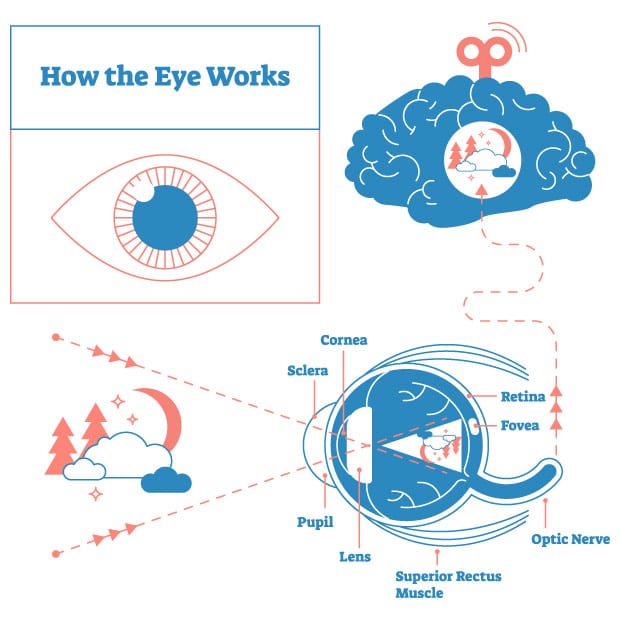

 I have said that different cultures have different standards as to what is considered beautiful and ugly, but where does this standard come from, and how do we get conditioned? Answer: We get conditioned by words. How, then, do words get attached to faces if beautiful and ugly faces are not traveling in the light itself? Does the word and face travel together in the light, allowing us to see this beauty and ugliness? Of course not. There has to be a way the word gets associated with certain facial structures. But no, people just handwave away whatever he wrote because they conclude it's of no import. But it has major implications, so it is important. He came from a completely different perspective. Although this knowledge did not come from astronomy, it doesn't make him wrong. In fact, knowledge can come from unexpected places. There is nothing in the anatomy of the eyes that proves he is wrong about how the brain and eyes work. Elon Musk and a few others are trying to see if they can make the blind see through internal processes. Only time will tell. I am saddened by the lack of interest other than telling me he was wrong when no one has understood his proof of determinism, either, and why he had to tweak the definition. One of his premises is that the past does not exist except in our memory. This is important because of the confusion over the word cause, which has important implications. If people can't accept that premise, even temporarily, then there is no point in continuing. It's disheartening that this group claims to be objective, but I don't see it.