• Welcome to the Internet Infidels Discussion Board.

2026 Mid-Term Elections

Though how to determine what is high and what is fair?
I’d model a progressive tax based on the conditions in the most successful a Republican presidency in history; the Eisenhower administration. And limit the duration that a person may hold an “unrealized profit” or the ability borrow against it.
 
1. They pay a disproportionately small income tax, both personal and corporate.
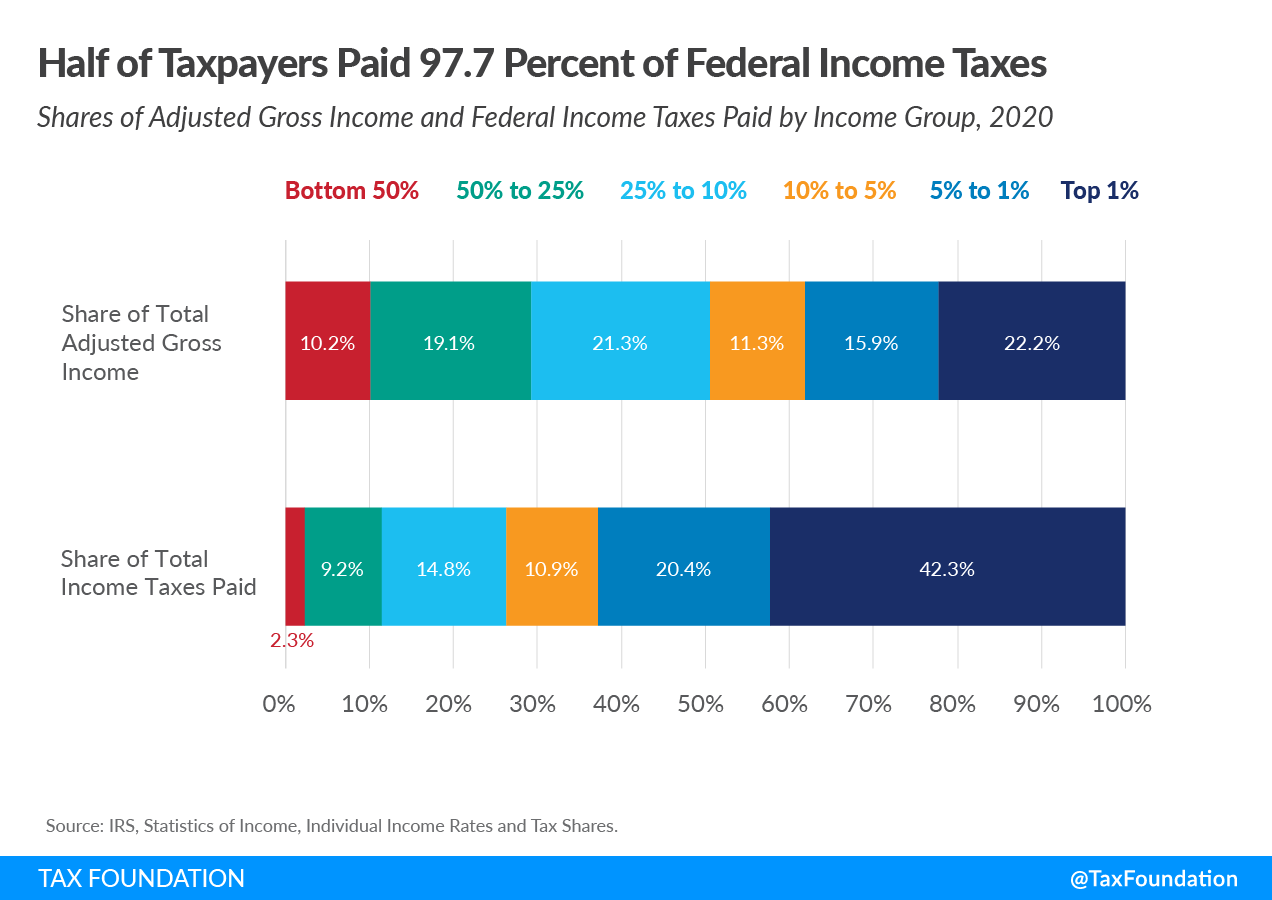
Actually, the wealthy pay a disproportionally high share of total federal income taxes.
FedData2023_2.png


They also collect a disproportionally high share of the wealth generated in this country.
 
Higher earners profit more than lower earners for the system. They should pay their fair share.
Sounds good.
Though how to determine what is high and what is fair?
In Australia I have noticed that nearly all those who rabbit on about higher taxes for certain people are loathe to actually say what level the higher taxes should kick in. When pressed invariably it is just above what they are making or own. Funny about that.
Sure, it’s easy to think someone else should pay more. I strongly believe in a progressive system of income tax, with lower limits but not upper limits. I also think that deductions should be carefully scrutinized. Our income prior to both our retirements was bordering on upper middle class. When we started out, we were raising kids on less than we paid in income taxes closer to the end of our working careers. While I marveled at the sums, I never begrudged a cent. Now, we are living on a very modest pension and SS plus the proceeds of our retirement savings, which, if we are modest in our expenditures, will allow us to live pretty much as we have been and should cover if one of us needs long term care. If we both do, it gets dicey. Probably we will be ok. Withdrawals from the account are heavily taxed. We still end up sending in more at tax time. While I wish it were less, just as I wish the utility bills were less or milk or bread were cheaper, I don’t begrudge a cent.
My daughter and her husband do not have children yet (maybe 1 day). What financial help from state and Commonwealth they be eligible to get to help raising any children will dwarf what my wife and I had with her. My wife was one of the last to be able to stay at home.
At times it was tough, especially when I was 7 years on contract work. We made it.
And go back to my parents with 4 children (1960s- 70s) - they only got a miniscule child endowment scheme from the Commonwealth. Unless you had 7 (or was it 6)? kids or more. Then it ramped up. No state aid.
Dad was an mechanical engineer. Mum was able to stay at home. They could afford a mortgage, car, some private health insurance. We had a holiday somewhere in Victoria each summer and every 4 years or so went to either NSW or South Australia. Once we got to Queensland! Certainly not a grand lifestyle, we were solidly middle class.
Yet prices were stable, housing was affordable, whilst not flashy like today seems to be.

Today prices are unstable, housing in Australia is insanely stupid. Permanent work in Australia only means you get 4 weeks notice instead of just 1 week.
Yet the expectations of people have changed in the mean time. My daughter expects so much more from her employer, government than we ever did and her grandparents would be flabbergasted at the sense of entitlement she has. we tried to raise her, moderating her expectations yet from somewhere she and her husband acquired a sense of entitlement that my wife and I do not understand.

It is not just that the overall financial situation has changed for the worse, the expectations of society from other members has changed dramatic and more clashes about who gets what, how and why will only intensify.
I don’t mind that lots of people want and get a grander life than I have. I mind that they begrudge every or any cent they do not personally control and direct and often seek to avoid paying what they well can afford with not a tiny hiccup to their own needs and wants and routines.
That is all too common and I am sad that my daughter has been infected by it to a degree,
 
Though how to determine what is high and what is fair?
I’d model a progressive tax based on the conditions in the most successful a Republican presidency in history; the Eisenhower administration.

And limit the duration that a person may hold an “unrealized profit” or the ability borrow against it.
That idea has some potential.
 
As far as I can see there's nothing in the federal constitution barring states from imposing their own wealth taxes; you'd have to check each state's own constitution to see if they prohibit them.
Inasmuch as property taxes are essentially wealth taxes (albeit only on a fraction of one's wealth) I doubt they're unconstitutional at the state level...
My home is a substantial fraction of my “wealth”, and it is unrealized. I don’t have access to its value unless I sell, or take a loan against it I guess. But I still pay a property tax.
Yes, that's one of many good reasons it's better to finance governments with income taxes than with property taxes.

But that said, if we have to have property taxes there's a better way to do it than the conventional assessor-pulls-a-number-out-of-his-ass procedure. If the people decide they're going to take 1% of your land and house every year, they should do it with a lien instead of a bill. You can just ignore it if you want, in which case the lien accumulates from year to year -- so if you're land rich and income poor you never get kicked out of your house over it. Whenever you finally sell your house they get the appropriate percentage of the purchase price. If you die you can leave your house to your kid if you still mostly own it, but if the government has a 51% interest by then then it's up to them who gets the house -- they can sell it for what the market bears and give your kid his 49%. If the government doesn't want a lien because it wants its money right now and can't stand to wait for you to sell, it's free to sell the lien on the open market for whatever an investor will pay for it. And if you object to having the government as a shareholder in your home you're free to buy back the lien yourself for whatever the government charges for it, which makes the system look to you pretty much like the standard property tax regime if you like that better. So there are no losers -- unless the assessor's office in your state is systematically lying about what homes are worth in order to jack up revenue.
Sounds like a variation on death duties.
 
Actually, the wealthy pay a disproportionally high share of total federal income taxes.
FedData2023_2.png

2. They have an outsized influence on everything in our society, from legislation to markets.
That is true. Doesn't mean they should be punished for it. There are other groups that also have an outsized influence without being demonized for it.
I’ve always found the use of share of federal income taxes paid by income class to be misleading because it ignores FICA taxes which are based on income up to a point. If one adds in the estimated shifting back of the employer’s share of FICA as well, I’d expect a significant lower tax burden on the high earners.
But taxpayers on average get most of their FICA tax back with interest when they retire. Social security is mostly* a compulsory retirement annuity program, not a government funding program, so FICA's impact on progressivity is pretty tiny.

(* About 85%, according to an actuarial calculation I saw some years ago.)

Of course, a progressive tax system should result in higher earners having a larger share of taxes paid because that is the point of progressive taxes. By construction, a progressive tax system “demonizes” higher earners. The policy issue is the degree of progressivity.
It wasn't the progressivity he said was demonizing higher earners, but the rhetoric for it.
 
"Eliminating billionaires by taxing them down to size" means confiscating all their wealth >$1G. That is a 100% wealth tax, even if you did not use that exact language.
Your analysis depends on an assumption as to what the target size. Neither logically mor linguistically does necessarily mean to $1 billion.
"Eliminating billionaires" provides a logically and linguistically unambiguous target size.
Taxing wealth (a stock) poses operational and policy issues. Personally, I think a stronger inheritance tax along with closing loopholes at higher tax brackets is a good start. Followed by increasing the progressivity of income tax rates.
And capital gains, yes. We agree there.
 
Which is a problem for a couple reasons:
1. They pay a disproportionately small income tax, both personal and corporate.
Actually, the wealthy pay a disproportionally high share of total federal income taxes.
FedData2023_2.png

Higher earners profit more than lower earners for the system. They should pay their fair share.
Based on the table, it looks like a 5%er is paying his fair share and two other people's fair share besides, while a 1%er is paying his fair share and twenty-nine other people's fair share besides.
 
Actually, the wealthy pay a disproportionally high share of total federal income taxes.
FedData2023_2.png

2. They have an outsized influence on everything in our society, from legislation to markets.
That is true. Doesn't mean they should be punished for it. There are other groups that also have an outsized influence without being demonized for it.
I’ve always found the use of share of federal income taxes paid by income class to be misleading because it ignores FICA taxes which are based on income up to a point. If one adds in the estimated shifting back of the employer’s share of FICA as well, I’d expect a significant lower tax burden on the high earners.
But taxpayers on average get most of their FICA tax back with interest when they retire. Social security is mostly* a compulsory retirement annuity program, not a government funding program, so FICA's impact on progressivity is pretty tiny.
Whether or not your estimate of some lifetime burden is reasonable, it is totally irrelevant to assessing current tax “burdens”.
 
Where does Derec hear about these people, False Equivalence Weekly?
I do not know what rock you have been hiding behind not to hear about Hasan Piker's influence on fauxgressive Dems. He has been in the news a lot.

Also, I fail to see how this is "false equivalence".
He showed up for a Saikat Chakrabarti rally in SF the other day. Chakrabarti is running for Nancy Pelosi's spot.

F-bombs and disco balls: Saikat Chakrabarti and Hasan Piker rally

Increasingly, Piker is being called on to rally for progressives and mobilize young voters, but his presence at the heart of Democratic politics is causing pushback. Jonathan Cowan and Lily Cohen of the moderate Third Way think tank wrote recently (opens in new tab)that “No left-wing agitator is more influential and extreme than Twitch streamer Hasan Piker. … He is anti-American, anti-women, anti-Western and antisemitic. No Democrat should engage with him.”

Ezra Klein, in an essay(opens in new tab) for The New York Times, took issue with this characterization and wrote of Piker, “He has called antisemitism ‘gross,’ ‘immoral,’ and ‘a hate crime.’ He has promoted Jon Ossoff, a Democratic senator from Georgia who is Jewish, as a 2028 presidential possibility. I have deep disagreements with Piker, but he isn’t a ‘Jew hater.’ He’s an anti-Zionist.”

Piker, when he took to the floor, noted that not a single person had turned up outside the venue to protest his presence.

Someone in the crowd yelled “Fuck Israel,” and Piker said that he had to behave himself. On the podcast “Pod Save America,” he had defended comments calling Hamas “a thousand times better” than Israel, saying he would vote for Hamas “every single time.” His slogan for Thursday night’s event: “We can let a thousand Zohrans bloom.”
 
unless the assessor's office in your state is systematically lying about what homes are worth in order to jack up revenue.
I don’t think our assessors are statewide offices. We have a “county assessor” with whom one may argue before they capriciously settle on a valuation that suits their preconceptions. They have feet on the ground and come around with their notepads and instamatic cameras, noting “improvements”.
I have been gobsmacked by their findings and have protested in the past. If you protest, it takes a lot of showing up to argue your case and providing documentation for any assertions.
If you have a good enough argument (I did) they might make some minor concession (they did) and make up for it over the next few years (they did that too) as they conveniently “forget” why they had walked it back.
 
trumptruth2.PNG

Election Integrity Army will be bigger and stronger.

Any ideas on what exactly this means?
 
Which is a problem for a couple reasons:
1. They pay a disproportionately small income tax, both personal and corporate.
Actually, the wealthy pay a disproportionally high share of total federal income taxes.
FedData2023_2.png

Higher earners profit more than lower earners for the system. They should pay their fair share.
Based on the table, it looks like a 5%er is paying his fair share and two other people's fair share besides, while a 1%er is paying his fair share and twenty-nine other people's fair share besides.
Curious, what is a fair share, your word, not mine. The bottom 50% made $50k or less in 2022. The 5% made over 5 times that at $260k. The 1% made well over double the 5% at $660k. Make with the standard deductions (and payroll taxes) and the bottom 50% has a lot less to tax than the 5%, forget 1%.

Yes, the people who make more money pay more of the taxes, because there isn't much of the money left for the bottom 50% to pay taxes with.
 
the wealthy pay a disproportionally high share of total federal income taxes.
What an incredibly stupid thing to say.
The wealthy TAKE a disproportionately high share of all wealth and PAY a lower percentage of what they take, than people on the bottom. They also USE more “common property” (roads, airports etc) than poor people.

“My secretary pays a higher percentage of her income in taxes than I do, and that’s wrong.”
-Warren Buffet
 
Though how to determine what is high and what is fair?
I’d model a progressive tax based on the conditions in the most successful a Republican presidency in history; the Eisenhower administration.

And limit the duration that a person may hold an “unrealized profit” or the ability borrow against it.
That idea has some potential.
How?

Maybe I'm missing something, but this sounds like the government would force a person out of valuable assets, especially their home, which is most people's largest investment and provider of stability. The same goes for stocks and any other investment.

Like I said, maybe I'm misunderstanding that post.
 
Though how to determine what is high and what is fair?
I’d model a progressive tax based on the conditions in the most successful a Republican presidency in history; the Eisenhower administration.

And limit the duration that a person may hold an “unrealized profit” or the ability borrow against it.
That idea has some potential.
How?

Maybe I'm missing something, but this sounds like the government would force a person out of valuable assets, especially their home, which is most people's largest investment and provider of stability.
If a person bought a house for $300k and it is worth $700k now, and they borrow $400k against it, they are at least realizing $100k in capital. Of course, we can put a limit on who this impacts and settle at $1 or 2 million for the threshold where it applies.
The same goes for stocks and any other investment.
I don't think we need to worry about average people being caught up in the thing to try and tax mechanisms used by the uber wealthy to gain access to cash without needing to realize an capital sales.
 
View attachment 54231

Election Integrity Army will be bigger and stronger.

Any ideas on what exactly this means?

The President of the United States is talking about elected American officials like they’re domestic enemies, and your takeaway is to ask what ‘Election Integrity Army’ will be bigger and stronger' means? :ROFLMAO: Who gives a shit what that means.
 
Maybe I'm missing something, but this sounds like the government would force a person out of valuable assets, especially their home, which is most people's largest investment and provider of stability.
You have obviously not checked out the tax system of the 1950s - early 60s.
Nobody got forced out of their homes then; only very rich people paid the top 90% plus tax rate and that only applied to incomes above $100,000 for individuals and $200,000 for married couples. 200,000 of 1955 dollars was worth 2.5 million today.
Do you think people would often lose their homes today if there were high taxes above $1.25 for individuals and couples taking in more than 2.5 million per year?
All I can say is BOO FUCKING HOO!
You know what wasn’t so common in the mid 1950s?
HOMELESS PEOPLE

There was a thriving middle class and resources to keep poor people from sleeping on Swiz’ doorstep.
 
Last edited:
View attachment 54231

Election Integrity Army will be bigger and stronger.

Any ideas on what exactly this means?

The President of the United States is talking about elected American officials like they’re domestic enemies, and your takeaway is to ask what ‘Election Integrity Army’ will be bigger and stronger' means? :ROFLMAO: Who gives a shit what that means.

I guess he already won. I've normalized his fascist word choices so much that I don't even notice them anymore.
 
Back
Top Bottom