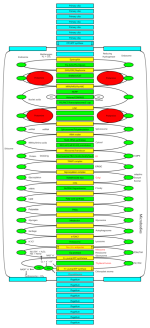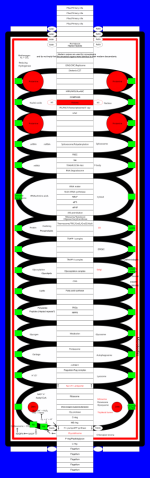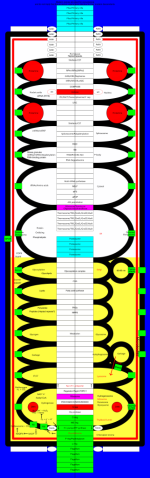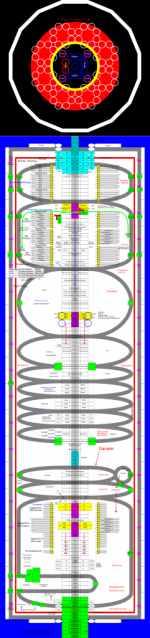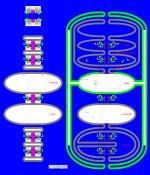
I'm not sure what I can say that isn't self evident. Everything is labeled pretty clearlyCould you perhaps so some explanatory text with this?

It's not the labeling that is the question. Rather, the explanatory text that Pood is seemingly requesting is text surrounding where these conclusions came from, discussion of the statistical model which indicates this life form as the LUCA, and possibly some discussion of the mechanisms and links to more resources about the sequencing of these things.I'm not sure what I can say that isn't self evident. Everything is labeled pretty clearlyCould you perhaps so some explanatory text with this?
Nucleus? Spliceosome? Golgi? Lysosome? Chloroplast? The diagram in the OP is clearly a eukaryote, not a LUCA. Nothing like it existed until 2.1 or 2.2 billion years ago.
LUCA wasn't a protocell. Protocells lived tens or hundreds of millions of years earlier than LUCA. The organisms in your diagrams lived over a billion years later. There's nothing original about LUCA -- it was just one of many similar life forms that were around at the same time, that had all evolved from earlier cells, which had evolved from protocells, which themselves had probably evolved from the "RNA World". LUCA was only unique in retrospect -- all the descendants of all its contemporaries went extinct one by one over the subsequent millions or billions of years, outcompeted by the various further-evolved descendants of LUCA.Nucleus? Spliceosome? Golgi? Lysosome? Chloroplast? The diagram in the OP is clearly a eukaryote, not a LUCA. Nothing like it existed until 2.1 or 2.2 billion years ago.Protocell - Wikipedia
en.wikipedia.org
I mean, imagine the early world being one where things ate or ended up accidentally encapsulating each other in very primitive ways not even guaranteed to digest anything. It's almost guaranteed that any even remotely symbiotic, "compatible" results would promptly become part of "the same organism" rather than being destroyed by whatever process led to the encapsulation.Didn't realize it incorporated what were originally separate entities.
The question that continues to plague this thread, however, is references, sources, and additional resources.
I mean, I did a bit of a cursory glance to their past contributions to the forums, as few and far between as they have been, and I have my doubts as to whether answers will be forthcoming.I mean, imagine the early world being one where things ate or ended up accidentally encapsulating each other in very primitive ways not even guaranteed to digest anything. It's almost guaranteed that any even remotely symbiotic, "compatible" results would promptly become part of "the same organism" rather than being destroyed by whatever process led to the encapsulation.Didn't realize it incorporated what were originally separate entities.
The question that continues to plague this thread, however, is references, sources, and additional resources.
The question that continues to plague this thread, IMO, is what does the person who started this this thread wish to discuss, if anything?![]()