• Welcome to the Internet Infidels Discussion Board.

Dear iidb: Guy babbling about Christ, evolution, and the big bang.

There are also religious firefighters who aren't Christian. Of course, a lot of Christians seem to think the only religious people who exist are Christian. I forgot, and they'll claim atheism is a religion, while simultaneously claiming atheists are secret Christians.
I was assuming bilby being impressed by the bravery of firemen would mean 'all firemen....
.... including those who are themselves impressed by Jesus. That, would be a tad humourous and ironic. Unless of course... bilby meant that he was only impressed by the non-religious firemen, which would be different discussion but just as interesting.
Perhaps you could skip the assuming altogether, and just read what I wrote.
 
As irony would have it:

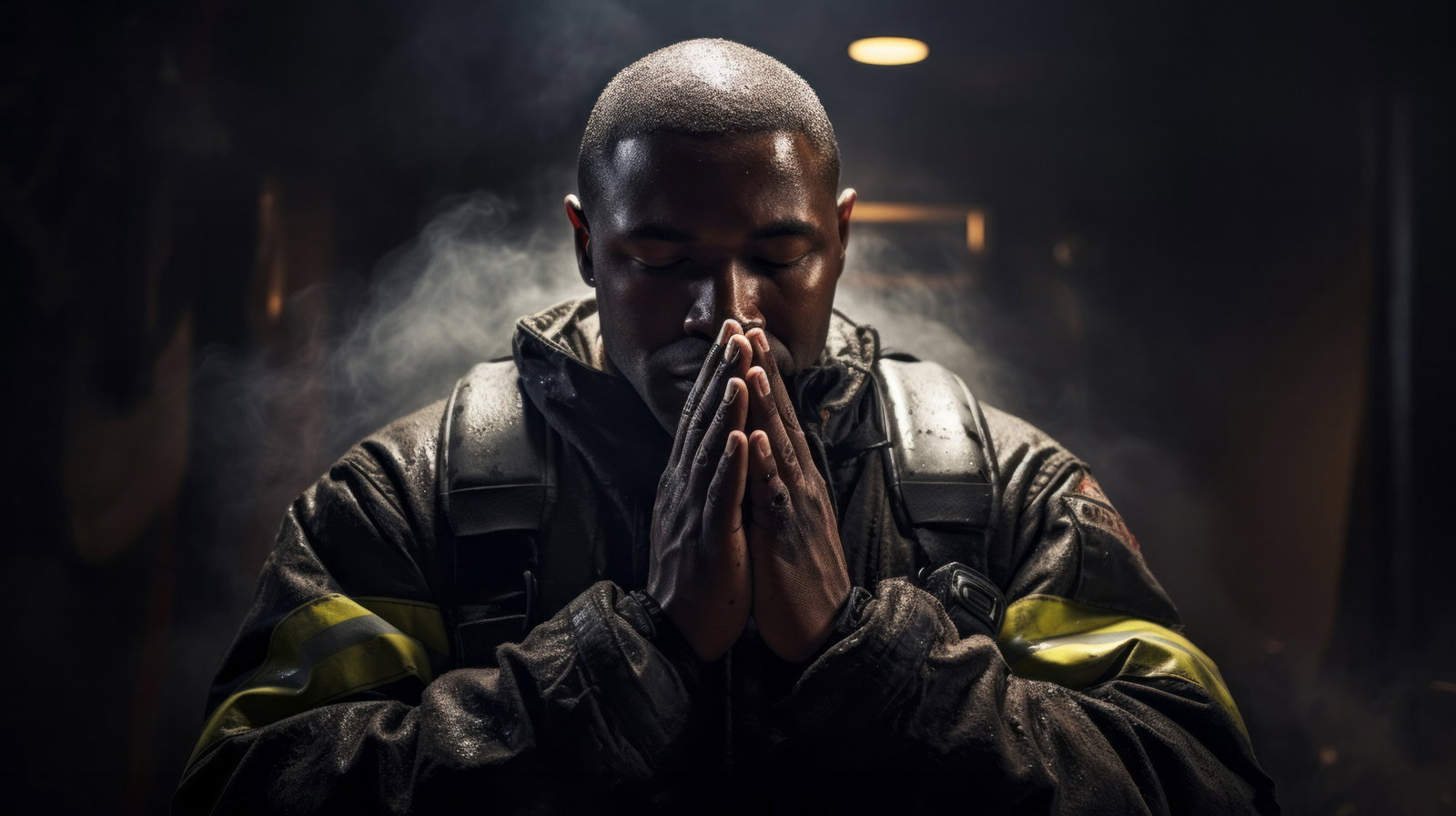
These Firemen also seem impressed with Jesus.


Being impressed all around. Jesus and firemen.
So what? Firemen are impressive because they save lives. Jesus is supposed to have saved something; But what he saved and how is utterly mysterious.
Saving souls is what the theme of the theology is actually about. Some of your atheist colleagues are telling me something else. Saving souls verses saving physical lives is were we differ in conceptual understanding, talking past each other...each having our own concepts of the Christian theology., but.I agree with you atheists...the theology that you have...just shouldn't make sense to you.

(I have to cut this short for now)
Well, you could save even more time by noticing that I have ALREADY responded to this:
Leave aside the question of what; My concern here is HOW.

A firefighter saves someone by running into a burning building, and physically carrying that person out. The firefighter tries hia best not to die, but is prepared to risk death in order to save others.

Jesus got nailed to a cross by some Romans. How does that help anyone? Jesus doesn't need not to die, because he will be walking around in a few days as though it had never happened. How does that help anyone but Jesus himself?

The question of what a soul even is is far too advanced to worry about when you can't even say how being nailed to a cross, and then coming back to life, might conceivably affect anyone not present at these events.
 
The question of what a soul even is is far too advanced to worry about when you can't even say how being nailed to a cross, and then coming back to life, might conceivably affect anyone not present at these events.
While I'm sad that I've never seen any sort of agreement, I'll point out that I might be the only person that most people in my life will EVER meet that has some coherent answer to that question (the nature of what a "soul" is) and every time I bring it up, some jackass accuses me of spitting a word salad.
 
There are also religious firefighters who aren't Christian. Of course, a lot of Christians seem to think the only religious people who exist are Christian. I forgot, and they'll claim atheism is a religion, while simultaneously claiming atheists are secret Christians.
I was assuming bilby being impressed by the bravery of firemen would mean 'all firemen....
.... including those who are themselves impressed by Jesus. That, would be a tad humourous and ironic. Unless of course... bilby meant that he was only impressed by the non-religious firemen, which would be different discussion but just as interesting.
Perhaps you could skip the assuming altogether, and just read what I wrote.
I can still make assumptions after reading what you wrote. I would say then, the assumption is correct... that being impressed by firemen you are also impressed by firemen who themselves are impressed with Jesus.
Nope. I am impressed by firemen who save lives. Whether they are impressed or not with Jesus is totally irrelevant to that.

However anyone who is impressed by Jesus is clearly very bad at thinking, and do will go down in my estimation.

Real people are complex. Heroes are also quite capable of being total arseholes. Whether or not someone is impressive is a matter of context, and if someone saves people while putting thrmselves at risk, that's impressive - but doesn't imply that I need to be equally impressed with their other behaviours or actions.

Reality isn't a comic book.

The real question still remains though; How does Jesus (or anyone else) sacrificing themselves have any effect at all on anyone not present at the time?

Some guy got crucified a couple thousand years ago. Lots of other people did too. By what mechanism could this possibly affect me? Even if one of them miraculously came back to life, by what mechanism does this affect me in any way?
 
As irony would have it:

These Firemen also seem impressed with Jesus.


Being impressed all around. Jesus and firemen.
So what? Firemen are impressive because they save lives. Jesus is supposed to have saved something; But what he saved and how is utterly mysterious.
Saving souls is what the theme of the theology is actually about. Some of your atheist colleagues are telling me something else. Saving souls verses saving physical lives is were we differ in conceptual understanding, talking past each other...each having our own concepts of the Christian theology., but.I agree with you atheists...the theology that you have...just shouldn't make sense to you.

(I have to cut this short for now)
Well, you could save even more time by noticing that I have ALREADY responded to this:
Leave aside the question of what; My concern here is HOW.

A firefighter saves someone by running into a burning building, and physically carrying that person out. The firefighter tries hia best not to die, but is prepared to risk death in order to save others.

Jesus got nailed to a cross by some Romans. How does that help anyone? Jesus doesn't need not to die, because he will be walking around in a few days as though it had never happened. How does that help anyone but Jesus himself?

The question of what a soul even is is far too advanced to worry about when you can't even say how being nailed to a cross, and then coming back to life, might conceivably affect anyone not present at these events.
We can see the obvious effects simply by noting the multitudes of believers in Jesus that are existing in the world today - each day someone nee decides to convert into the fold.
 
@Learner
"We can see the obvious effects simply by noting the multitudes of believers in Jesus that are existing in the world today - each day someone nee decides to convert into the fold."

What effects would that be, that millions of people have been taken in by a myth? And what about all the other religions that people think are the truth? Haven't there been other religious leaders that were killed or sacrificed, supposedly for the greater good or something like that? How does one know they have the right god, considering how many there are? Why can't a person simply be a person with good morals without any beliefs in gods? And, how do you explain all the horrible people that claim to be Christians, including the current president and the Speaker of the House in the US etc.? If Jesus saved their so called souls, he certainly didn't teach them to have a good moral compass.
 
Saving souls is what the theme of the theology is actually about.

What is a soul? And what is it being saved from?
How the bible portrays it. The soul or spirit (depending what you choose to define it with) is an existence of any conscious individual that isn't the part that's made up of the usual physical matter that we are accustomed to by observing through our eyes.

What is it exactly consisting of, you may ask?
God only knows. 🤔

Jesus wore sandals but I couldn't tell you what size he was wearing. But I still believe he wore sandals though.
 
I found a definition of the concept of the soul, which is not something limited to Christianity.

https://www.britannica.com/topic/Christianity/The-immortality-of-the-soul

I just consider soul to be one of my favorite genres of music, which was originally an offshoot of gospel, but then evolved into secular music that has a high degree of emotional vibes to it. Basically I regard soul as something to do with our inner emotions and maybe our moral values, but to me, it has nothing to do with immortality. Believing that a part of our inner thoughts etc. will live one just seems like wishful thinking to me.

Human beings seem always to have had some notion of a shadowy double that survives the death of the body. But the idea of the soul as a mental entity, with intellectualand moral qualities, interacting with a physical organism but capable of continuing after its dissolution, derives in Western thought from Plato and entered into Judaismduring approximately the last century before the Common Era and thence into Christianity. In Jewish and Christian thinking it has existed in tension with the idea of the resurrection of the person conceived as an indissoluble psychophysical unity. Christian thought gradually settled into a pattern that required both of these apparently divergent ideas. At death the soul is separated from the body and exists in a conscious or unconscious disembodied state. But on the future Day of Judgmentsouls will be re-embodied (whether in their former but now transfigured earthly bodies or in new resurrection bodies) and will live eternally in the heavenly kingdom.

 
As irony would have it:

These Firemen also seem impressed with Jesus.


Being impressed all around. Jesus and firemen.
So what? Firemen are impressive because they save lives. Jesus is supposed to have saved something; But what he saved and how is utterly mysterious.
Saving souls is what the theme of the theology is actually about. Some of your atheist colleagues are telling me something else. Saving souls verses saving physical lives is were we differ in conceptual understanding, talking past each other...each having our own concepts of the Christian theology., but.I agree with you atheists...the theology that you have...just shouldn't make sense to you.

(I have to cut this short for now)
Well, you could save even more time by noticing that I have ALREADY responded to this:
Leave aside the question of what; My concern here is HOW.

A firefighter saves someone by running into a burning building, and physically carrying that person out. The firefighter tries hia best not to die, but is prepared to risk death in order to save others.

Jesus got nailed to a cross by some Romans. How does that help anyone? Jesus doesn't need not to die, because he will be walking around in a few days as though it had never happened. How does that help anyone but Jesus himself?

The question of what a soul even is is far too advanced to worry about when you can't even say how being nailed to a cross, and then coming back to life, might conceivably affect anyone not present at these events.
We can see the obvious effects simply by noting the multitudes of believers in Jesus that are existing in the world today - each day someone nee decides to convert into the fold.
Each day people decide to convert to Islam too. Once again you're acting as though Christianity is the only religion.
Oh dear. I thought Christianity was the "only" religion intended for the topic of the thread,which as far as I could tell, was according to the title of the topic which has the word 'Christ' in it.

So, It's you lot who's acting as if I am making the claim that Christianity is the only religion.
We are also talking about things which Christians have to contend with- other religions being relevant to that.
 
As irony would have it:

These Firemen also seem impressed with Jesus.


Being impressed all around. Jesus and firemen.
So what? Firemen are impressive because they save lives. Jesus is supposed to have saved something; But what he saved and how is utterly mysterious.
Saving souls is what the theme of the theology is actually about. Some of your atheist colleagues are telling me something else. Saving souls verses saving physical lives is were we differ in conceptual understanding, talking past each other...each having our own concepts of the Christian theology., but.I agree with you atheists...the theology that you have...just shouldn't make sense to you.

(I have to cut this short for now)
Well, you could save even more time by noticing that I have ALREADY responded to this:
Leave aside the question of what; My concern here is HOW.

A firefighter saves someone by running into a burning building, and physically carrying that person out. The firefighter tries hia best not to die, but is prepared to risk death in order to save others.

Jesus got nailed to a cross by some Romans. How does that help anyone? Jesus doesn't need not to die, because he will be walking around in a few days as though it had never happened. How does that help anyone but Jesus himself?

The question of what a soul even is is far too advanced to worry about when you can't even say how being nailed to a cross, and then coming back to life, might conceivably affect anyone not present at these events.
We can see the obvious effects simply by noting the multitudes of believers in Jesus that are existing in the world today - each day someone nee decides to convert into the fold.
Really? Are those people affected by Jesus' sacrifice? Or just by the words of his followers?

How many people decide to convert without first having someone proselytise to them?

If their salvation were through his ressurection, why do they need to also be told - usually browbeaten - before converting?

Or to put it another way, it's pretty obvious that people can be persuaded to believe a religion that isn't true - as a Christian, you are surely aware that most non-Christians are religious, right?

So arguing that it is something unique to Christianity that influences people to convert to a religion is obviously false.

And the question you are STILL dodging is HOW?

How does being nailed to a cross, and then coming back to life, conceivably affect anyone not present at these events?

Jesus died for my sins? How does that work, then? A murderer killed someone, but later became a devout Christian. What did Jesus do about it? He certainly didn't prevent it from happening; How does he make it an OK thing to have done? He already died either way, so what did his "sacrifice" have to do with that murder at all?

People as a whole seem not to be any less inclined to sin now, than they were before Jesus' bad weekend. So what did he achieve, and HOW - by what mechanism - did his death achieve that?
 
How the bible portrays it. The soul or spirit (depending what you choose to define it with) is an existence of any conscious individual that isn't the part that's made up of the usual physical matter that we are accustomed to by observing through our eyes.
to me, this has a remarkable similarity to the definition of "free will" offered by "libertarians" and "hard determinists".

It is a nonsense-idea incapable of contemplation once someone leverages that nonsense term of the proposed definition, but that nonsense term is attached to a notion that does have merit for contemplation.

Rather, an acknowledgement of material reality has led me to the conclusion that "the existence of some mechanism of compilation unto automatic execution renders upon some compilable and executable source (to possibly include context) 'soul property'."

It is a property made metaphysically possible by the presence of a mechanism to build and execute upon a "text", something which operates on some "context", which may be provided or left absent depending on what behavioral features you are interested in asking about or observing, but in the existence of this compiler, the property is actually held by the thing that is itself: it necessarily IS a series of models and momentary contexts across some series of transformations.

Of course, if we accept that things with this property either have or are souls, as it were, this means that the relationship between this thing, being "saved" from some bad end around the process, and forgiveness CAN be related, but not in such a facile way as described by the boilerplate Christian faith.
 
The soul is the nonexistent element of the two elements of a person that make up substance dualism, which is itself demonstrably not a correct description of reality.

The idea is that there is a "me", made of flesh, bone, sinew and neurons; And that that "me" is driven around by a "real me" or "soul" that is my thoughts and feelings, made of some material substance that both interacts with my flesh and blood components, and is indetectable. This is now known to be impossible.

Of course, we still feel like we are a consciousness that somehow pilots our physical hardware, but is separate from it.

Having dispensed wjth the possibity of a material soul, one might postulate the existence of a "soul" that is not material in nature; Like software (perhaps most suitably analogised as our Operating System) - it is perhaps the pattern of information flow through our physical hardware. While such an "operating system" has some of the characteristics associated with a "soul", and can explain the feeling of separation between thought and physical body, it lacks the property held by religionists to be the most important - it cannot survive the destruction of the hardware on which it runs. That is, it is not eternal, and indeed it is highly ephemeral.

In a very real sense, the person I was at age 12, or 25, or 40 is gone forever. The person I am now has memories of those people, and has some continuity with them, but they are nonetheless no longer in existence.

When I die, my personhood will irrevocably cease to exist. It can no more survive without my brain than a computer program could run without any hardware. It is a soul of sorts, I guess, if you really want to call it that; But it's about as far from eternal as it could be.

Life after death is a fairytale. Eternal souls are provably impossible. Belief in these things is an artefact of the failings of our educational systems.

And all of this is an effort to explain a feeling - but feelings may not be amenable to explanation. I feel like a consciousness driving around in a meat-sack; But that separation may just be pure illusion.

We are not just purely rational brain computers driving our bodies around; We also have a hugely complex endocrine system, all of those three "components" are merged, overlapping, and inseperable; and the whole set up is built on three or four billion years of evolutionary kludges none of which had any intent, and whose sole significant attribute is that they didn't go extinct.

Souls are just a bad idea. Pure fiction. A childish just-so tale that attempts (and mostly fails) to explain how existence feels, and worse, that has been hijacked to support the unsupportable and truly absurd idea of eternal life.
 
Last edited:
How the bible portrays it. The soul or spirit (depending what you choose to define it with) is an existence of any conscious individual that isn't the part that's made up of the usual physical matter that we are accustomed to by observing through our eyes.
to me, this has a remarkable similarity to the definition of "free will" offered by "libertarians" and "hard determinists".

It is a nonsense-idea incapable of contemplation once someone leverages that nonsense term of the proposed definition, but that nonsense term is attached to a notion that does have merit for contemplation.

Curiously pondering before the time I became a 'born again':

I used to ponder in the past on the thought of evolution: the processes that initialized the formation of living beings. 'Intelligently thinking' creatures made up from elements of lifeless material, bringing about Intelligent awareness.

I used to think that through aaallll the time available ...
...why couldn't the fundamental forces evolve like the biological form to be intelligently aware?

Interestingly with the same thought: organic lifeforms (humans in this case)when broken down to it's utmost 'baseline fundamental....would be quite similar to the non-biological, non-physical intelligent entity that has also evolved. Basically the idea is: literally ALL intelligent entities, physical AND and non-physical beings are at the core,' forces of many contained fields'.
Rather, an acknowledgement of material reality has led me to the conclusion that "the existence of some mechanism of compilation unto automatic execution renders upon some compilable and executable source (to possibly include context) 'soul property'."

It is a property made metaphysically possible by the presence of a mechanism to build and execute upon a "text", something which operates on some "context", which may be provided or left absent depending on what behavioral features you are interested in asking about or observing, but in the existence of this compiler, the property is actually held by the thing that is itself: it necessarily IS a series of models and momentary contexts across some series of transformations.

Of course, if we accept that things with this property either have or are souls, as it were, this means that the relationship between this thing, being "saved" from some bad end around the process, and forgiveness CAN be related, but not in such a facile way as described by the boilerplate Christian faith.
I have different view to the previous posted above because of the Christian faith obviously, although a little similar but not quite in terms of souls/spirits that doesn't require a physical body to exist,etc. The difference of course is: if the fundamental forces evolve to become intelligent thinking entities without the biology , then these entities, would have a beginning - which would not be truly eternal.

(I also had a theory on the appearances of ghosts and apparitions but that's another topic)
 
Last edited:
In concept you could still have a beginning and still be eternal ever after. What I meant previously was being eternal without a beginning.
 
I began when some sperm found an egg, but I was too young to remember it.
 
Jesus’s Bad Weekend would be a good name for a movie. Preferably a comedy. “Dude, wtf is up with this cross and these nails they are showing me??”

“Bro, I’m afraid this ain’t going to go well for you. But don’t worry, it’s all for the best.”
 
Back
Top Bottom