• Welcome to the Internet Infidels Discussion Board.

Hartshorne’s Ontological Argument for God

SLD

Contributor
Joined
Feb 25, 2001
Messages
7,079
Location
Birmingham, Alabama
Basic Beliefs
Freethinker
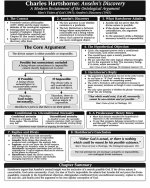
Charles Hartshorne was a 20th century philosopher who had studied under Alfred North Whitehead and Heidegger in the inter war years and later taught at the University of Chicago. He believed that he had rescued Anselm’s Ontological argument from Kant’s criticism and refined it as this diagram shows.

IMG_8794.jpeg

He basically move away the middle argument that Anselm ignored: that is that a god is possible, but non existent. But I think he still viewed god in rather pantheistic ways.

Your thoughts?
 
Charles Hartshorne was a 20th century philosopher who had studied under Alfred North Whitehead and Heidegger in the inter war years and later taught at the University of Chicago. He believed that he had rescued Anselm’s Ontological argument from Kant’s criticism and refined it as this diagram shows.

View attachment 55955

He basically move away the middle argument that Anselm ignored: that is that a god is possible, but non existent. But I think he still viewed god in rather pantheistic ways.

Your thoughts?

What I would like to see is an article describing all this rather than an annoying flow chart. It should be noted that Kurt Godel offered an intriguing ontological argument. This sounds similar from what I have gleaned from a quick scan.
 
This actually sounds almost identical to the Godel ontological arguement. If God possibly exists he necessarily exists (there is no possible state of reality at which he fails to exist)). If God does not exist he necessarily does not exist (no state of reality at which he exists). An excercise in modal logic.
 
I have never got my head around this or understood why it convinces anyone.
It seems to imply that if my mind can imagine the ultimate, ideal leprechaun, then that leprechaun must exist.
Or the ultimate sand flea. Whatever.
How is that not a validation of wish fulfillment?
 
Charles Hartshorne was a 20th century philosopher who had studied under Alfred North Whitehead and Heidegger in the inter war years and later taught at the University of Chicago. He believed that he had rescued Anselm’s Ontological argument from Kant’s criticism and refined it ... Your thoughts?
In his 2010 article, "Militant Modern Atheism", Philip Kitcher notes that with regards to “the ‘proofs’ offered in premodern theology” (such as that put forth by Anselm), "Whether anyone has ever regarded them as a potential route from atheism or agnosticism to theism is doubtful, and it seems plain that those who constructed the more-or-less intricate arguments did so in attempts to elaborate ideas about a deity to whose existence they were already committed."

Essentially this same point is made by John E. Smith in his 1984 article "Some Aspects of Hartshorne’s Treatment of Anselm" included in Existence and Actuality, John B. Cobb and Franklin I. Gamwell, editors. Smith regards "Hartshorne's treatment of [Anselm's] argument and his tracing of its subsequent history as making at least three distinctive contributions to this philosophico-theological topic. There was first his return to the original argument without, we may say, benefit of Descartes, who confused the issue by asking for the cause of the idea of God. This return was accompanied by a new emphasis on the importance of the nature of God achieved by a reinterpretation of the 'that than which nothing greater ...' formula. The question of the divine nature was often thrust into the background because of exclusive concern with the divine existence. Hartshorne rightly redressed the balance in calling attention to the abstract character of existence taken by itself." In so doing, Hartshorne stands "in opposition to Kant ... who thoroughly disconnected modality from the content of the concept". Smith says that "According to Hartshorne, Anselm was engaged in a meditative analysis of what it means to believe in God from within, as it were, since the believer is involved in a self-examination” of his own characterization of God - a characterization which is forever incomplete for being replete with the sorts of difficulties to be expected when the matter at hand is thought to be ultimately beyond complete human understanding (at which point there might well be no other resort than to apophasis, to tie in with the Apostrophism thread).

 
These arguments are mostly preaching to the choir. They give theists a response.

I was talking with an Evangelical. He pointed out the widow and said, 'Just look, it is obvious it was created by god'.

From participating on the forum and experience with Christians, proofs boil down to three or four general categories. One of the categories is 'it is obvious god exists', expressed in different forms informally and formally.

The academic theist frames them in polished logical arguments and formality. In Christian culture there are colloquial ways to express them. It is art o fhe language.
 
I think these arguments all lead to the conclusion that there must be an extreme dichotomy - either there is a God who is maximal in all qualities, or there is no God of any kind whatsoever.

They essentially define God as infinitely (X) for all (X). If your God isn't that, then it isn't a God, according to Anselm (and his successors).

I suspect that this is more an effort to eliminate the competition - the thousands of gods and god-like beings previously worshipped - than an effort to prove that a God exists. It's more a defence of monotheism, than a defence of theism.

IMO it embrittles the concept of God; By being infinite in all respects, God becomes easy to refute, for example by the Argument from Evil.

If we agree that Anselm has shown that there can exist only one, infinitely perfect God; OR no gods of any kind at all; AND we observe that suffering exists, then we have proven atheism.

Sadly, I must admit that I disagree with the definition of God as maximal and infinite in all ways. I see no sound basis for dismissing Small Gods as not Gods at all. If a being can do magic* - even magic limited in scope and context - it would be a God despite its ignorance or narrow field of operations.

I don't believe that any beings exist at any scale that can do magic; But it's a difficult thing to prove, and pure logic is probably inadequate to the task. Understanding reality IMO requires contact with reality - any sound belief (or disbelief) in anything beyond pure mathematics is going to need experimental as well as logical underpinning.


*Magic being defined as making changes to reality by willing it to change, without any action outside the brain's forming of that will.

If I can split a log solely by imagining it to have split, rather than the mundane processes of using that imagination to inspire me to (eg) fetch an axe and hit the log; or to inspire me to say "hey, you, go get an axe and split this log", or any other mundane intervention into reality, then I have done magic, which is synonymous with performed a miracle, and which makes me at the very least the God of log-splitting.
 
Back
Top Bottom