
• Welcome to the Internet Infidels Discussion Board.

Earliest Known Controlled Fire

steve_bank

Diabetic retinopathy and poor eyesight. Typos ...
Joined
Nov 9, 2017
Messages
16,861
Location
seattle
Basic Beliefs
secular-skeptic

A stunning discovery at an archaeological dig in the UK is rewriting the timeline of when humans first made fire.

Researchers have discovered the earliest known instance of human-created fire, which took place in the east of England 400,000 years ago.

The new discovery, in the village of Barnham, pushes the origin of human fire-making back by more than 350,000 years, far earlier than previously thought.

The ability to create fire was the moment that changed everything for humans. It provided warmth at will and enabled our ancestors to cook and eat meat, which made our brains grow. It meant we were no longer a group of animals struggling to survive – it gave us time to think and invent and become the advanced species we are today.

The team say they found baked earth together with the earliest Stone Age lighter – consisting of a flint that was bashed against a rock called pyrite, also known as fool's gold, to create a spark.

BBC News has been given world exclusive access to the prehistoric site.

Under the treetops of Barnham Forest lies an archaeological treasure, buried a few metres beneath the Earth, that dates back to the furthest depths of human pre-history.

Around the edges of a clearing, tangled green branches frame the scene like a curtain, as if the forest itself were slowly revealing a long-buried chapter of its past. Prof Nick Ashton of the British Museum leads me through the trees and we both step into his astonishing story.

"This is where it happened," he tells me in a reverent tone.

We walk down onto a dirt floor carved into deep, stepped hollows of raw earth and pale sand.

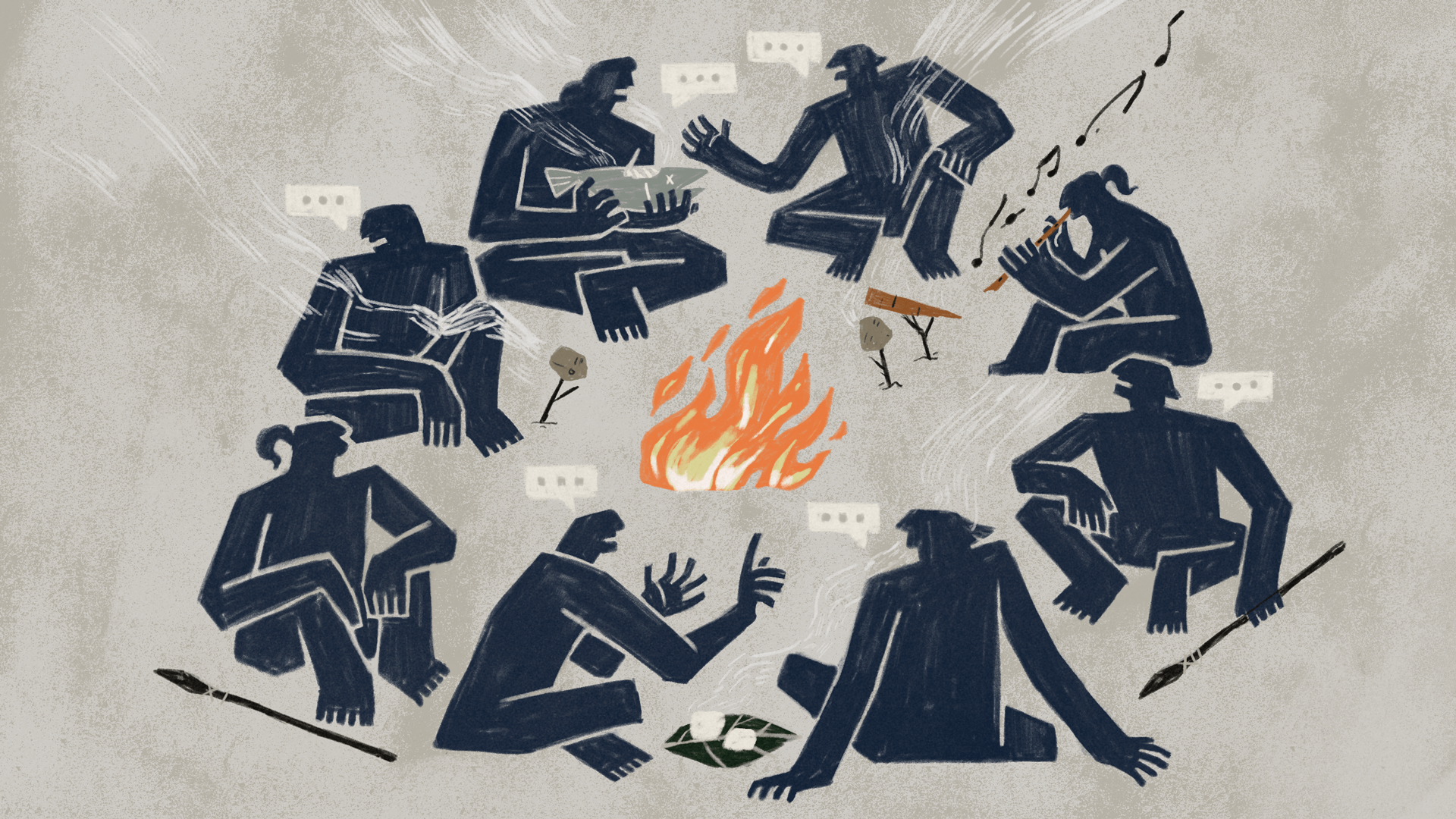
This was an ancient fireplace at the heart of a prehistoric "town hall", around which early Stone Age people came together hundreds of thousands of years ago.


Origin of our climate crisis?
 
I thought it started in Exodus 3, with the bush that was burning but not consumed, so just...burning and burning and burning. So God our Father actually started it.
From the Seneh Scroll:
Moses said, When I come unto the children of Israel, and shall say, The God of your fathers hath sent me; they shall say, What is his name? And what shall I say unto them?
And God said, I AM THAT I AM, thus you shall say to the children of Israel, I AM sent me unto you.
And Moses said, Thou needeth not all caps, for they shall heed thy word in a normal font.
And God said, Go, go then, unto -- and he coughed a mighty cough, for the hydrocarbons were ascending unto the firmament.
 
Watch out, you're gonna get climate change deniers claiming "this means libruls even WANT TO BAN FIRE!!!"
 

A stunning discovery at an archaeological dig in the UK is rewriting the timeline of when humans first made fire.

Researchers have discovered the earliest known instance of human-created fire, which took place in the east of England 400,000 years ago.

The new discovery, in the village of Barnham, pushes the origin of human fire-making back by more than 350,000 years, far earlier than previously thought.

The ability to create fire was the moment that changed everything for humans. It provided warmth at will and enabled our ancestors to cook and eat meat, which made our brains grow. It meant we were no longer a group of animals struggling to survive – it gave us time to think and invent and become the advanced species we are today.

The team say they found baked earth together with the earliest Stone Age lighter – consisting of a flint that was bashed against a rock called pyrite, also known as fool's gold, to create a spark.

BBC News has been given world exclusive access to the prehistoric site.

Under the treetops of Barnham Forest lies an archaeological treasure, buried a few metres beneath the Earth, that dates back to the furthest depths of human pre-history.

Around the edges of a clearing, tangled green branches frame the scene like a curtain, as if the forest itself were slowly revealing a long-buried chapter of its past. Prof Nick Ashton of the British Museum leads me through the trees and we both step into his astonishing story.

"This is where it happened," he tells me in a reverent tone.

We walk down onto a dirt floor carved into deep, stepped hollows of raw earth and pale sand.

This was an ancient fireplace at the heart of a prehistoric "town hall", around which early Stone Age people came together hundreds of thousands of years ago.


Origin of our climate crisis?
"East of England".

Sure.

I expect that if they looked in places closer to the origin of human morphology (where earlier hominids would be more commonly discovered), we would discover this as much as twice as far back... It's just that there's money for archeology in England where people with time and resources for archeology don't have to travel much,
 
Origin of our climate crisis?
Nope; Burning recently grown timber is carbon neutral. The climate crisis started with the first burning of coal, which released CO2 that has been sequestered for two or three hundred million years. Releasing carbon that was sequestered by trees a mere few decades ago isn't going to do anything to the climate at all.

Burning coal is a more recent thing, with evidence of coal mining going back a mere 4,000 years or so.
 
there's money for archeology in England
Precious little. But yeah, something doesn't smell right about this being in England. If it were in the Rift Valley, I would be less skeptical.

The fact is that this claim probably does more to secure "money for archeology in England", than it does to advance our understanding of human prehistory.
 
Maybe 400ky- old stuff preserves better at higher latitudes?
Otherwise it sounds like a dubious claim.
But I figure there’s probably a million or more years of humanoid history and fire is fairly ubiquitous …,
 
Back
Top Bottom