

unapologetic
55+ years without a god
- Joined
- Dec 12, 2023
- Messages
- 2,718
- Location
- Penna., Fascist States of Amerika
- Basic Beliefs
- Hasa Diga Eebowai, antitheist,
Your source is Dr Oz, on Faux?
"What a maroon".
"What a maroon".
 Net international investment position
In 1980, the United States net international-creditor position was bigger than the total net creditor-positions of all the other countries in the world. Only six years later, in 1986, when the nation’s international investment position was at a year-end negative $107.4 billion, the U.S. became a net-debtor nation for the first time since 1914 ... By 1990, the U.S. was the world's largest debtor.

And I would prefer to live in a system that spends this money.What's all this fuss I keep hearing about spending a billion dollars on healthcare for ill eagls (sic)? Can't some private avian 501c3 charity fund this instead of MY tax dollars?[/Emily Litella]
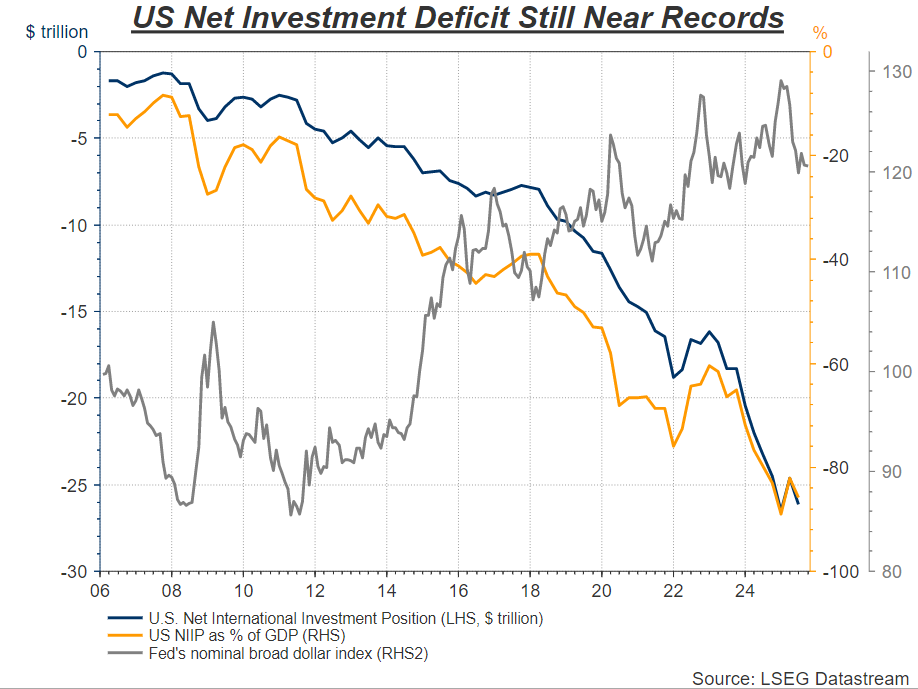
The problem here is that what you're actually showing is that people see American investments as a good thing. People think that American companies will do well. Especially from places like China where the citizens see domestic investment as unsafe. (Correctly--it's really far more about how the government will act vs the fundamentals of the company. Value is in the political winds.)Nothing new to report but This article from Reuters provides an eye-opening graph (shown below) which highlights an effect of the Triffin Dilemma.
Brief history review: By the 1930's the U.S. Dollar was so respected that people all around the world were selling their gold to the U.S. Treasury for what then seemed like the outrageously high price of $35 per ounce. Just a decade or two later, after the devastation of WWII, it seemed that the U.S.A. owned much of the world! Let's continue the story by quoting
In 1980, the United States net international-creditor position was bigger than the total net creditor-positions of all the other countries in the world. Only six years later, in 1986, when the nation’s international investment position was at a year-end negative $107.4 billion, the U.S. became a net-debtor nation for the first time since 1914 ... By 1990, the U.S. was the world's largest debtor.
In just ten years the U.S. went from "owning much of the world" to being "the world's largest debtor"!!
The Wiki page has a table that can be sorted by NIIP as a % of GDP. At the top are well-known prosperous countries like Norway, Singapore, Switzerland, Germany, Japan. At the bottom are economic "basket cases" like Sudan, Greece, Nicaragua, and ... the USA. The U.S. NIIP is Negative $26 Trillion. As shown in the graph this is 85% of U.S. GDP. This is the NET investment position. It doesn't just mean that foreigners own $26 Trillion of U.S. real estate, stocks and bonds. It means they own $26T Plus X, where X is foreign-based assets owned by U.S. entities.
Is this a Bubble? Should we be worried that there will be a "fire sale" on U.S. assets if foreigners lose faith in U.S. governance?
I dunno. I report; you decide.
Except for a minor aberration in 1919, these are the first losses in FedRes history.The Federal Reserve had 11 consecutive quarterly operating losses as of August 2025, starting in the fourth quarter of 2022.
According to the ADP, in the first two months of Trump's administration, the economy added about 115,000 jobs a month. Since the tariffs, over the last seven months it has added 180,000 jobs... total or about 26,000 a month.
Reduced immigration is the main reason for the sudden drop in employment figures, IIUC.Alí Bustamante, an economics professor at the University of New Orleans, said
“Just two years ago, we basically had an economy where we had to add about 250,000 jobs a month to achieve break-even employment.”
Jason Ma at FORTUNE said:Publicly held debt is already at 99% of GDP and is on track to hit 107% by 2029, breaking the record set after the end of World War II. Debt service alone is more than $11 billion a week, or 15% of federal spending in the current fiscal year.
In a Project Syndicate op-ed last week, [renowned economist Jeff] Frankel went down the list of possible debt solutions:
* faster economic growth
* lower interest rates
* default
* inflation
* financial repression, and
* fiscal austerity.
While faster growth is the most appealing option, it’s not coming to the rescue due to the shrinking labor force, he said. AI will boost productivity, but not as much as would be needed to rein in U.S. debt.
Frankel also said the previous era of low rates was a historic anomaly that’s not coming back, and default isn’t plausible given already-growing doubts about Treasury bonds as a safe asset, especially after President Donald Trump’s “Liberation Day” tariff shocker.
Relying on inflation to shrink the real value of U.S. debt would be just as bad as a default, and financial repression would require the federal government to essentially force banks to buy bonds with artificially low yields, he explained.
“There is one possibility left: severe fiscal austerity,” Frankel added.
How severe? A sustainable U.S. debt trajectory would entail elimination of nearly all defense spending or almost all non-defense discretionary outlays, he estimated. For the foreseeable future, Democrats are unlikely to slash top programs, while Republicans are likely to use any fiscal breathing room to push for more tax cuts, Frankel said.
“Eventually, in the unforeseeable future, austerity may be the most likely of the six possible outcomes,” he warned. “Unfortunately, it will probably come only after a severe fiscal crisis. The longer it takes for that reckoning to arrive, the more radical the adjustment will need to be.”
The austerity forecast echoes an earlier note from Oxford Economics, which said the expected insolvency of the Social Security and Medicare trust funds by 2034 will serve as a catalyst for fiscal reform. In Oxford’s view, lawmakers will seek to prevent a fiscal crisis in the form of a precipitous drop in demand for Treasury bonds, sending rates soaring. But that’s only after lawmakers try to take the more politically expedient path by allowing Social Security and Medicare to tap general revenue that funds other parts of the federal government.
“However, unfavorable fiscal news of this sort could trigger a negative reaction in the US bond market, which would view this as a capitulation on one of the last major political openings for reforms,” Bernard Yaros, lead U.S. economist at Oxford Economics, wrote. “A sharp upward repricing of the term premium for longer-dated bonds could force Congress back into a reform mindset.”

Is the answer AI communism?AI also threatens our economy and could lead to widespread loss of jobs. Many of those people, those who are over 50, would have a very hard time finding new jobs that fit their skills and/or retraining themselves, at their age.
MIT study claims AI could currently replace 12% of total US jobs market
One in nine US workers could be displaced by AIwww.techradar.com

 www.project-syndicate.org

I’m not so sure about your last point. We only really have about 150 years of modern capitalism history of the markets. That may seem like a lot, but it isn’t compared to the long history of humanity. Indeed these last 150 years represent an anomaly in human history that may not be repeated, probably cannot be repeated. The changes we’ve seen have almost all been due to technological advances that are not necessarily going to be repeated, even with AI. Are we really going to find ways to transport ourselves quicker around the globe? Probably not. A Star Trek technological society is nice, but probably unrealistic. The laws of physics constrain AI as much as it constrains us.The "AI Bubble" is a wish made by people who either refuse to accept or don't understand just how deeply embedded it already is within every aspect of the economy, governmental functions, and defense. It may or may not cause job loss, but its value as an asset isn't going anywhere. Dire predictors of collapse are a penny a dozen. They can be found from the kids shouting about "late stage capitalism" all the way up to economics professors and even those who have deep, real life experience in things economic.
The first group can safely be ignored. Hell, they should be ignored.
The second group sometimes provide insight into possibilities.
The third group wants to be on tv and sell books. There's good money in fear.
There will always be some measure of volatility in markets. History proves it. However, it always bounces back no matter how hard the downtown, and tech will play a part in any future recovery.
The "AI Bubble" is a wish made by people who either refuse to accept or don't understand just how deeply embedded it already is within every aspect of the economy, governmental functions, and defense. It may or may not cause job loss, but its value as an asset isn't going anywhere. Dire predictors of collapse are a penny a dozen....
There will always be some measure of volatility in markets. History proves it. However, it always bounces back no matter how hard the downtown, and tech will play a part in any future recovery.
I believe Warren Buffett is right but IMO he is mostly only correct only about himself. Because unlike the average working stiff, Buffet has the knowledge and connections to make good on a large chest of powder when it is needed. The rest of us would never have opportunity nor knowledge just what to buy during a moment of market fear.The last two webpages I clicked on really pissed me off.
(1) A Professor Emeritus* babbled boringly about the pending devaluations, but I used the Fast Forward facility to find his "punch-line." He mentioned that the Legendary Sage of Omaha is mostly holding cash, and then advised listeners to do SOMETHING (anything?) with their cash. He IGNORED that, after praising Buffett, he advised listeners to do the opposite of Buffett. (It's a paradox that when there's a risk of inflation, CASH may be the best option! Stay liquid so you can re-direct the funds quickly when fear strikes.)
* - I used to think "Emeritus" was a distinction of honor. But maybe it sometimes means "This guy has no personal life so we let him hang out in the faculty lounge."
(2) Nothing new, but I hadn't checked the markets for a few days and clicked when I saw a headline that implied the Great Crash had begun! The NASDAQ-100 plummeted a breath-taking TWO percent on Monday, collapsing all the way down to the (record-setting) levels not seen for almost two weeks. (It did bounce back and is now only 1½% away from its all-time high.) Gold took a nose-dive as well. It hasn't been this cheap since ... October.
Scary bold-face. Hate to imagination the consternation if QQQ falls THREE percent.
First, the AI Bubble at the moment, I think is similar, in part to the Internet Bubble, with a notable difference of, there ain't that many companies left, so it isn't a thing such as a trillion AI IPOs happening. But rather, the money in the stock market is blowing Nvidia to what... a 25 price/sales ratio? Which is most certainly high!The "AI Bubble" is a wish made by people who either refuse to accept or don't understand just how deeply embedded it already is within every aspect of the economy, governmental functions, and defense. It may or may not cause job loss, but its value as an asset isn't going anywhere.
AI's biggest improvement is unemploying lots of people. That is where the money savings are.Dire predictors of collapse are a penny a dozen. They can be found from the kids shouting about "late stage capitalism" all the way up to economics professors and even those who have deep, real life experience in things economic.
I don't really disagree with you on anything of substance. I do think that Nvidia will continue to dominate and grow. So there's that for some pedantic, worthless response.The "AI Bubble" is a wish made by people who either refuse to accept or don't understand just how deeply embedded it already is within every aspect of the economy, governmental functions, and defense. It may or may not cause job loss, but its value as an asset isn't going anywhere. Dire predictors of collapse are a penny a dozen....
There will always be some measure of volatility in markets. History proves it. However, it always bounces back no matter how hard the downtown, and tech will play a part in any future recovery.
If by "AI Bubble" you refer to the high stock prices of the "Magnificent Seven" and what retail investors should do, here is what I've gleaned from reading opinions of the "smart guys."
* AI WILL come to dominate human society. AI is already producing some things (e.g. computer code) much faster than humans can. AI is already a reason why young college grads have trouble finding a job, and is improving rapidly. "Super-intelligence" may be hard to define but is likely to arrive by the 2030's.
* But just as the Internet eventually came to dominate society (with Alphabet, Meta and Amazon highly profitable) but only after a "bubble" bursting in 2000-2002, so there may (soon?) be a sharp fall in the prices of some AI-related shares.
* Some of the Magnificent Seven are cash machines one needn't hurry to sell. Warren Buffett, the value investor and very cautious Oracle of Omaha recently bought a large stake in Alphabet.
* NVIDIA and Palantir, on the other hand, while raking in cash at present do not have guaranteed hardware monopolies.

