Note, though, that in the above, the scientist is an astronomer, not a biologist. OTOH, in my reading experience it is usually the biologists who are most pessimistic about finding alien life.
Finding alien life requires both of two things: Alien life must exist; And we must be able to find it.
The latter is a huge problem. We don't really have a good working definition of "life"; We muddle by on Earth, where most things are clearly on one or the other side of the line (albeit with exceptions such as viruses and prions, which don't really fit in either the "life" or "non-life" pigeonhole), but on Earth we know that life is going to be not just Carbon based, but RNA/DNA/Amino Acid based, and that it will use one of a handful of metabolic pathways to obtain useable energy, ultimately (in most cases) using Adenosine phosphates as the direct carrier of energy, in cells with a set of well known organelles doing well known stuff, and separated from each other and the environment usually by phospholipid bi-layer membranes, and or cellulose exoskeletons.
None of that needs to be true of alien life. The one thing we know for sure about alien life is that it will be a long way away.
If we were living on Mars (Thanks, Elon!), and wanted to detect microscopic life in Antarctica, it would be hugely challenging to do - even though we know what kinds of soil bacteria to expect, and what kind of chemicals would be a positive signature of their presence.
The huge distances involved make picking the exact analytical tests to include on our very weight-restricted probes, to get the most convincing and definite results, really difficult.
To be honest, there are lots of people who would deny that we had found alien life, even if we brought a sample to Earth, grew it in a lab, and let everyone who wants it have some to study. If it was very similar to terrestrial life, people would say it was contamination from Earth. If it was sufficiently different, they would say it wasn't "life" at all, just complex cyclic chemistry that reproduces instances of itself.
And of course if we grew alien life on Earth and let just anyone take a sample, the Panel on Planetary Protection (PPP) at
COSPAR would have kittens*.
*In the figurative sense, that is; I expect at least some of them literally have kittens, or have had in the recent past, given the popularity of cats as pets, and the size of the PPP, which currently has twenty eight members.




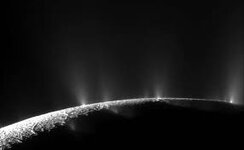
 , and that's not much time. Earth was probably a billion years post formation when prokaryotes appeared, and maybe a billion (?) years more for eukaryotes to show up? Of course earth, presumably a semi-molten glob at the time, had more cooling to do than Enceladus. Enceladus is thought to have formed by accretion of "ring" material**, whereas the aftermath of earth's collision with Theia was pretty hot and earth's surface/volume ratio is much lower ... so maybe there have been suitable conditions on Enceladus for long enough to leave traces of something that some (irreligious) people might call "life", or little lifelike thingies?