• Welcome to the Internet Infidels Discussion Board.

2026 Mid-Term Elections

Thanks, that clarifies things. Drilling down the numbers, it turns out the reason Buffett's total tax rate is so low is because he gives so much to charity. The tax code lets people deduct charity from their income to encourage charitable giving because helping the needy is a big part of what government does so philanthropists are volunteering to do part of the government's job for it. In effect we tax people on what they get, not on what their charities get. If we correct for the amount of charity Buffett is allowed to deduct, his effective total tax rate was 25%, not 17.7%. (And this actually understates it for Buffett since he actually gives away a lot more of his income than the 30% he's allowed to deduct.)
Buffett thinks his effective tax rate is too low. It doesn't matter what he does with his income to get the rate that low.
Why not? Seems to me it matters a lot. Getting it that low by using one's income to bribe legislators to write a personalized exemption just for you into the tax code is bad; getting it that low by doing the public some great service the legislature wanted citizens to do for others and therefore chose to reward is good.
Which has nothing whatsoever to do with actual tax burdens.
But morality aside, consider: if your total tax rate is 18% because you invested in a tax-shelter, that means the IRS is letting you keep 82% of your money for yourself. If your total tax rate is 18% because you voluntarily gave away 30% of your income to the American people, that means the IRS is letting you keep 52% of your money for yourself. Compare these numbers to the 67% that the other people in Buffett's office are allowed to keep for themselves. What makes 18% < 33% a better measure of progressivity vs. regressivity in the tax system than 52% < 67% would be?
Who cares if both they think both numbers are too low?
Even if Buffett's actual effective tax rate is 25%, that is still lower than his employees stated effective tax rate.
True, but it brings the rates into the same ballpark, where the second-order effects we've already discussed need to be taken into account. It seems very likely that his employees were counting FICA. I know we aren't going to see eye-to-eye on this, but I think the fact that his employees are going to get most of their FICA taxes back with interest when they retire is pretty darn important for calculations of progressivity. Taking that into account, and also taking into account that Buffett was taxed on his fictional capital gains because his basis was measured in bigger dollars than his sales price, it looks like both Buffett and his employees are effectively paying something like 28%.
If you are going to take into account lifetime tax flows (SS payments are negative tax flows), then one needs to be much more careful. And granting that SS makes the overall system more progressive over one's life, it doesn't follow that more progressive/less regressive meets one's view of lifetime fairness nor that the someone's current tax burden isn't constraining. For example, when I was 35, supporting 4 children, the prospect of receiving SS in 40 years meant nothing to my finances at that time.
And even if their effective tax rate is about the same or lower, the point that a billionaire's tax rate is too low (at least according to him).
He's entitled to his opinion; personally I don't see anything unreasonable about a 28% tax rate on everybody who can afford it, (plus 4.5% Nebraska state tax, I wish!). The American people aren't under-taxed; our government over-spends. But personal tastes aside, this isn't about Buffett and his experience doesn't generalize to other rich people. Other than charity, the main reason his tax rate is so low is that the nominal tax rate on capital gains is lower than for ordinary income. But nominal does not equal real. The difference between the two is small for him but big for others -- a lot less of Buffett's reportable capital gains are fictitious than normal rich people's because he's better at investing than they are. His real capital gains rate is still lower than the ordinary income rate; theirs isn't. Even though Buffett himself isn't paying a higher effective rate than his staff, most rich people are. This comes out clearly in Derec's table. Buffett is a one-off.

As for why his office staff's rate was 32.9%, that's implausibly high for federal income tax given BH's legendarily modest pay scale, so it presumably includes state taxes, or FICA, or both.
Why would you think Buffett or his employees don't know how to compare effective tax rates?
:consternation2: Who said they don't? My whole analysis is based on assuming they do.
You're the one saying they don't when they include FICA.
But, since you bring up the topic... What Buffett did was clearly not a scientific measurement -- he didn't have tax accountants collect everyone's tax returns and analyze them; he just asked around the office and averaged the answers. Of course Buffett knows how to compare effective tax rates, but that doesn't mean all the respondents did. Buffett's 17.7% was his total tax rate, so presumably that's what he asked his employees about. But what are the odds that they all understood this? Their answers averaged 32.9%. Would you bet a nickel that none of them told Buffett their marginal tax rates?
Why would they tell him a marginal rate when he was asking about the average?
 
The very poor use Medicaid, emergency rooms for non-emergency medical problems, Medicare, public schools, roads, social services, police protection, food stamps, EITC, and in extreme cases, public parks and sidewalks as homes.
I use most of that stuff too. Its peanuts per capita compare to the excesses of billionaires. Your “very poor” (a well defined group I’m sure) are always the lament of those they serve. 🙄
Their terrible impact upon the lifestyles of the “very rich” is just the high price the very rich have to pay in this unjust world!
I feel for you B20, but
Can’t
Quite
Reach
You
Yeah. How dare those poor people use all that stuff. The nerve of sleeping on the street or in the park.

Police and military mostly serve to protect the economic interests of the rich. I wonder if the rich ever pay as much as they derive in benefit? Doesn’t seem so with the debt funding the military. They always seem to put the cost burden of environmental clean up on the public too. Socialize the cost/negative externalities but privatize the profit. It’s a good gig if you can get it.
 
I was homeless for three months in 2021. I mean homeless, not sleeping in my car, or riding some friend's couch. Before my money ran out, it wasn't bad at all. But even when the money ran out, it was still do-able. Where I live (Mohave Desert) the weather is very forgiving in the winter time, and the coldest night got to around 40 F. As long as I stayed bundled up I was fine at night; during the day it was fine even without a jacket.

Even penniless, I could get a sack lunch at the Salvation Army every Monday, Wednesday, and Friday; the other three days, the Catholic Church in town served hot meals to the homeless, even anyone who came. I could get clothes and other needful items at the Salvation Army, free. I slept where I could, sometimes in a park restroom, or other nooks and crannies, tunnels, etc. I walked around to stay busy, and spent a lot of time in the library. They were fine with homeless there as long as you didn't cause a disturbance and didn't sleep there. I could get water and use bathrooms anywhere. The cops here will talk to you if they see you sleeping on a bench, or on the ground, but by and large they are sympathetic and will leave you alone, as long as you aren't being a dick, basically.

After I got my shit together and an apartment again, I missed being outside at first. I missed the fresh air and sunshine, and the hustle-bustle of other people. I met a lot of homeless people, mostly middle aged men like me. A few were truly down and out, obviously with some mental problem, or serious addiction, either meth or alcohol. But there were several who actually had a job, or SS, or Disability, and chose to live in their car, or a tent, to save all the money that would go to rent and utilities. Not having to pay rent and electric gave them more money for coffee shops, or restaurants, even clubs. Some of these guys paid for a membership at a gym so they could use the showers.

When I go on SS soon, it won't be a lot. I may actually be returning to a homeless life. The memories of it are not haunting or terrible. I realize I'm lucky and my experiences were not typical, least of all for the homeless in big cities, or in places with nasty weather.
 
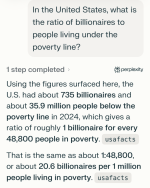
For every billionaire in the US, there are about 430,000 people living below the poverty line, hardly using any “common property”, while billionaires gorge on it.
:consternation2: Where do you get this stuff? The notion that those in poverty hardly use any common property is beyond absurd. What, do you think "common property" is 90% airports? The very poor use Medicaid, emergency rooms for non-emergency medical problems, Medicare, public schools, roads, social services, police protection, food stamps, EITC, and in extreme cases, public parks and sidewalks as homes.
In response to which, you two said:

The very poor use Medicaid, emergency rooms for non-emergency medical problems, Medicare, public schools, roads, social services, police protection, food stamps, EITC, and in extreme cases, public parks and sidewalks as homes.
I use most of that stuff too. Its peanuts per capita compare to the excesses of billionaires. Your “very poor” (a well defined group I’m sure) are always the lament of those they serve. 🙄
Their terrible impact upon the lifestyles of the “very rich” is just the high price the very rich have to pay in this unjust world!
I feel for you B20, but
Can’t
Quite
Reach
You
:picardfacepalm:

Yeah. How dare those poor people use all that stuff. The nerve of sleeping on the street or in the park.
:picardfacepalm:
Where the bejesus did you two get the notion that I was complaining about those poor people using all that stuff? I listed stuff they were using because I was disproving Elixir's ludicrous claim. Of course it's perfectly appropriate for those who need social services to use them -- that's what they're for.[/Captain Obvious]

Elixir, did you do this on purpose? Did you deliberately make a false claim about a matter of fact in order to draw me into pointing out the truth, with the intent of subsequently pretending my correction of your false statement about the facts was me lamenting the facts I pointed out, as a way of setting me up for a trumped-up ad hominem attack? Or is this a Hanlon's Razor situation?
 
  • Like
Reactions: WAB
Elixir, did you do this on purpose? Did you deliberately make a false claim about a matter of fact
My profound apology! Too many zeroes!
Plus - That was ancient data from back in ‘24 when there were probably only half as many billionaires as today, after Trump improved the economy so much !
“
1778967032278.png

Do you feel better about your scoff now? Which figure do you want to adjust to what? And on what basis? I think my point is clear, notwithstanding your nitpicks my 10x typo.
 
Last edited:
You tax corporations, mandate minimum compensation, and progressively tax income. You insist that corporations adhere to stringent environmental rules and regulations as well as zoning. Instead of taxpayers subsidizing the building of another Walmart, insist that Walmart ( or whatever corp) pays for the new roads, utilities, etc. rather than granting them exemptions from property taxes. We enforce anti-trust legislation and insist that large retailers fairly compensate manufacturers and suppliers instead of using their enormous sizes to control the market and the processes well as the wages.
If you buy a lot of inventory you can negotiate better terms from suppliers. Do you think that's not fair?
Does Walmart get exemption from property taxes? I know a lot of time major projects such as factories or headquarters do get a tax break, but not a store. In any case, a retailer like Walmart still creates jobs and economic activity.
We limit the amount of media outlets of any type any organization or individual can own or partially own. A handful of people gave their hands in everything, and privately duct up the spoils amongst themselves.
Duct up the spoils? And no, a handful of people do not control everything.
You get that we are not real people to them, right? We’re just little army ants and worker bees to them.
Who is "them"? Billionaires? Politicians?
A handful of individuals control what products are available for purchase,
That is bullshit. There are a lot of companies that offer things for purchase, from multinational corporations to local businesses.
what media we consume, what ‘news’ we see/hear/read which makes it easier to elect their candidates to increase favorable laws and regulations and court rulings.
There is a lot of different media outlets these days. Whose candidates? Tom Steyer is a billionaire supporting "progressive" causes for example.
It is not easy to move from working in a warehouse to other, more remunerative and fulfilling work.
People switch jobs all the time. Often you have to develop skills, but it's not like it's unheard of. I doubt most people stay in warehouse type jobs for many years.
$20/hr ain’t great if you can get $17/hr at McDonalds. Especially given how punishing the work can be.
I very much doubt McD pays $17 around here. And yes, there is a tradeoff between pay and other things. And different people will be drawn to different jobs. Those who hate interacting with the public will choose the warehouse job every single time over working food service.
A lot of physically demanding work pays considerably more: work in the various trades, for example.
Sure. There are many different jobs. I just used Amazon warehouse job as an example of a low-level job that does not have a bad wage.
While some billionaires and famous douches such as Ben Shapiro believe no one should ever retire, although such work is physically punishing enough that it’s hard to continue far into your 60’s if you are lucky.
[citation needed] about what exactly these people said. I very much doubt they think people should be working physically punishing jobs into old age. But sure, if they did say it, do you have a link?
Many retire before 60 or when they can , shift to supervisory roles that are less hard on backs and knees.
Well, yeah, different jobs are better fit for one life stage vs. another. Hell, even something like stripping is usually a young woman's (or man's) game - unless you go to the Clermont Lounge.
The desire to have McMansions is waning at least in part because fewer people can afford them.
I hope the desire for McMansions is waning because they are usually constructed with cheap materials and are mess architecturally. There is even a website mocking them - McMansionHell.
They are expensive to heat and cool and to maintain. Fewer people are opting to have families meaning that they have less need for 4 bed/bath 3000 sq ft homes.
Yeah, for the last few decades square footage of the average home increased as the average household size decreased.

Coupled with general population increase, and limited real estate in desirable real estate markets, is it any surprise that housing costs are up.
housing1.png


If we are genuinely interested in helping people find suitable housing, we need to focus more on ‘starter homes’ and housing for older adults and younger ones as well. And they need to be reasonably priced, energy efficient and easy to maintain, and accessible to those with physical limitations.
Developers would not be building larger homes if they weren't selling. But yes, in recent years I have seen a lot of new apartment/condo complex construction in several areas of metro Atlanta. And who can forget the pre-pandemic fad of "tiny houses". Although those never made much sense to me. For smaller housing, multiple units per building is a much better use of space and are a lot more efficient with heating and cooling since you share walls with other units. Tiny houses have a lot of outside surface area for heat transfer relative to volume. And if you want to move a lot, just go with an RV or a fifth wheel trailer - it does not have to look like a house.
A lot of adults my age are facing the conundrum of no longer needing a home the size they had wh
en raising their children but would in fact have to spend substantially more for a smaller home that may not actually suit their desire for single floor living. Not everyone wants to live in an apartment. Or should.
There are also townhouses that still have a small backyard, but also have a smaller footprint compared to traditional detached dwellings. But they have two or three stories that may not be great for older folks with mobility issues.
The only smaller one-story detached homes I see around here are the 1960s era bungalows. Which is alright I guess - houses can last a long time. Nothing says you have to move into new construction. 1970s era has more split level and new(er) construction is almost always two or more stories.
Btw, if my sister who was looking to sell her home to move into an apartment t until she figured out rent would be substantially more than her mortgage—unaffordable for her. And that is in a small area in the middle of the Midwest.
When considering costs you have to look at all the costs of home ownership that the rent covers such as maintenance. But yes, I think if she got a good mortgage rate from when interest rates were low, staying and paying off her mortgage might be a smarter play than renting. What size dwelling is she in right now?

 
We’re all subsidizing Bezos, if you want something to complain about.
Are we? Because buying from a company is not the same as subsidizing the part-owner. You are not subsidizing Piggly Wiggly (or whatever the grocery store you guys have in your neck of the woods - rural areas around here often have Piggly Wiggly) either when you shop there.
And Musk who seems bent on producing as many children he doesn’t raise ( in his case that’s a good thing).
Presumably he does pay a lot of child support for them though. The taxpayer is not subsidizing his kids. Unlike some guy who has 14 kids as well but all his baby mamas are on SNAP and Medicaid.
 
Last edited:
Let's straighten this out, okay? Buffet was talking about the tax rate when he made that famous quote.

https://www.fool.com/taxes/2020/09/25/why-does-billionaire-warren-buffett-pay-a-lower-ta/
Thank you, SoHy, for at least finding something. Unfortunately, it does not give the sort of details I was looking for.

Why do the wealthy pay such little tax?​

In a 2007 interview, Buffett explained that he took a survey of his employees and compared their tax rates to his. All told, he found that while he paid a total tax rate of 17.7%, the average tax rate for people in his office was 32.9%.
The difference between income tax vs. capital gains is a real one, sure. But 32.9% seems high for people in his office, unless they were exceptionally well-paid. After all, you need >$200k single and >$400k married to get to 32% marginal tax rate, never mind the average rate.
So I think the old Oracle of Omaha engaged in some shenanigans to get to the 32.9% in order to make his point more forcefully.

All in all, for this quote to mean anything, we would need more data not only about WB's financials, but also about the people in his office.
I used to be a big fan of shows like CNBC and I distinctly recall the day he made that statement. He mentioned that the tax rate was much lower for the extremely wealthy compared to the middle class like those who worked in his office. He never mentioned an amount of taxes, just the rate paid. Carry on....
Yeah, just comparing two percentages without other information is not very useful, except as a polemic.
 
What is interesting is to look at the lifestyle of a family of four earning $500,000 to one making $50,000. Better still, a family of three earning $500,000 to a family of four earning $50,000, because that is closer to reality. We do know there is an inverse relationship between income and family size at these levels.
The claim was not about how much better the former's lifestyle was, but about the use of public resources. Specifically, the claim was that the $500k person was using >10x as many public resources compared to the $50k person.

So I snipped the points that were not really related to public resource consumption.
It's the difference between private school and public.
The family sending their kids to private school consumes fewer public resources than the one sending their kids to a public school. The private school family still pays for the public school via taxes, esp. property taxes.
It's the difference between three people living in 4500 square foot home and four living in a 1400 square foot home.
The 4500 consumes more resources, yes, but nowhere near 10x as many, and both need the exactly same access to the public street, public water/sewer etc.
It's the difference between being able to take two or three vacations a year to unwind and living a life of constant stress and worry.
Vacations do consume resources, yes, but the family with $50k should still be able to travel occasionally. Even to fly abroad.
It's the difference between having a vacation home and worrying if you'll make rent because the car broke down.
How many people have a vacation home, even making $500k/a?
Do I care how the playing field is leveled? Only to the point that it can stand up in court.
What do you mean by playing field being leveled? Do you think people should have a similar lifestyle irrespective of income?
 
I didn’t say that: I said ‘taxing them all down to size.’
You also said "eliminate billionaires".
Currently many uber wealthy individuals live off of loans that they take out on the growth of their assets ( stocks, real estate, etc.). They are not taxed on the amount of the loan, nor on the growth in value of assets they continue to hold. This strategy is called: Buy, Borrow, Die.
That strategy is overstated. It doesn't really work as a long term strategy.
Ok, so Bezos is 62 years old. Getting up there in age. Let's say this year he wants to spend a cool $1G. He doesn't want to sell his stock and pay capital gains on it, so he borrows at 2%, an unrealistically favorable interest rate. Within 12 years, that cumulative interest is already the same as the long term top rate of 23.8% capital gains, and that is if he pays the interest every year and not borrow more and more to cover interest payments because then we'd be dealing with compound interest.
So unless he intends to croak at 74, it does not make sense.

That's why people like Bezos do take capital gains and pay hundreds of millions in capital gains taxes. While borrowing against stock does happen, it is not nearly as widely used as polemics suggest.
DC FPI is not exactly the most trustworthy source here, given their biases. And that page is very superficial and does not go into any detail as to how that is supposed to work in practice.
 
Last edited:
But the 50m/yr guy is another story,
But then he'd have to consume >1000x as many public resources than the $50k guy, not merely >10x.
Can you demonstrate that?
and the few 5b+/yr guys are a real problem
Who are they? I do not think even Musk or Bezos spend that much per year.
But even if they did, they'd have to consume >100,000x worth of public resources as much as the original $50k middle class guy.
because in addition to having the power to tilt the entire playing field in their own favor, they buy elections to ensure their continued ability to do so, and there are now zero constraints on that.
But now we are well beyond your initial claim about relative use of public resources.
 
When the contractor illegally released Trump's and other super wealthy people's taxes, we found out many pay almost no tax at all.
[citation needed]
If you are talking about that ProPublica piece, it is not that they paid "almost no taxes at all", as they paid substantial amount of taxes. It is that the ProPublica people divided not by income, which is how you calculate effective tax rates, but by unrealized increase in paper net worth, which is not how effective tax rates are calculated. The latter gives you a low rate, but it is rank nonsense.
 
“Billionaire wealth jumped by over 16 per cent in 2025, three times faster than the past five-year average, to $18.3 trillion – its highest level in history, according to a new Oxfam report today as the World Economic Forum opens in Davos.
Billionaire wealth has increased by 81 per cent since 2020. This comes as one in four people don’t regularly have enough to eat and nearly half the world’s population live in poverty.”
-Oxfam (an organization that is infamous for causing billionaires to starve)
There are a couple of reasons for that.
For one, there was an inflation spike following the Pandemic. In the US (and it was similar in much of the World) the cumulative inflation between 1/2020 and 1/2025 was 23%. A person with $812M to their name in 2020 would reach $1G in 2025 just by matching inflation, i.e. with 0% real increase in wealth. That is equivalent to saying that a billion (and thus being classified among the "billionaires") is not worth nearly as much in 2025 as it was in 2020.

But of course there was also a lot of real increase in wealth. Governments, including the US government, pumped a lot of money into the economy through various programs. The people who got stimulus payments and expanded child tax credits and unemployment had money to spend. But they largely spent it on things like shopping from home and online services rather than going out and spending locally because they were socially distancing. That meant that the spending was concentrated toward large corporations like Amazon rather than local stores or restaurants or bars. Others used the money they saved by not going out to invest in the stock market, which buoyed stock prices and with it the net worths of major holders of those stocks. That's how Musk's wealth exploded - TSLA was $32 in January 2020 and is >$400 now.
 
Last edited:
Elixir, did you do this on purpose? Did you deliberately make a false claim about a matter of fact
My profound apology! Too many zeroes!
Plus - That was ancient data from back in ‘24 when there were probably only half as many billionaires as today, after Trump improved the economy so much !
“

Do you feel better about your scoff now? Which figure do you want to adjust to what? And on what basis? I think my point is clear, notwithstanding your nitpicks my 10x typo.
:picardfacepalm:
Dude, "For every billionaire in the US, there are about 430,000 people living below the poverty line" is not what you owe me an apology for. You owe me an apology for:

The very poor use Medicaid, emergency rooms for non-emergency medical problems, Medicare, public schools, roads, social services, police protection, food stamps, EITC, and in extreme cases, public parks and sidewalks as homes.
I use most of that stuff too. Its peanuts per capita compare to the excesses of billionaires. Your “very poor” (a well defined group I’m sure) are always the lament of those they serve. 🙄
Their terrible impact upon the lifestyles of the “very rich” is just the high price the very rich have to pay in this unjust world!
I feel for you B20, but
Can’t
Quite
Reach
You

You falsely and groundlessly accused me of lamenting the very poor's use of public services and being aggrieved at the terrible impact this had on lifestyles of the rich. That was a trumped-up personal attack on my character. What you did to me was unethical. If you sincerely believed my pointing out a fact that contradicted your earlier claim was a complaint about the poor using social services then you formed your beliefs about me by means of an unethically irresponsible inference procedure; contrariwise, if you knew you were misrepresenting me then your rhetorical tactics in this discussion are unethically malicious.
 
You falsely and groundlessly accused me of lamenting the very poor's use of public services and being aggrieved at the terrible impact this had on lifestyles of the rich.
Can you spell “facetious”?
Of all the posters here, I believe you’d be among the very last to lament in any way over the condition of the very poor and the way that such condition permits the excesses of the very rich. In fact I'd expect you to minimize any possible such causal relationship.
OTOH, I would always expect you to be the very first to rightfully jump down my throat for an order of magnitude error in a “factual” statement. Were you REALLY going to let that go?
Are we in bizzarro world now?
 
Last edited:
unethically irresponsible inference procedure
No, I think it's pretty solid, honestly.

If you weren't lamenting, you would correct the figure, or bring it under reign... And then still acknowledge that Elixir's point remains that the difference of use of infrastructure by the wealthy is orders of magnitude greater than the use of infrastructure by the poor.

The fact you didn't? Sorry, but it's not "unethically irresponsible inference" to infer from the fact that you nitpicked for rhetorical reasons rather than logical ones that your nitpick was entirely technical and not in any way defeating Elixir's point, and thus that your priorities are severely out of whack.
 
The point I would try to make is that the actual real levels of consumption by the very rich are systematically obscured through the corporate, and other systems. The three martini surf & turf luncheon at the seaside resort and transportation to and from, don’t count as “consumption” by the very rich because someone recommended closure of the Company’s distribution center in Bumfuk Iowa at some point during the meal. A very necessary Corporate expense, to be deducted from Corporate profits or carried forward as a loss, but in no way a reflection of anyone’s consumptive habits. 🙄
The middle class couple at another table pays out of pocket, and probably feels wasteful and indulgent for spending three figures on lunch on a “special occasion”.
No wonder they look out of place!
 
I didn’t say that: I said ‘taxing them all down to size.’
You also said "eliminate billionaires".
Currently many uber wealthy individuals live off of loans that they take out on the growth of their assets ( stocks, real estate, etc.). They are not taxed on the amount of the loan, nor on the growth in value of assets they continue to hold. This strategy is called: Buy, Borrow, Die.
That strategy is overstated. It doesn't really work as a long term strategy.
Ok, so Bezos is 62 years old. Getting up there in age. Let's say this year he wants to spend a cool $1G. He doesn't want to sell his stock and pay capital gains on it, so he borrows at 2%, an unrealistically favorable interest rate. Within 12 years, that cumulative interest is already the same as the long term top rate of 23.8% capital gains, and that is if he pays the interest every year and not borrow more and more to cover interest payments because then we'd be dealing with compound interest.
So unless he intends to croak at 74, it does not make sense.

That's why people like Bezos do take capital gains and pay hundreds of millions in capital gains taxes. While borrowing against stock does happen, it is not nearly as widely used as polemics suggest.
DC FPI is not exactly the most trustworthy source here, given their biases. And that page is very superficial and does not go into any detail as to how that is supposed to work in practice.
I’m pretty sure I did not type eliminate but would be happy to acknowledge that I did if you would link the post.

In any case I’m certain that any reasonable person would understand that I did not mean to do bodily harm to billionaires nor to imprison them. My meaning is that we should structure our tax code and corporate structure, including strengthening ant-monopoly laws to make it impossible to become a billionaire.
 
Back
Top Bottom