• Welcome to the Internet Infidels Discussion Board.

MCATs, Affirmative Action, and DEI, Oh My

You "forgot" the word "historically."
That's how they started, but they are still heavily focused on race. I have heard people say how great it is to have a university where black people can be surrounded and taught by people who look like them. I.e. the very opposite of the "diversity über alles" message usually pushed. With HBCUs, the lack of diversity/near monochromaticity is touted as a positive and as their major selling point.
 
I get the machismo behind pursuing a degree and/or a career in hard sciences and mathematics.
I really wish you would stop saying things like this. All it does is highlight that you aren't actually reading what I'm saying.
I wish you would recognize that I don’t actually agree with you and that I might have insights as well.
It's quite clear that you don't agree with me. I'm certain you have insights.

But you've repeatedly framed this as if I don't respect liberal arts degrees, or if I only care about STEM degrees. None of that is true, and your insistence of presenting it in this way is disingenuous.
No, not at all. You are the person who thinks only certain degrees should be funded by the state.

My position is that the state has no business limiting what people can study based upon how much utility to the state the state believes the degree is worth.

The state is to serve the people not the other way around.
 
That makes no sense as a rationale. HCBU began because of racism.
Yes, they did. But these days they exist to give special treatment to blacks.
How so?
Derec said:
If nonblack students are deterred from applying , that’s on them.
It's on the whole idea of HBCUs in their current form. Yes, black universities made sense when they were created. But they market themselves in a very race-based way that is counterproductive in today's day and age.
For example, take this article where they admit that the purpose of a new HBCU med school is to graduate "more black doctors".
More Black Doctors On The Way: Xavier University Of Louisiana Makes History As The Gulf South Gets First HBCU Medical School
How is that counter productive?

Derec said:
No. Reread what I wrote.
I understood you the first time. You are either misunderstanding or misrepresenting.
Both sentences are untrue.
 
Last edited:
Do you think medical care in the US is accessible to all? Affordable to all? Or even to enough people?
First of all, let me apologize for neglecting this thread. There have been many threads and things happening in the world. Plus, it seems lately every time I had time to post the website was down.

But no, I do not think medical care is accessible or affordable for all. But I do not see how taxpayers picking up the student loan tab for the already extremely well-paid physicians will improve either access nor affordability. It will just increase costs to normal people either directly through higher taxes or indirectly through higher interest rates and inflation.
There are many many pieces as to why health care is so expensive in the US but one factor is the cost of higher education in the US.
I disagree. The way physicians are compensated here - i.e. mostly "fee for service" - contributes to high costs of healthcare, as does the lawsuit culture that increases the costs of malpractice insurance and encourages defensive medicine.
We are graduating newly minted doctors with hundreds of thousands of dollars in medical debt.
And they can well afford it.
They then face very large start up costs and probably relocation costs as they launch their career—at a time when many are thinking about purchasing a home —requiring a down payment—or rent—rents are extremely high so that’s not much of a savings, and starting a family.
Unlike many other Americans, physicians are doing just fine, to say the least.
Taking away the cost of loan repayment —or dramatically reduce it abd you take some of the economic pressure off the equation.
And you spread it onto other people. Most of whom are far less generously compensated.
It’s only a part of the issue but it is part of the issue.
I disagree that it is a part of the issue. Physician compensation is. Administrative/middleman costs are. Cost of malpractice insurance is. But having highly compensated physicians pay off their student loans is not.
One of the primary justifications for the prices a physician charges is absolutely rooted in the need to discharge enormous student debt.

Another piece that goes into the cost of a simple office visit os that out of the fee that is paid, only a percentage goes into the physician’s bank account, after it has been duly taxed, of course. But this office visit fees must cover the cost of the facility including utilities and insurance and property taxes, plus the cost ( amortized) of equipment t and supplies ( which are astronomical ) plus the cost of wages plus benefits for all of the staff you encounter including the physician plus those you never see: cleaners, bill filers, everything related to the business office plus insurance for the physician and all of the employees. I know I’m missing pieces here but it’s a chunk of every bill you pay. And then there is the fact that insurance companies negotiate how much of anny fee they will pay in return fur forcing their insurers to only use the doctors the insurance company decides. And of course the same for labs ordered, etc.

Straight out paying for public education through university and grad and professional schools is a step towards lowering the cost of a doctor’s visit.

I don’t resent doctors being paid well. I resent insurance companies deciding what treatments I can receive and where and by whom and under what circumstances.

Truthfully, I think that everyone should be able to earn enough at a full time job to pay for good housing, good food, good medical care, transportation, clothing, utilities: basic necessities of life.
 
You "forgot" the word "historically."
That's how they started, but they are still heavily focused on race. I have heard people say how great it is to have a university where black people can be surrounded and taught by people who look like them. I.e. the very opposite of the "diversity über alles" message usually pushed. With HBCUs, the lack of diversity/near monochromaticity is touted as a positive and as their major selling point.
Here’s the thing: Maybe it should not but it frankly dies matter if students see someone teaching a class who looks like them. My husband’s destine t used to be comprised of only make faculty. Once they hired a woman, there was an uptick in female majors.

It’s not just race: it’s everything. I think that over time we will become accustomed to the fact that ability/suitability fur any kind of work will not be tied to race or sex or gender or religion or class..

I wish we were there but we are not.
 
You "forgot" the word "historically."
That's how they started, but they are still heavily focused on race. I have heard people say how great it is to have a university where black people can be surrounded and taught by people who look like them. I.e. the very opposite of the "diversity über alles" message usually pushed. With HBCUs, the lack of diversity/near monochromaticity is touted as a positive and as their major selling point.
So?
 
One of the primary justifications for the prices a physician charges is absolutely rooted in the need to discharge enormous student debt.
You're correct - that is one of the most common excuses given.

I don't think it's a good excuse. I think it's convenient, and when people see "$200K of student debt" their eyes go wide, and they tend to stop there and think "Oh, that's a lot, of course they need to be able to pay that".

Which is fine, if you don't look further than that. If you actually look, you end up finding that student loan debt is in about the same range as any other doctorate for any other subject. But people in other fields don't make as much in income as doctors do. So we have special pleading for doctors due to their debt load, which doesn't apply to any other field with a similar debt load.

Additionally, if you look at the actual quality of life and discretionary spending of doctors, there's a disconnect. They have nicer homes, nicer cars, nicer everything than the average person AFTER paying toward their student loans. They're objectively and observably NOT just scraping by under an enormous debt load. They're clearly doing just fine even with student loans. There's nothing stopping them from choosing a smaller house, a more modest car, and foregoing the country club membership for a few years so they can prioritize those loans - just like normal people are expected to do when they take on a large loan that they're expected to pay back.

It's a common excuse, but it doesn't stand up to scrutiny.

And since doctor's charges are fairly large portion of the cost of healthcare and health insurance in the US, I don't think they should get a free pass from scrutiny just because they have debts.

Another piece that goes into the cost of a simple office visit os that out of the fee that is paid, only a percentage goes into the physician’s bank account, after it has been duly taxed, of course.
And AFTER all of those expenses, they STILL bring home a salary that puts them in the top 5% of household incomes in the US.

Straight out paying for public education through university and grad and professional schools is a step towards lowering the cost of a doctor’s visit.
If you don't address the fallacious arguments around debt burden, you end up expecting that the public subsidizes the doctor's lifestyle, while not being able to have a similar quality of life themselves. You're creating an elite class that are more worthy than everyone else. If that's what you want to do, fine, say that.

Truthfully, I think that everyone should be able to earn enough at a full time job to pay for good housing, good food, good medical care, transportation, clothing, utilities: basic necessities of life.
Question: Do you think that doctors are living lives that meet only the basic necessities of life?

 
One of the primary justifications for the prices a physician charges is absolutely rooted in the need to discharge enormous student debt.
You're correct - that is one of the most common excuses given.

I don't think it's a good excuse. I think it's convenient, and when people see "$200K of student debt" their eyes go wide, and they tend to stop there and think "Oh, that's a lot, of course they need to be able to pay that".

Which is fine, if you don't look further than that. If you actually look, you end up finding that student loan debt is in about the same range as any other doctorate for any other subject. But people in other fields don't make as much in income as doctors do. So we have special pleading for doctors due to their debt load, which doesn't apply to any other field with a similar debt load.
According to my Google AI search

AI Overview

The average student debt for doctorate and Ph.D. holders varies significantly by field of study, institutional type, and whether the degree is research- or practice-based:
• Ph.D. Holders (Non-Education): Average student debt is roughly $98,800 (often including debt from prior undergraduate and master's degrees), with about 45% to 47% of education/research Ph.D. graduates carrying debt. Many STEM and research Ph.D. programs are fully funded through assistantships or fellowships, whereas fields like humanities, social work, and psychology face higher borrowing.
• Doctor of Medicine (M.D. or D.O.): Average debt is around $235,788 to $246,000, with roughly 76.2% of graduates owing student loans.
• Other Health Science Doctorates (Dentistry, Pharmacy, Veterinary, etc.): Average debt reaches approximately $299,131, with over 90% of graduates carrying student loans.
• Doctor of Education (Ed.D.): Average debt is about $80,508 overall (with graduate-school-only debt averaging $47,297), and roughly 47% to 62.5% of borrowers carrying debt.
• Other Non-Ph.D. Doctorates: Average debt is approximately

According to that data, non-health care doctorate debt is 1/2 or less than health care debt. Add in that for Non-education PH.D holders, that only about half incur debt. So there is a big difference between your claim and the information I quickly found. According to the data I found, medical school debt for doctors (for humans and animals) is at least twice the debt for others with a much larger portion having debt.
 
Last edited:
One of the primary justifications for the prices a physician charges is absolutely rooted in the need to discharge enormous student debt.
You're correct - that is one of the most common excuses given.

I don't think it's a good excuse. I think it's convenient, and when people see "$200K of student debt" their eyes go wide, and they tend to stop there and think "Oh, that's a lot, of course they need to be able to pay that".

Which is fine, if you don't look further than that. If you actually look, you end up finding that student loan debt is in about the same range as any other doctorate for any other subject. But people in other fields don't make as much in income as doctors do. So we have special pleading for doctors due to their debt load, which doesn't apply to any other field with a similar debt load.

Additionally, if you look at the actual quality of life and discretionary spending of doctors, there's a disconnect. They have nicer homes, nicer cars, nicer everything than the average person AFTER paying toward their student loans. They're objectively and observably NOT just scraping by under an enormous debt load. They're clearly doing just fine even with student loans. There's nothing stopping them from choosing a smaller house, a more modest car, and foregoing the country club membership for a few years so they can prioritize those loans - just like normal people are expected to do when they take on a large loan that they're expected to pay back.

It's a common excuse, but it doesn't stand up to scrutiny.

And since doctor's charges are fairly large portion of the cost of healthcare and health insurance in the US, I don't think they should get a free pass from scrutiny just because they have debts.

Another piece that goes into the cost of a simple office visit os that out of the fee that is paid, only a percentage goes into the physician’s bank account, after it has been duly taxed, of course.
And AFTER all of those expenses, they STILL bring home a salary that puts them in the top 5% of household incomes in the US.

Straight out paying for public education through university and grad and professional schools is a step towards lowering the cost of a doctor’s visit.
If you don't address the fallacious arguments around debt burden, you end up expecting that the public subsidizes the doctor's lifestyle, while not being able to have a similar quality of life themselves. You're creating an elite class that are more worthy than everyone else. If that's what you want to do, fine, say that.

Truthfully, I think that everyone should be able to earn enough at a full time job to pay for good housing, good food, good medical care, transportation, clothing, utilities: basic necessities of life.
Question: Do you think that doctors are living lives that meet only the basic necessities of life?

Why do you resent physicians earning a very good living?

Do you believe that a person in their thirties who is working full time should be able to marry, have children, purchase a home? Save for their own retirement t? Save for their children’s future education?

What do you call fallacious debt burden?

Is it the $200K+ student debt? The debt to buy into an established practice or set up a new practice? The small burden of a home mortgage? The burden of car payments?

Child care costs are enormous right now.
 
https://www.salary.com/research/salary/recruiting/primary-care-physician-salary
Just read the last few pages of this crazy thread. Just wanted to say that regardless of the other stuff mentioned, the salaries below don't look that extraordinary considering all the years of education one must have to become an MD. Despite my personal dislike of most of them, I don't think their salaries, at least not the primary care ones, are very high. A good programmer/developer with a four year degree can likely make about 175 to 200K after 5 years of experience, depending on who they work for etc. Nurses these days make twice what I made when I retired. In some states entry level RNs make about 100K and while nursing is the hardest subject I ever studied after majoring in English for over 3 years, that's still pretty decent money, despite nursing being a stressful job, depending of course on what area you work in. Enough ranting from me, for now.

Oh wait. One more thing. While studying English was easy for me, I remember talking to a male math major once when I was an English major and he told me that he never had good writing skills and in his opinion, math classes were much easier than his English classes. That told me that we likely each have different skills and talents, and not to generalize which subjects are hard or easy, when it comes to basic college subjects.

Still, there are plenty of very smart people who have never finished high school, who can still write well etc. And, there are plenty of people with advanced degrees who can't write well and are totally incompetent. I've known quite a few from both groups. So, let's not pretend that having a so called good education necessarily makes for a smarter society. If any of you read this entire post, thank you. You have a lot of time on your hands, and/or like me, you're retired.

Below are the MD salaries. And, don't forget that most MDs these days work for large corporations. Small and single practices are becoming a thing of the past. Most NPs and MDs hate paper work and documentation, and it shows if you read their notes.


Primary Care Physician Salary in the United States​

SalarySalary + BonusJob DescriptionCompare JobsSimilar JobsJob Openings

How much does a Primary Care Physician make in the United States?​

As of October 01, 2026, the average salary for a Primary Care Physician in the United States is $242,515 per year, which breaks down to an hourly rate of $117.

However, a Primary Care Physician's salary can vary significantly. Here’s a look at the typical salary range:

  • Top Earners (90th percentile): $291,537
  • Majority Range (25th-75th percentile): $227,469 to $268,175
  • Entry-Level (10th percentile): $213,770
 
Why do you resent physicians earning a very good living?
I don't resent them earning a good living. I do, however, think it's inappropriate for them to earn a very good living while simultaneously complaining about the debt they incurred to get that very good living, and expecting that the rest of society bear the cost on their behalf.

🤷‍♀️ I'm pretty protective of the public's money across the board. I don't think that's a bad thing.
Do you believe that a person in their thirties who is working full time should be able to marry, have children, purchase a home? Save for their own retirement t? Save for their children’s future education?
Sure. What gives you the impression that I don't?
What do you call fallacious debt burden?
I didn't call the debt burden fallacious. I called the argument that the reason doctors need to charge so much is because of their debt a fallacious argument.
Is it the $200K+ student debt? The debt to buy into an established practice or set up a new practice? The small burden of a home mortgage? The burden of car payments?

Child care costs are enormous right now.
Tell you what... you figure out a way where ANYONE who has a home mortgage and car loan and child care costs can go to their employers and just increase their own salaries so they can afford all of those things with money left over for luxuries, and without it breaking the economy, and we can talk.

I'm not a fan of special pleading that exports the inconvenience of debt onto other people.
 
https://www.salary.com/research/salary/recruiting/primary-care-physician-salary
Just read the last few pages of this crazy thread. Just wanted to say that regardless of the other stuff mentioned, the salaries below don't look that extraordinary considering all the years of education one must have to become an MD.
Roughly the same amount of years required for a doctorate in any other field. Very few doctorates make the same as doctors fresh out of residency do. Most don't even reach that level of salary.
Despite my personal dislike of most of them, I don't think their salaries, at least not the primary care ones, are very high. A good programmer/developer with a four year degree can likely make about 175 to 200K after 5 years of experience, depending on who they work for etc.
AI Sparkles AI Generated Content

An average computer programmer with a bachelor's degree and 5 years of experience typically makes between $87,000 and $130,000 per year, depending on location, industry, and tech stack. [1, 2]

Key Salary Breakdown
    • By Experience Bracket (4–6 Years): Industry data from sources like Coursera put the average salary for programmers with 4 to 6 years of experience at around $87,000 per year. [1]
    • By Overall Median Pay: The U.S. Bureau of Labor Statistics reports a median annual wage of $100,390 for all computer programmers, with the middle 50% earning between $75,850 and $130,680. [1]
    • By Education: Roughly 88% of computer programmers hold a bachelor's degree, which aligns closely with baseline market averages (as opposed to non-degree holders who start significantly lower). [1, 2]
    • By Specialization & Title:Mid-level titles or overlapping roles often skew higher depending on the programming language or domain:
      • Python Developer: ~$130,000
      • React Developer: ~$121,000
      • Web Developer / Java Developer: ~$93,000 to $101,000
      • Software Developers (broader category): ~$133,080 [1, 2]


Top-Paying Regions
Location heavily impacts total earnings. For instance, tech hubs and states like Washington, California, and Connecticut feature averages and medians that scale well past $120,000 to $150,000+ for mid-level technical talent. [1, 2]


Nurses these days make twice what I made when I retired. In some states entry level RNs make about 100K and while nursing is the hardest subject I ever studied after majoring in English for over 3 years, that's still pretty decent money, despite nursing being a stressful job, depending of course on what area you work in. Enough ranting from me, for now.

Oh wait. One more thing. While studying English was easy for me, I remember talking to a male math major once when I was an English major and he told me that he never had good writing skills and in his opinion, math classes were much easier than his English classes. That told me that we likely each have different skills and talents, and not to generalize which subjects are hard or easy, when it comes to basic college subjects.

Still, there are plenty of very smart people who have never finished high school, who can still write well etc. And, there are plenty of people with advanced degrees who can't write well and are totally incompetent. I've known quite a few from both groups. So, let's not pretend that having a so called good education necessarily makes for a smarter society. If any of you read this entire post, thank you. You have a lot of time on your hands, and/or like me, you're retired.
:) Periods of time on my hands, but not retired by any means. I can usually get a few hours a week. Once in a while I have a slow week or I'm screwing around while on vacation and spend more time. Some weeks it's less.
Below are the MD salaries. And, don't forget that most MDs these days work for large corporations. Small and single practices are becoming a thing of the past. Most NPs and MDs hate paper work and documentation, and it shows if you read their notes.


Primary Care Physician Salary in the United States​

SalarySalary + BonusJob DescriptionCompare JobsSimilar JobsJob Openings

How much does a Primary Care Physician make in the United States?​

As of October 01, 2026, the average salary for a Primary Care Physician in the United States is $242,515 per year, which breaks down to an hourly rate of $117.

However, a Primary Care Physician's salary can vary significantly. Here’s a look at the typical salary range:

  • Top Earners (90th percentile): $291,537
  • Majority Range (25th-75th percentile): $227,469 to $268,175
  • Entry-Level (10th percentile): $213,770
I found an interesting source:

Highest paying jobs are all medical:
 
I don't know where this website pulled that data from (perhaps from where the Sun don't shine) but it is way off base.
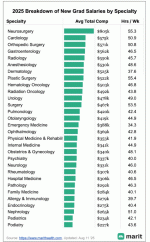
Note that for the first 3 years after graduating med school, a primary care doctor is not done with learning and has to complete postgraduate training called "residency" (so called because original residents lived in the hospital) in either Family Medicine or Internal Medicine. Even then, the pay during residency is higher than claimed by your web site. Look for example at this residency program. I chose it because it's a MCOL and a medium-sized metro area.
As you can see, a PGY-1 (first year resident) makes $67k in base pay, plus $12k in housing allowance, which brings it up to $79k even before other bennies like computer allowance and continuing education stipends. The program also pays for initial moving expenses.
After PGY-3, a primary care doctor is done with residency and in their first real job, the figure given by Toni (~$250k) is more realistic, but still a lowball.
new-physician-grad-salaries-by-specialty-chart.gif
From here.
Btw, the PGY-4 to 6 are for those who want to pursue a fellowship in a subspecialty like cardiology or nephrology after IM residency, not for PCPs. There are also residencies (like surgery) that take longer than 3 years.
Considering the cost of school, insurance and other basic equipment, it doesn't appear as if primary care doctors make very much money in the US.
It only appears that way if you are using a website with bogus numbers.
 
Last edited:
Crap, I remember making way under that and still a lot more than my parents or in-laws or any of my relations ever earned and being shocked at how little was left after taxes, SS, insurance premiums, etc.
As you said, you were making "way under that". A lot more is left from a $250k or $300k salary even after taxes. You don't necessarily need to buy a McMansion and a 911 or an AMG Merc fresh out of residency, and demand that others must pay for your student loans.
 
@ Emily Lake

There is a big different between the time one needs to become a Phd compared to an MD. MDs are required to have clinical experience, internships and usually residencies before they can actually practice. I think you might have mentioned that.

I've known a few Phd grads and while it does take awhile to get those degrees, it's not nearly as long or probably as stressful as becoming an MD, not that all of them are that smart. My brother in law is a retired dentist. He's an idiot, so having that doctorate degree imo, doesn't necessarily mean much. All I can think is that he must have been good at memorizing things and then quickly forgot them once he finished his classes.

The former leader of the now defunct Humanists of Georgia had a Phd in primatology. He was very smart but he told us getting that Phd wasn't that difficult. I had a friend who did a summer program to obtain her Phd, years after obtaining her MS. I'm not knocking anyone's education, but getting an MD, regardless if you're a good one or not, takes longer than most any other degree.
 
Someone who has taken out hundreds of thousands of dollars in student loans is going to be living a more modest lifestyle for a good long while. And HAS already lived a pretty spartan lifestyle for the previous 10 years or so.
Not necessarily. Many med students have physician or otherwise well-off parents. They do not need to live spartan during college and med school.
And relevant to the original purpose of this thread, I think this has mostly to do with subjective metrics needed to get into med school - letters of recommendation, extracurriculars (where family connections can help a lot), parents knowing people on the admissions committee.
We don’t have enough physicians in this country as it now stands.
That is controversial. I think it is more about distribution (both geographically and by specialty) and other factors, not the total number.
And even if there were such a shortage, there is certainly no shortage of applicants. Obviously, many people want to become physicians, even with the prospect of taking on large student loans.
Expecting physicians to undergo years of grueling education and training should be enough. Why should we expect them or anyone to bear such an enormous monetary burden?
Because they are also extremely well compensated. Why should people making <$100k bear the monetary burden of student loans for people making >$250k?
As it is, people —with any type of degree—are struggling to pay off student loans before their own kids go off to college. If they managed to have kids.
But most people aren't paid anywhere close to what physicians are paid.
Sadly —no, tragically and I fear fatally, as a nation we have lost that value of funding education in a way that makes it affordable to anyone who can gain admission.
Now you are talking about university education and not about med schools and physicians specifically. But briefly, a big part of the problem in the US is this idea that everybody should be able to go to college, even if they have struggled to finish high school. Countries like Germany where attending university is cheap or even free also restrict admissions much more than the US. A relatively small number of kids graduate with Abitur, or "allgemeine Hochschulreife" (literally "general maturity for university"). There is also a secondary path to university, but many other kids learn a trade instead, which Germans have elevated into an artform.
There is simply no way to have everything - broad access to college even for marginal students and low costs to students. There are always tradeoffs.
I’ve known parents a generation younger than me whose attitudes towards student loans was extremely blasé. As though it would be easy to pay off $100K in student debt.
It depends wholly on what career their offspring have after graduating.
 
@ Emily Lake

There is a big different between the time one needs to become a Phd compared to an MD. MDs are required to have clinical experience, internships and usually residencies before they can actually practice. I think you might have mentioned that.

I've known a few Phd grads and while it does take awhile to get those degrees, it's not nearly as long or probably as stressful as becoming an MD, not that all of them are that smart. My brother in law is a retired dentist. He's an idiot, so having that doctorate degree imo, doesn't necessarily mean much. All I can think is that he must have been good at memorizing things and then quickly forgot them once he finished his classes.

The former leader of the now defunct Humanists of Georgia had a Phd in primatology. He was very smart but he told us getting that Phd wasn't that difficult. I had a friend who did a summer program to obtain her Phd, years after obtaining her MS. I'm not knocking anyone's education, but getting an MD, regardless if you're a good one or not, takes longer than most any other degree.
I think it really depends on the degree in question, and how stringent the thesis requirements are.

From what I can tell, for a general practitioner MD:
4 years undergrad
4 years med school
3-4 years residency
Total: 11 to 12 years

For PhDs:
4 years Bachelor's
2 years Master's
5 to 7 years PhD
Total: 11 to 13 years

I suspect that some degrees spend less than 5 years in the PhD phase, but some spend more than the 7. I didn't make it that far so I'm going by whatever the google tells me.
 
Why do you resent physicians earning a very good living?
I don't resent them earning a good living. I do, however, think it's inappropriate for them to earn a very good living while simultaneously complaining about the debt they incurred to get that very good living, and expecting that the rest of society bear the cost on their behalf.

🤷‍♀️ I'm pretty protective of the public's money across the board. I don't think that's a bad thing.
Do you believe that a person in their thirties who is working full time should be able to marry, have children, purchase a home? Save for their own retirement t? Save for their children’s future education?
Sure. What gives you the impression that I don't?
What do you call fallacious debt burden?
I didn't call the debt burden fallacious. I called the argument that the reason doctors need to charge so much is because of their debt a fallacious argument.
Is it the $200K+ student debt? The debt to buy into an established practice or set up a new practice? The small burden of a home mortgage? The burden of car payments?

Child care costs are enormous right now.
Tell you what... you figure out a way where ANYONE who has a home mortgage and car loan and child care costs can go to their employers and just increase their own salaries so they can afford all of those things with money left over for luxuries, and without it breaking the economy, and we can talk.

I'm not a fan of special pleading that exports the inconvenience of debt onto other people.
Most people do not complete their education having accrued >$200K in student debt.

My argument is that NO ONE should graduate from any public university or professional school with student debt approaching $100K, much less twice that.

My argument further is that most of the fees for visits to physicians do not go into the pockets of physicians but are used to defray the costs of the practice, including debt, staff salaries and benefits, equipment t and supplies, etc.
 
Crap, I remember making way under that and still a lot more than my parents or in-laws or any of my relations ever earned and being shocked at how little was left after taxes, SS, insurance premiums, etc.
As you said, you were making "way under that". A lot more is left from a $250k or $300k salary even after taxes. You don't necessarily need to buy a McMansion and a 911 or an AMG Merc fresh out of residency, and demand that others must pay for your student loans.
See my reply to Emily Lake.

I believe that I took home about 60% of my wages. An income of $250K would be in a higher income tax bracket, so the take home would be less. This was after I would have had no childcare expenses.

If you had been a patient at the medical practice where I worked you would have helped pay for my wages and my benefits.

When you go to the grocery store, you help pay for the wages of the cashiers and stocking clerks, etc.

When you buy something from Amazon, you are enriching Jeff Bezos.

If you go to the hospital, your bill helps pay for the wages of every employee of that hospital. When you see a physician, your fees help pay the wages of every employee of that medical practice.

I do get the ire. My kids’ orthodontist used to talk about his pretty fancy vacations. My kids’ vacations were car trips to see out of state grandparents. Any disposable income that might have paid for a vacation instead was spent making their teeth straight. I thought it was not particularly wise of the orthodontist to talk about his trips to the Caribbean and ski vacations to the parents of his patients.

My mother stopped working for pay due to the difficulty and expense of daycare. And became disabled as she was starting to return to work as my youngest sibling was in school all day. Both of my parents finished high school but did not even consider going beyond. It would have been close to impossible for them to go to college. They did not pay for the college education of their kids, me included. It was not within the realm of possibility. We lived in a very modest ranch house and all of our family vacations involved a tent and sleeping bags. We wore hand me downs and made a decent amount of our clothes. My father’s job involved travel and so he got a car allowance, ensuring that we always had a pretty new car—which was required by his job.

Yes 3 of the four of us kids earned significantly more than our parents did. My husband outearned his parents. 2 of my kids earned significantly more than I ever did. I wish the others did and hope that they make the needed changes further their own sake.
 
Last edited:
Someone who has taken out hundreds of thousands of dollars in student loans is going to be living a more modest lifestyle for a good long while. And HAS already lived a pretty spartan lifestyle for the previous 10 years or so.
Not necessarily. Many med students have physician or otherwise well-off parents. They do not need to live spartan during college and med school.
And relevant to the original purpose of this thread, I think this has mostly to do with subjective metrics needed to get into med school - letters of recommendation, extracurriculars (where family connections can help a lot), parents knowing people on the admissions committee.
We don’t have enough physicians in this country as it now stands.
That is controversial. I think it is more about distribution (both geographically and by specialty) and other factors, not the total number.
And even if there were such a shortage, there is certainly no shortage of applicants. Obviously, many people want to become physicians, even with the prospect of taking on large student loans.
Expecting physicians to undergo years of grueling education and training should be enough. Why should we expect them or anyone to bear such an enormous monetary burden?
Because they are also extremely well compensated. Why should people making <$100k bear the monetary burden of student loans for people making >$250k?
As it is, people —with any type of degree—are struggling to pay off student loans before their own kids go off to college. If they managed to have kids.
But most people aren't paid anywhere close to what physicians are paid.
Sadly —no, tragically and I fear fatally, as a nation we have lost that value of funding education in a way that makes it affordable to anyone who can gain admission.
Now you are talking about university education and not about med schools and physicians specifically. But briefly, a big part of the problem in the US is this idea that everybody should be able to go to college, even if they have struggled to finish high school. Countries like Germany where attending university is cheap or even free also restrict admissions much more than the US. A relatively small number of kids graduate with Abitur, or "allgemeine Hochschulreife" (literally "general maturity for university"). There is also a secondary path to university, but many other kids learn a trade instead, which Germans have elevated into an artform.
There is simply no way to have everything - broad access to college even for marginal students and low costs to students. There are always tradeoffs.
I’ve known parents a generation younger than me whose attitudes towards student loans was extremely blasé. As though it would be easy to pay off $100K in student debt.
It depends wholly on what career their offspring have after graduating.
We all pay for each other. Everything you purchase whether it is a good or service or combination pays the wages of everyone in the potentially long line of people involved in getting that good or service into your hands.
 
Back
Top Bottom