• Welcome to the Internet Infidels Discussion Board.

Generative AI behind a possible simulation

excreationist

Married mouth-breather
Joined
Aug 28, 2000
Messages
3,568
Location
Australia
Basic Beliefs
Probably in a simulation
I am a fan of this quote:

“...the games will become indistinguishable from reality. ...there would probably be billions of such computers and set-top boxes. ...it would seem to follow that the odds that we're in base reality (NOT a simulation) is one in billions”

- Elon Musk

So he's talking about simulations on a large number of affordable small devices - not huge supercomputers.

The steps would be - simulations with keyboard and mouse, VR simulations, and having an interface with a brain.

This is a bit what an interface with a brain could be like: (which involves a lot time scaling)


Here is a recent development - Genie 3 - which can also create realities based on paintings or video-game style visuals.


I'd recommend watching at least the first 30 seconds - or 60 seconds.

The start demonstrates a simulation within a simulation.

Does anyone think it is impossible that one day people could have VR experiences that are close to being indistinguishable from reality? I think in the future we will approach that.
 
Last edited:
People might ask about there being conscious-seeming characters in those simulations...

Well here is a lot of progress towards that... I think in the future this could happen in real time...


This demonstration of realistic voices and humour done in real-time about a year ago:

 
Last edited:
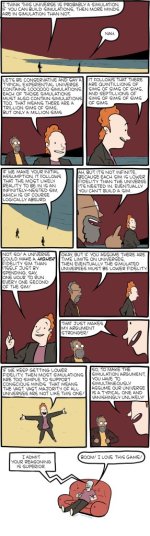
Zach Weinersmith >> Elon fucking Musk.
I'll try and explain why your cartoons aren't very relevant to the specific kind of simulation I'm talking about.

In the Roy game, sound, visuals, and sensory data are generated for the player.

In Genie 3 visuals and possibly sounds are generated for the player.

In Sora 2 the sound and visuals are generated for the camera/viewer.

A relevant concept is "If a tree falls in a forest and no one is around to hear it, does it make a sound?"

In Sora 2 you could be in front of a stadium with 80,000 people. It involves "level of detail". They would initially be approximated but if the viewer went right up to some people they would be simulated in a lot more detail.

If you were far away from the people in the stadium do you think each mind must be simulated in a high level of detail in order to fool the viewer? I think a simulation could make the people basically cheer or chant, etc, without all 80,000 explicitly having their train of thought and qualia, etc, (and the states of billions of neurons) being simulated.

In a more advanced version of Genie there could be a world where a lot of people are playing video games (i.e. simulations within the simulation) - like in the video in the OP. It wouldn't affect the central player whether or not each of those video games are detailed simulations or not. So if they're not being viewed or detected in some way they'd only be very loosely approximated.

The concept is similar to lucid dreams. In a lucid dream you could simulate some bystanders but that doesn't mean it is possible for a million highly detailed minds or a million highly detailed simulations to exist within it.

So I'm talking about very limited things like Genie 3 and Sora 2 and just making them more and more detailed/memory intensive - but still somewhat limited so it doesn't ever simulate a million minds simultaneously to a very precise degree (explicitly simulating 86 billion neurons for each person)
 
Last edited:
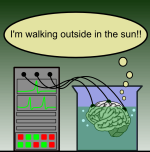
Brain_in_a_vat_(en)_v2.png

This is relevant... though I thought usually the brains would be inside heads. It is called a "brain in a vat". Though I guess if it was in a head the regular senses would need to be bypassed so they are not being distracting.
This also addresses the problem that maybe true consciousness/qualia can't be replicated in a computer. The brain is the conscious player while the generative AI characters wouldn't be because they aren't being simulated accurately enough.

So I'm talking about solipsism. The cheapest simulations in the future would involve "p-zombies". It could be possible for a simulation to have truly conscious non-player characters (NPCs) - if true consciousness can be generated within a computer - but it would be billions of times more expensive and cause genuine suffering in billions more people.
 
Last edited:
@bilby

Screenshot 2026-02-16 at 3.56.00 pm.png

The fidelity is not just based on time but also space. It could take many atoms to store the state of a single atom. So each universe with a given number of atoms could only simulate a universe with less atoms so it seems like infinitely nested simulations aren't possible. Also to store the position of a single atom would take many atoms... e.g. to store the position of an atom within the sun along one axis to the resolution of an atom takes about 64 bits. In 3 axes that's 192 bits. My point is that the information would take multiple atoms to store. Then you'd need to read and store that information and have a physics system that allows the atoms to interact, etc.

Though this is different with the kind of simulations I'm talking about where you don't need to explicitly simulate every atom though it would be possible to use an electron microscope and it would give the impression that there were atoms there (using a "level of detail" system).
 
Last edited:
@bilby
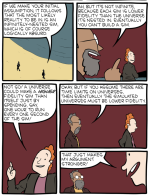
NOT SO! A UNIVERSE COULD MAKE A HIGHER FIDELITY SIM THAN ITSELF JUST BY SPENDING, SAY, ONE HOUR TO RUN EVERY ONE SECOND OF THE SIM!
So say you wanted to run a simulation that was a higher fidelity than your current resources. Say you wanted to spend an hour in it. That would take 3600 hours or 150 days.

But in my favourite simulation thought experiments the Roy game involves decades that are simulated within minutes and Alan Watts dream thought experiment involves 75 years within 8 hours of sleep.

I guess you still think those cartoons have better arguments than that quote from Elon Musk.

A UNIVERSE COULD MAKE A HIGHER FIDELITY SIM THAN ITSELF
Say you start with a universe with 1080 atoms and want to simulate a universe with 1080 + 1 atoms. The simulation isn't going to use every atom in the universe. It is possible it could use every atom in the sun, giving it 1057 atoms. Using simplistic simulation techniques, I don't know how a 1080 + 1 atom universe could be simulated with 1057 atoms. But assuming it could be done, it is very expensive to build a simulation that uses 1057 atoms. I think it is more likely that it would be like what Elon Musk has been talking about and what I've been saying about generative AI.
 
Last edited:
I guess you still think those cartoons have better arguments than that quote from Elon Musk.
Mate, I have had bowel movements that are better arguments than that quote from Elon Musk.
Note I quoted bits and pieces of what he said. He said that he thinks it would happen within 10,000 years.

There has been a huge amount of progress since Genie 1 came out in December 2023. See some of what it can do in version 3 within the first 30 seconds in the video in the OP.

You didn't really respond to what I said. You seem to think those arguments like "A universe could make a higher‑fidelity sim than itself" are better than what Elon Musk was saying.

Perhaps since you think Elon Musk's quote is worse than a bowel movement then the bar is low and the cartoon arguments are a bit better than that.
 
Last edited:
If you just gobble up everything Elon Musk says, I've got a bridge to sell you.
 
I notice in a lot of discussion about the concept of simulation that the assumptions are made that physical laws are the same in both universes, and that computers in the simulating universe would operate the same as ours. But their computers could use principles unknown and unknowable to us that make them much, much more powerful, and they could have physical laws that are much stranger than our already strange ones.
 
If you just gobble up everything Elon Musk says, I've got a bridge to sell you.
I basically agree with what he had to say. I mentioned that Elon Musk said it because he is well known. Do you have counter-arguments against what he had to say or are you saying it is nonsense because he had said it?
See:


I initially disagreed with:
"40 years ago we had pong" (in 2016 that was 1976). Pong was available in homes in 1975. I thought about Space War that was made in 1962 but Elon Musk is talking about technology that is in homes.
 
Last edited:
I notice in a lot of discussion about the concept of simulation that the assumptions are made that physical laws are the same in both universes, and that computers in the simulating universe would operate the same as ours. But their computers could use principles unknown and unknowable to us that make them much, much more powerful, and they could have physical laws that are much stranger than our already strange ones.
The generative AI I'm talking about can take big shortcuts (see the videos). It's talking about simulating the inputs for the player rather than simulating the environment too much.
 
If you just gobble up everything Elon Musk says, I've got a bridge to sell you.
I basically agree with what he had to say. I mentioned that Elon Musk said it because he is well known. Do you have counter-arguments against what he had to say or are you saying it is nonsense because he had said it?
See:


I initially disagreed with:
"40 years ago we had pong" (in 2016 that was 1976). Pong was available in homes in 1975. I thought about Space War that was made in 1962 but Elon Musk is talking about technology that is in homes.

If we're going by sheer probabilistic arguments, if Musk said it, yes, it is highly likely to be false.
 
If we're going by sheer probabilistic arguments, if Musk said it, yes, it is highly likely to be false.
Nick Bostrom also said similar things (but I prefer Musk talking about set top boxes, etc). Do you have counter arguments or is he also almost certain to say false things.
 
If we're going by sheer probabilistic arguments, if Musk said it, yes, it is highly likely to be false.
Nick Bostrom also said similar things (but I prefer Musk talking about set top boxes, etc). Do you have counter arguments or is he also almost certain to say false things.
For one thing Musk didn't provide any evidence whatsoever such devices are feasible. He just says stuff.
In the video he only talks for about 3 minuntes. I think the videos I've shown show signs that it is feasible. It seems possible that there would one day be VR that is indistinguishable from reality (where you use VR equipment). The next step is connecting a brain to the VR.

Life is not a video game. It is unevidenced nonsense.

The next step is not connecting a brain to a VR. The next step, if possible, is to end war and human suffering. It is to mitigate and reverse climate change, if possible. It is to find a way to house and feed and clothe and provide decent health care to everyone. Bogus techno-fantasies propounded by billionaire techno-bros without souls will do nothing.

But I also realize that ending human suffering, etc., is itself a fantasy. Humans are not a good species.
 
If we're going by sheer probabilistic arguments, if Musk said it, yes, it is highly likely to be false.
Nick Bostrom also said similar things (but I prefer Musk talking about set top boxes, etc). Do you have counter arguments or is he also almost certain to say false things.
For one thing Musk didn't provide any evidence whatsoever such devices are feasible. He just says stuff.
In the video he only talks for about 3 minuntes. I think the videos I've shown show signs that it is feasible. It seems possible that there would one day be VR that is indistinguishable from reality (where you use VR equipment). The next step is connecting a brain to the VR.

Life is not a video game. It is unevidenced nonsense.

The next step is not connecting a brain to a VR. The next step, if possible, is to end war and human suffering.
Video games can sometimes include unavoidable war and human suffering...
It is to mitigate and reverse climate change, if possible. It is to find a way to house and feed and clothe and provide decent health care to everyone.
The player can try and help do those things even if they're not successful.
Bogus techno-fantasies propounded by billionaire techno-bros without souls will do nothing.

But I also realize that ending human suffering, etc., is itself a fantasy. Humans are not a good species.
I think there could be simulations that don't have suffering though
 
Last edited:
Back
Top Bottom