• Welcome to the Internet Infidels Discussion Board.

Pendulum Generator

Tapping the Earth’s rotational kinetic energy would require a fixed place to push against.
Don’t tidal generators do that?
They push against the moon and sun; The suggestion that these are fixed, or indeed that anything is fixed, is bizarre.

The old "paradox" about the immovable object and the irresistable force comes to mind.

The solution is simple and trivial; All objects are movable, (and all forces are irresistable), so the problem is impossible to create. Which is only a problem for folks who believe in a God for whom nothing is impossible.
 
So yeah - tapping tidal energy re-directs some energy from the earth’s rotation as well as from the velocities of the earth and moon orbiting each other, plus a little from the earth-moon system orbiting the sun.
 
You have a spinning flywheel in deep space attached to nothing far away from gravitational influences. Where do you put a generator to get electricity?
 
Tapping the Earth’s rotational kinetic energy would require a fixed place to push against.
Don’t tidal generators do that?
They push against the moon and sun; The suggestion that these are fixed, or indeed that anything is fixed, is bizarre.

The old "paradox" about the immovable object and the irresistable force comes to mind.

The solution is simple and trivial; All objects are movable, (and all forces are irresistable), so the problem is impossible to create. Which is only a problem for folks who believe in a God for whom nothing is impossible.
In my mind, an immovable object would be like an object whose definition in a positional system is "hard-coded".

It's the sort of thing that takes extraordinary effort from outside a system entirely to influence. Like decapping a live chip in a vacuum or inert gas environment.
 
You have a spinning flywheel in deep space attached to nothing far away from gravitational influences. Where do you put a generator to get electricity?
100% free from Gravitational influences?
Are you a massless observer? How can you tell it’s spinning vs you (observer) orbiting it?
 
One can fairly well imagine a vacuum, and perhaps even imagine this vacuum at a very early sort of "moment", in which the curious event of only a few singular particles happen to coalesce inside what, for them, is a bubble of silence. The horizon is unmarred by microwave background because of the random chance of nothing actually being there, but no "light" has started to arrive from there, either.

From their perspective, some may very well coalesce with angular momentum going in directions roughly around parallel and opposite to neighbors, but gravitationally seeing each other, so that they fall towards each other but retain angular momentum. Because angular momentum can't be created nor destroyed without outside forces, which haven't come to influence this little thing, it can't be "nowhere".

From the perspective of these particles, they must be "rotating" even given the curious lack of outside reference point, and this will be measurable from the sum capability of these particles to resist each other's gravity, I would expect.

In this model, the entire "visible universe" may at any moment have a nonzero rotation, and that rotation will be different everywhere, and change in every moment as new particles with their own new rotational velocities are observed.
 
Some clock tivia.

A typical grandfather clock requires very little energy, storing approximately 80 to 180 Joules of potential energy when fully wound, which lasts for about a week. Powered by falling weights, this energy is released at an incredibly low rate to overcome friction in the pendulum mechanism, requiring roughly 2-3 milliwatt-hours (\(mWh\)) per day.

Windup clocks typically run for either 7-8 days (most common for mantel/wall clocks) or 30 hours (daily wind) per full winding, though some specialized models can run for 31 days or even 400 days. It is recommended to wind them fully, until the key stops, on a regular schedule, such as weekly for 8-day clock

A traditional mechanical windup clock stores very little energy, typically measured in joules, as it only needs to overcome friction and power a pendulum or balance wheel. A common mechanical watch spring stores about 0.033 Joules). Large weight-driven grandfather clocks might store around 178 Joules.

Digital watches have a wide range of battery life depending on whether they are basic, solar-powered, or GPS-enabled smartwatches, generally ranging from
several days to 10 years.

Basic Digital Watches (e.g., Casio): The battery usually lasts between two to five years. Some models with low-power consumption can last up to 10 years.

Capacity & Energy: A common watch battery with 10mAh capacity and 1.55V holds approx 55.8 Joules. Energy Consumption: A quartz watch typically draws only about 1 microamp allowing small batteries to last for over 2 years.
 

Attachments

  • 1770381719220.gif
    1770381719220.gif
    43 bytes · Views: 1
  • 1770381719235.gif
    1770381719235.gif
    43 bytes · Views: 1
  • 1770381719227.gif
    1770381719227.gif
    43 bytes · Views: 1
Last edited:
Yes, a Foucault pendulum can technically be used to generate a very small amount of electricity, but it is not a practical or efficient power source. By attaching magnets to the pendulum bob and surrounding it with coils, the pendulum's motion can generate electrical energy, essentially acting as a transducer for its kinetic energy.

Mechanism: The swinging, magnetized pendulum induces a current in surrounding coils as it moves.

Low Output: Experiments have shown that such devices produce extremely low voltage, such as 17 microvolts, which is significantly less than what is needed for practical applications [2, Nature, Futurism https://futurism.com/scientists-generate-electricity-earth-rotation].

Energy Consumption: Because of friction and air resistance, Foucault pendulums require constant energy input (often via electromagnets) to keep swinging [5, 7, University at Buffalo]. The energy needed to maintain the swing is far greater than the electrical energy generated.

Purpose: While a patented concept exists for using a magnetized pendulum to create power, these devices are predominantly used as educational exhibits to demonstrate Earth's rotation, rather than as functional generators.

Interesting that there is a patentt for a Foucault power gernerator.


As you say, educational exhibits. There is a market, therefore a value in a patent.
 
Probably not. The swing of a pendulum cannot be used as a power source; You can store power in it, but the 1LoT says you can't get out more than you put in.

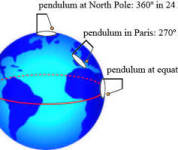
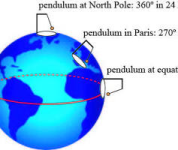
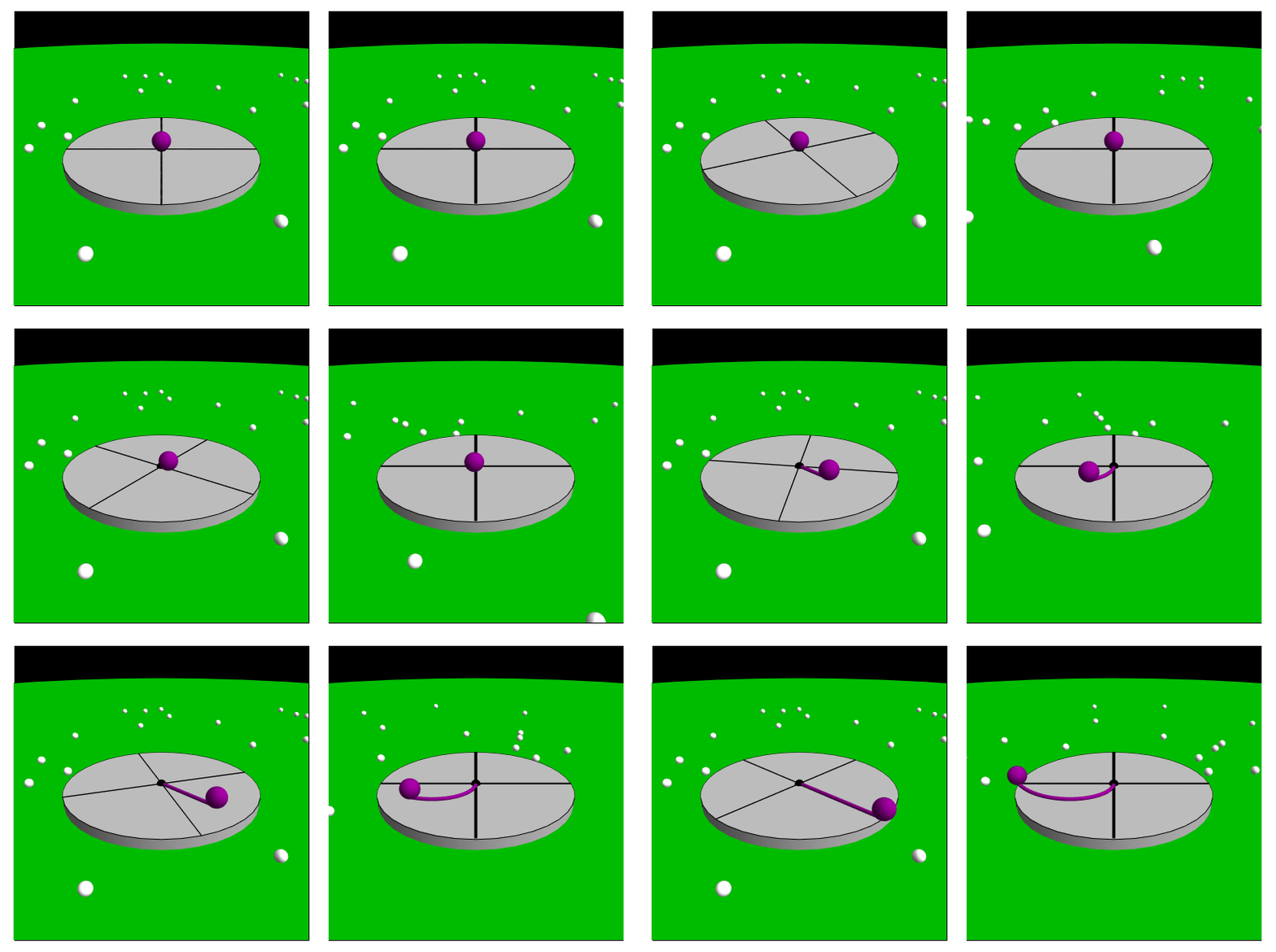
The precession of a foucault pendulum is a different matter, as it is 'powered' by the rotation of the Earth - You could in principle extract some useful power, by slightly slowing the planet and lengthening the day. The rotation of the Earth has an effect on any pendulum; If it is free to precess, then it causes precession; If not, the torque generated energy is typically lost - usually as frictional heat in the bearing from which the pendulum hangs.

The power available by this method is incredibly tiny. For a really big, heavy pendulum, enclosed in a vacuum chamber to eliminate losses to air resistance, and with a really high quality bearing to keep frictional losses as low as possible, I seriously doubt that you could generate anywhere close to sufficient power just to keep the pendulum swinging against those minimal frictional losses, much less extract any useful power for other purposes.

I can't be arsed to do the sums, but if someone else wants to have a crack, I have five bucks that says you can't get more than a nanowatt out of any pendulum made from regular baryonic matter at standard temperature and pressure, that would fit in any currently existing building, even assuming frictionless bearings and zero air resistance.

My gut feeling is that a system that rotates at 0.0007 RPM simply cannot generate enough torque to be useful. But perhaps I don't know what I am torquing about...
The power available by this method is a big fat zero. Angular momentum is conserved. An object can't change its rotation rate by pushing on itself around its axis any more than Wile Coyote can keep his sail-skateboard going by blowing on his sail. To get power from the rotation of the earth you'd have to dump some of the angular momentum into an external object, such as the moon. So unless the precession of the pendulum somehow torques the moon you're getting zilch.

(* An object can reduce its rotation rate by pushing on itself radially, moving mass farther from its axis, increasing its moment of inertia. Climb a flight of stairs and you've slowed the Earth. But (a) a pendulum doesn't do that, and (b) it takes energy to climb stairs. )
Why zero? There is a force making it precess, else it would not move. Make it climb whatever hill (obviously, very tiny) it can with that energy.

(And the Mythbusters actually got their boat to move by blowing on the sail--you're simplifying too much. The air hits the sail and bounces back. It's that bounced air exiting the system that provides the propulsion. The flip side of this is a known danger--hovering helicopter can get caught in a vortex created by air bouncing off terrain. This feeds air into the blades that's already moving down, reducing the lift. Try to hover in something akin to a box and you might go down--this is suspected in the crash of the helicopter on the Bin Laden raid, the box being the wall around the property.)
 
The power available by this method is a big fat zero. Angular momentum is conserved. An object can't change its rotation rate by pushing on itself around its axis ... To get power from the rotation of the earth you'd have to dump some of the angular momentum into an external object, such as the moon. So unless the precession of the pendulum somehow torques the moon you're getting zilch.

(* An object can reduce its rotation rate by pushing on itself radially, moving mass farther from its axis, increasing its moment of inertia. Climb a flight of stairs and you've slowed the Earth. But (a) a pendulum doesn't do that, and (b) it takes energy to climb stairs. )
Why zero? There is a force making it precess, else it would not move. Make it climb whatever hill (obviously, very tiny) it can with that energy.
You say that like the plane of the pendulum's swing is a physical object. It's a mental abstraction. The physical object being moved is the bob, and that's being pulled straight toward the center of the earth, and straight toward the pivot at the top of the room. Neither exerts torque.

Funny story. In pilot lore there's a well-known trick you can supposedly do to save your life if you're in fog and your instruments fail. You quickly jury-rig a pendulum, set it swinging, and watch its precession. When it holds steady you know you've achieved straight-line flight and you can avoid going into a spin from your natural tendency to overcorrect when you try to aim the airplane by feel. The pendulum serves as a poor man's gyroscope. When you're turning with a gyroscope, the gyroscope's plane of rotation isn't moving because there's a force making it precess; it's moving because you're observing it relative to a rotating frame of reference. It isn't really changing direction at all, but holding still while the airplane turns around it.

... any more than Wile Coyote can keep his sail-skateboard going by blowing on his sail. ...
(And the Mythbusters actually got their boat to move by blowing on the sail--you're simplifying too much. The air hits the sail and bounces back. It's that bounced air exiting the system that provides the propulsion. The flip side of this is a known danger--hovering helicopter can get caught in a vortex created by air bouncing off terrain. This feeds air into the blades that's already moving down, reducing the lift. Try to hover in something akin to a box and you might go down--this is suspected in the crash of the helicopter on the Bin Laden raid, the box being the wall around the property.)
Heh. Okay, bad metaphor. Let's make that, an object can't change its rotation rate by pushing on itself around its axis any more than you can rise into the air by pulling up on your bootstraps. You have to pull or push an external object.
 
HeeeHee

The first time I drove cross country in the 80s I pulled a trailer. I was moving from New Hampshire to North Idaho. There is a stretch of highway in Montanan known for high winds. Hazardous to semis.

At one point I almost lost control. I had something hanging from the rear view mirror. I noticed I could see the pendulum start to swing when the car started swaying before I felt it.

Solid state accelerometers us tiny silicon cantilevers. Deflection is measured with a strain gauge. They are in your smart phone. 3 axis. You could put one on a Foucault pendulum. Cheap enough to set up in your back yard.You can probably get one with Bluetooth. Make the mass of the ball >>>> than the mas of the accelerometer.

Integrate acceleration in 3D and you get velocity and direction. Integrate velocity in 3d and you can derive position versus time in 3 space.
 
Last edited:
The power available by this method is a big fat zero. Angular momentum is conserved. An object can't change its rotation rate by pushing on itself around its axis ... To get power from the rotation of the earth you'd have to dump some of the angular momentum into an external object, such as the moon. So unless the precession of the pendulum somehow torques the moon you're getting zilch.

(* An object can reduce its rotation rate by pushing on itself radially, moving mass farther from its axis, increasing its moment of inertia. Climb a flight of stairs and you've slowed the Earth. But (a) a pendulum doesn't do that, and (b) it takes energy to climb stairs. )
Why zero? There is a force making it precess, else it would not move. Make it climb whatever hill (obviously, very tiny) it can with that energy.
You say that like the plane of the pendulum's swing is a physical object. It's a mental abstraction. The physical object being moved is the bob, and that's being pulled straight toward the center of the earth, and straight toward the pivot at the top of the room. Neither exerts torque.
Ok, yeah, I see it--the pendulum isn't moving, the Earth is moving under it. I was thinking there was a tiny force involved but you're right.
Funny story. In pilot lore there's a well-known trick you can supposedly do to save your life if you're in fog and your instruments fail. You quickly jury-rig a pendulum, set it swinging, and watch its precession. When it holds steady you know you've achieved straight-line flight and you can avoid going into a spin from your natural tendency to overcorrect when you try to aim the airplane by feel. The pendulum serves as a poor man's gyroscope. When you're turning with a gyroscope, the gyroscope's plane of rotation isn't moving because there's a force making it precess; it's moving because you're observing it relative to a rotating frame of reference. It isn't really changing direction at all, but holding still while the airplane turns around it.
Yup, gyros are simply fast and stable.
 
Put the abstraction of your head in front of a the abstraction of a 200 pound ball swinging on the end of a rope, see what happens.

Energy is ability to do work. Work equals energy. It it moves your head then work is done and there is energy in the pendulum.
 
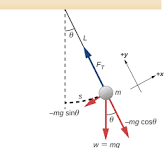
Look up pendulums, Foucault pendulums free body diagrams.

1770778139838.png


A Foucault pendulum's free-body diagram (FBD) in the rotating Earth frame includes the gravitational force (\(mg\) downwards), tension (\(T\) along the wire), and the Coriolis force (\(-2m\Omega \times v\)) acting perpendicular to the direction of motion. This non-inertial frame analysis explains the apparent precession of the swing plane. Key Forces in the FBD (Rotating Frame) Gravity (\(F_{g}=mg\)): Acts directly downward, directed toward the center of the Earth.Tension (\(T\)): Acts along the wire towards the pivot point, pulling the bob back to equilibrium.Coriolis Force (\(F_{c}=-2m\Omega \times v\)): Acts horizontally, perpendicular to the velocity (\(v\)) of the bob. This force is responsible for the rotation of the swing plane, with a magnitude that depends on the latitude (\(\phi \)).Centrifugal Force (Often neglected): A small outward radial force (\(m\Omega ^{2}R\)) that is generally combined with gravity into an "effective gravity" vector, as it is small compared to \(mg\).


1770778462270.png
 

Attachments

  • 1770778237051.png
    1770778237051.png
    59.2 KB · Views: 0

"A fictitious force[1], also known as an inertial force or pseudo-force, is a force that appears to act on an object when its motion is described or experienced from a non-inertial frame of reference. Unlike real forces, which result from physical interactions between objects, fictitious forces occur due to the acceleration of the observer’s frame of reference rather than any actual force acting on a body. These forces are necessary for describing motion correctly within an accelerating frame, ensuring that Newton's second law of motion remains applicable.[2][3]

Common examples of fictitious forces include the centrifugal force, which appears to push objects outward in a rotating system; the Coriolis force..."
 
Fictitious force sounds like a misnomer. Like imaginary numbers.

On launch astronauts experience physical compression.

To compress a spring-mass system(accelerometer) under acceleration like in a car is work(force*distance) which takes real energy.

Which is why I look at it as a free body diagram.
 
Who's the Einstein in the patent office who approved that?

As someone who has interacted with patent examiners I can say that among the requirements for a patent -- novelty, utility, non-obviousness, invention, and enablement -- utility is probably of least interest to the examiner. And rightly so, since useless patents are least likely to be litigated.
 
Back
Top Bottom