• Welcome to the Internet Infidels Discussion Board.

The Christ Myth Theory

Learner is inventing theology again, it is what Christians do,

Two things essential to Chrtianity are the virgin birth and the resurrection. The few statements in the gospels are considered objective eyewitness accounts, IOW proof.

Everything else in Christian theology is largely irrelevant.
Well, to be fair, I wouldn't expect a "Virgin birth". That's why the mother has to be a compulsive liar: it's a trait that went into the original mix, if there was a historic figure behind the myth.

The mother absolutely requires a trait that would at least lead to a CLAIM of being a virgin at the time, and that is a heck of a lie, and so 'liar'.

Yes, yes, the act of collecting money for personal wealth and gain requires you to be atheist
Non sequitur. Did I strike a nerve?

Plenty of people claim to be Christians, think they are Christians, are utterly convinced by their "Christianity" that their activities in favor of personal gain are "saving" people eternally.

In some senses, you could call these people "false Christians", but then you would be struck with the fact that most of the most vocal "Christians" fall into that "fake Christian" camp, including the folks you take your marching orders from.

Without offering strong, academically valid supporting arguments as to why and when and how to be a good person, people can and do twist it until they're "totally not doing it for personal gain".

I would rather people "totally doing things FOR personal gain" but where the model of "personal gain" does more to raise all tides and creates that gain through indirect methods, than the opposite, where the "for everyone" ends up being mostly just for themselves.

I have never even ONCE seen a church go out, help homeless people, maybe the retired members getting real jobs and just... Giving all that extra income away... And doing it quietly, without pushing "the message" in any way.

Doing it the other way, "as public Christians", rather than "as atheists" directly contributes to this FALSE piety, this "hook in the bait" model.

The people I know who spend their money directly, here, today on useful charity without administrative overhead eating the majority of the pie are ATHEISTS who realize that if we don't help one another, NOBODY will get any help from anyone, because we are all we have.

Ah, but of course, an individual "born in the mid of winter" ,the invention doesn't fit the description of a LAMB being born in the warm 'lambing season
It's traditional to celebrate the birth on Christmas, so whoever it is needs to be born around that time. It doesn't matter if the original was or wasn't, the followup has to more match the myth than anything else.

This isn't about being Jesus, it's more about upstaging the Christians at their own act, in some respects?

Also, "the lambing season" is too wide of a window. You could potentially aim for "Easter" there? But because this is a "redeaux", it needs to hit a very narrow statistical model, and adding targets dilutes the 'spooky coincidences' that make the juxtaposition work.

In some ways it is a direct rhetorical attack on the foundation of many apologist "lines" discussing "Prophecy".

You'll have to invent it though.
Not really. It already mostly exists. Secular philosophy has plenty of candidate philosophies. Heck, I invented a candidate philosophy myself that would probably suffice.

All that's really necessary is a figurehead who can give a few food sermons, do some clever stuff to feed more people than expected, deal with some people's problems according to their philosophy, and then stand for the Temple Tantrum arc (so as to get executed after going on public record about their contemporarily "heretical" ideas). Preferably the figurehead has enough in common with Jesus to trigger people's "spooky coincidence senses".

The problem is that unless the candidate actually agrees to and with and is genuine about all of it, I'm not sure you could pull it off.

Finding someone who generally enjoys life and loves living but is still willing to die knowing they will be dead forever if it means that philosophy survives?

The script has already been written.

The real question is whether there's anyone out there to cast for the part.

As I said though, you're gonna have to ask Carrier for a good bullseye to hit and the odds of hitting it. That's the way you recover the philosophy from God and Special Revelation and "Prophecy", while supporting the construction of "heaven on earth, today, for everyone".

But the point is, that's just what happened the first time: some story sets a target to hit, people claim some individual hits the target, assign that undue importance, and use that to leverage a philosophy. It's almost like Bitcoin, "person who has the proof of some unlikely useless work having been done gets piles of money", but it's "whoever has the proof of some unlikely repetition of a two thousand year old trope gets a chance to start a new religion", and using the opportunity to start a joke religion.

The real question would then be "why does 'Jesus' and 'God' matter at all, if this kind of person and philosophy can be a secular phenomena?"
 
No, the gospels are not considered objective, or proof. They are believed on faith.
For me the word is 'evidence' - what the clues points to.

Proof for some people, are claims made from personal experiences which of course is uniquely their own witnessing an event. The gospels make the claim that they have been 'seeing with their own eyes' these events.

Religion is not about knowing, but believing. In fact, apologists and believers who try to 'prove' anything about their religious beliefs are at odds with their faith.
I suppose, I would say it's is both, about knowing and believing in today's times for modern day Christians.
Evidence as in the clues that point to the claims of what they witnessed with their own eyes as being true
 
Yes, yes, the act of collecting money for personal wealth and gain requires you to be atheist
Only if by "atheist" you don't mean "person who does not believe gods exist", but rather "person who does not subscribe to Learner's very narrow set of beliefs".

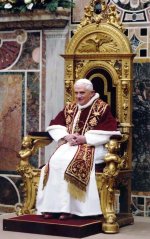
Behold, an atheist on his golden throne:

IMG_3241.jpeg
 
Learner

Only atheists pursue profit for personal gain?

Western civilization in Europe especially at the peak of its exploitive economics around the world was Christiana not atheist.

So you are against western free market economics? What are you some kind of communist?
 
You must not know my history on the forum.

Not to me, objective first hand accounts and proof to Christians.

There is a very old saying about something being 'the gospel truth'.

To Christians the gospels and the OT are the TRUTH.

The resurrection is true because there are witnesses in the gospels.

Without he resurrection and divine birth Christianity does not exist. If not Jesus is just another wandering moralist.

HJ or not. the resurrection to believers means an eternal afterlife. Bear your burdens and believe.
If this was to me, yes, I do know your posting history. I've been here 21 yrs, and you post a lot. And...I keep close attention.

I did not mean that YOU think the gospels are objective. Not hardly. What I argue is that Christians don't regard the gospel accounts as objective. Rather, they are accepted as true on faith. There may be Christians who claim the gospels are objectively true, but they would be the ones who don't know what objective means.
 
ok. Then substitute the word factual for objective.

The gospel words of Jesus are the factual accounts of Jesus.

That Jesus rose from the dead and walked around is factual.

There are philosophical Christians who dismiss the supernatural. At the time of Nicaea a major di8spute was whether Jesus was divine. The Nicene Creed established the divinity of Jesus as orthodox theology.

Thomas Jefferson a Deist created a version of the NT minus the supernatural elements.

I wo0uld not say it is universal among all who identify as Christian, but the RCC and the rest of tge major denomination are based in the resecrection story with resurrection for all who believe and follow go;s words.

Without that there is no incentive to believe.

Once the basic supernatural orthodoxy was established and enforced an HJ was irrelevant.
 
Learner is inventing theology again, it is what Christians do,
🙄

Two things essential to Chrtianity are the virgin birth and the resurrection. The few statements in the gospels are considered objective eyewitness accounts, IOW proof.

I see...so is 'proof" the same word you don't use to make the claims for the following below ?


No Final Certainty:
As physicist Richard Feynman said, "If it doesn't agree with experiment, it's wrong." Even the most successful theories—like evolution, relativity, or the Big Bang—remain theories because they are subject to future testing and possible revision.

Everything else in Christian theology is largely irrelevant.
That's where you keep missing a lot.

Nothing is irrelevant when investigating thoroughly, ancient cultures, the psychological aspects or character profile of minds back then (emotional, cultural traditions, attitudes,relationships etc.& etc. to name a few).
Regarding the Richard Feynman quote. As you put your opinion on the same line (and also in italics) I initially got a surprise that Feynman would say that, then I saw where the second quotation mark was. That is deceptive; shame on you.
Your claim is wrong. They do not remain theories because of something in the future. They are theories even when it is known that they are immutable truth. It is a term that is used that has a precise meaning, unlike the popular use of the word.

For instance, the theory of evolution has had additional concepts added to it. This simply means that it is a more accurate theory, but it was 100% scientific in its basic concept before and after the changes, as that did not change.
Also good luck trying to find an experiment that would make evolution wrong.
I like to think of it as the distinction between the theory of evolution and the fact of it.

The fact of evolution is that we can see it happening. Things did "evolve" and do "evolve".

The theory of evolution is the model which largely explains this fact as a series of simpler processes.

All theories of evolution, to be accepted, must fit the facts of evolution.

No theory of not-evolution in any way fits the facts, which are evolution-shaped. The shape of reality presents a stark challenge to anyone who claims a not-evolution-shaped model, because it would require an extraordinarily dishonest deity to pull it off.
 
1. The “crucified messiah” problem (aka: no one would make this up).

Holland’s favorite point.
In the 1st-century Roman world, crucifixion was:
reserved for rebels, slaves, and traitors
deliberately humiliating
designed to erase honour

A crucified Jewish messiah is basically a theological faceplant.
If early Christians were inventing a founder, they picked the worst possible option.

You don’t invent a god who:
gets arrested
tortured
executed naked

by imperial authorities

That only makes sense if something like that actually happened, and the followers were stuck explaining it afterward.
I disagree with this argument. Paul makes a point of emphasizing this degradation: "I preach Christ crucified!" (I'm quoting from memory. Many of the Gospel stories deal with Jesus degrading himself - hanging with prostitutes and drinkers, and lower class individuals, That's a big part of what made Christianity appealing to so many - "He's one of us." I'm not necessarily claiming that Jesus, or at least a major figure in the Jesus movement, wasn't crucified. I just don't think it's a very strong argument for his historicity.

Many folk stories and myths involve Kings or gods who disguise themselves as ordinary men, only to produce a big reveal.

Early Christianity offered:
persecution
no political power
no wealth
no military backing
social stigma
Yet it spreads anyway.
And it offered the promise of eternal life to those who already were persecuted, had no power, no wealth, and no military backing, which included vast swaths of the population. No wonder it spread.
 
Learner is inventing theology again, it is what Christians do,
🙄

Two things essential to Chrtianity are the virgin birth and the resurrection. The few statements in the gospels are considered objective eyewitness accounts, IOW proof.

I see...so is 'proof" the same word you don't use to make the claims for the following below ?


No Final Certainty:
As physicist Richard Feynman said, "If it doesn't agree with experiment, it's wrong." Even the most successful theories—like evolution, relativity, or the Big Bang—remain theories because they are subject to future testing and possible revision.

Everything else in Christian theology is largely irrelevant.
That's where you keep missing a lot.

Nothing is irrelevant when investigating thoroughly, ancient cultures, the psychological aspects or character profile of minds back then (emotional, cultural traditions, attitudes,relationships etc.& etc. to name a few).
Regarding the Richard Feynman quote. As you put your opinion on the same line (and also in italics) I initially got a surprise that Feynman would say that, then I saw where the second quotation mark was. That is deceptive; shame on you.
Your claim is wrong. They do not remain theories because of something in the future. They are theories even when it is known that they are immutable truth. It is a term that is used that has a precise meaning, unlike the popular use of the word.

For instance, the theory of evolution has had additional concepts added to it. This simply means that it is a more accurate theory, but it was 100% scientific in its basic concept before and after the changes, as that did not change.
Also good luck trying to find an experiment that would make evolution wrong.
Quite.

Gravity is a theory.

When Einstein proposed an adjustment to Newton's original theory, and Eddington showed experimentally that Einstien was right, and Newton was wrong, rocks didn't start falling upwards.

Nothing will ever change the theory of gravitation so that rocks fall upwards; It is a theory whose predictions are absolutely correct - up to a point. Extreme conditions, when working with stellar mass components (the Sun is in the order of a million times the mass of the Earth), produce slightly different results, but any observations made on Earth match Newton's predictions (and Einsteins), and always will - even if Einstein were to in turn be superceded by some future Grand Unified Theory.
 
1. The “crucified messiah” problem (aka: no one would make this up).

Holland’s favorite point.
In the 1st-century Roman world, crucifixion was:
reserved for rebels, slaves, and traitors
deliberately humiliating
designed to erase honour

A crucified Jewish messiah is basically a theological faceplant.
If early Christians were inventing a founder, they picked the worst possible option.

You don’t invent a god who:
gets arrested
tortured
executed naked

by imperial authorities

That only makes sense if something like that actually happened, and the followers were stuck explaining it afterward.
I disagree with this argument. Paul makes a point of emphasizing this degradation: "I preach Christ crucified!" (I'm quoting from memory. Many of the Gospel stories deal with Jesus degrading himself - hanging with prostitutes and drinkers, and lower class individuals, That's a big part of what made Christianity appealing to so many - "He's one of us." I'm not necessarily claiming that Jesus, or at least a major figure in the Jesus movement, wasn't crucified. I just don't think it's a very strong argument for his historicity.

Many folk stories and myths involve Kings or gods who disguise themselves as ordinary men, only to produce a big reveal.

I think you're going about this completely backwards. First off, prophets and messiah figures, before Jesus are all aristocracy. I mean... Darius I is called a messiah. Before the age of Jesus Judaism is just another form of paganism. And as such their holy figures (for all cults and religions all around the Mediteranian) follow a pattern. It's basically might makes right. If you are successful in the secular world, it means you are also blessed by the sacred world.

Isn't it more likely that Jesus came as a successful but standard pagan-style prophet, who (as most of them did) failed, and then Jesus followers started to change the backstory to make Jesus into a more humble character than he really was. A bit like, Jesus once helped carry a plank, and after some Chinese whispers, now Jesus is a carpenter. Or Jesus, using his wealth, to show up with loads of fish and wine to impress the peasants, and this gets, over time, changed to him miraculously turning water into wine and making bread and fish apear from thin air.

Bart Ehrman makes a good case for that Jesus most likely was a rabbi, ie aristocratic. Around the time of Jesus there was a project to agree on a single agreed upon Tanakh. In Judaism Jews never stop adding Biblical books to it. A result of this is that Jewish theology, at the time of Jesus, is all over the place and the Sanhedron thinks this is a problem. So there's a project to remove the books that are a bit out there. We know this took place.

Bart Ehrman's theory is that the Jesus movement, and the New Testament, is one of the sides in this debate that lost. All the leaders of the sides in that debate who lost were executed. I'm not saying Ehrman is right. It's speculative. But it's more likely that Jesus was a prophet, who followed the standard pattern of prophets, got humiliatingly executed, and then his followers, over time, changed the story to that Jesus was a more humble figure than previously thought.

There's also the pharisees vs sephardic conflict going on around the time of Jesus. Since Jesus, in the Bible, got condemned by pharisees. It's not hard to imagine that Jesus was aligned with the sephardic side. Ie, liberal, wealthy, cosmopolitan. Totally the type of Jew who is more open to association with gentiles.

Most of the theology of Christianity comes from Paul and S:t Augustine. People who never knew Jesus and people who spent most of their life mingling with gentiles. S:t Augustine was a gentile.

I can recommend Bart Ehrman's book, Misquoting Jesus, which explains the general problem with Chinese whispers in manual book copying.

To sum up. It's more likely that Jesus was made into a humble character after the fact of a humiliating death, rather than that he started as a humble character who then had a death that fit his movements marketting strategy. Remember, the Roman authorities picked a type of death designed to kill his movement.


Early Christianity offered:
persecution
no political power
no wealth
no military backing
social stigma
Yet it spreads anyway.
And it offered the promise of eternal life to those who already were persecuted, had no power, no wealth, and no military backing, which included vast swaths of the population. No wonder it spread.

I think the main reason it spread was because it, uniquely, was open to poor people. Christianity is the first religion that actively tries to convert poor people. Every religion before it, in all of world history, had focused conversion on those with status, power and wealth. And actively trying to exclude those further down the status hierarchy. I think that's a better explanation to why is spread explosively and obliterated every other religion in it's path. And the fact that it also preached intolerance towards other religions.

People often forget the unique selling point of Christianity.
 
Learner is inventing theology again, it is what Christians do,
🙄

Two things essential to Chrtianity are the virgin birth and the resurrection. The few statements in the gospels are considered objective eyewitness accounts, IOW proof.

I see...so is 'proof" the same word you don't use to make the claims for the following below ?


No Final Certainty:
As physicist Richard Feynman said, "If it doesn't agree with experiment, it's wrong." Even the most successful theories—like evolution, relativity, or the Big Bang—remain theories because they are subject to future testing and possible revision.

Everything else in Christian theology is largely irrelevant.
That's where you keep missing a lot.

Nothing is irrelevant when investigating thoroughly, ancient cultures, the psychological aspects or character profile of minds back then (emotional, cultural traditions, attitudes,relationships etc.& etc. to name a few).
Regarding the Richard Feynman quote. As you put your opinion on the same line (and also in italics) I initially got a surprise that Feynman would say that, then I saw where the second quotation mark was. That is deceptive; shame on you.
Pardon me. I just lifted that from a page and posted in haste. I didn't write it, I just copied and pasted it as a quick response..but 'shame on me' anyway for not checking before posting.😐
Your claim is wrong. They do not remain theories because of something in the future. They are theories even when it is known that they are immutable truth. It is a term that is used that has a precise meaning, unlike the popular use of the word.
The line after the quotation marks wasn't mine as I said, but I posted it because I do agree with it, in context to the word proof!

For instance, the theory of evolution has had additional concepts added to it. This simply means that it is a more accurate theory, but it was 100% scientific in its basic concept before and after the changes, as that did not change.
Also good luck trying to find an experiment that would make evolution wrong.
Sure, still classified as a theory though. Perhaps it's that way because the science community think it's currently the correct term, the idea needing further updating.

We can highlight obvious examples where some things just can't be tested, or reproduced, like the 'big bang'.

In my initial post on this particular point: I asked one of our forum friends (half jestingly) what he meant by the word proof, to be sure if he actually meant to say evidence.
 
The ore I think about the Jesus myth as was passed own and existst today came out the Nicaea council, convened to reduce conformal between competing sects.

We are the real Christians, all else is heresy.

The Nicene Creed established the basic myth. A divine Jesus son of god, and the resurrection as orthodox theology.

Everything else suppressed.

The NT became standardized later.

The Gnostic summary shows the murky origins of Christianity.

Plus a few of the early sects.

To get a clear picture would probably require reading 5 r 6 books from different authors.

I doubt it can be known how Christianity as it became in large part over power struggles relatess to a wondering Jewish rabbi.

I rthink it is a safe bet to say beliefs and cultures 2000 yearss ago were eclectic.


The origins of Gnosticism are obscure and still disputed. Alexandria was of central importance for the birth of Gnosticism. Gnosticism is strongly influenced by Middle Platonism and its theory of forms.[31][32][33] Elaine Pagels has noted the influence of sources from Hellenistic Judaism, Zoroastrianism, and Middle Platonism on the Nag Hammadi texts.[8] The Christian ecclesia (i. e. congregation, church) was of Jewish–Christian origin, but also attracted Greek members, and various strands of thought were available, such as "Judaic apocalypticism, speculation on divine wisdom, Greek philosophy, and Hellenistic mystery religions."[34] The proto-orthodox Christian groups called Gnostics a heresy of Christianity.[note 13][36]

While rejecting the underlying framing that proto-orthodox Christianity is the 'original' and 'true' Christianity from which Gnosticism and other 'heresies' then deviated, scholars such as Simone Pétrement[37] and David Brakke[38] have argued that Gnosticism originated as an intra-Christian movement, being one of several responses to the life, death, and presumed resurrection of Jesus, with Pétrement tracing it specifically to tendencies in the letters of Paul and the Gospel of John.[39] Within early Christianity, the teachings of Paul the Apostle and John the Evangelist may have been a starting point for Gnostic ideas, with a growing emphasis on the opposition between flesh and spirit, the value of charisma, and the disqualification of the Jewish law. The mortal body belonged to the world of inferior, worldly powers (the archons), and only the spirit or soul could be saved. The term gnostikos may have acquired a deeper significance here.[34]


The term proto-orthodox Christianity or proto-orthodoxy describes the early Christian movement that was the precursor of Christian orthodoxy. Older literature often referred to the group as "early Catholic" in the sense that their views were the closest to those of the more organized "Catholic" Church that was the State church of the Roman Empire during the 4th and 5th centuries. The term "proto-orthodox" was coined by Bentley Layton, a scholar of Gnosticism and a Coptologist at Yale,[2][non-primary source needed] but is often attributed to New Testament scholar Bart D. Ehrman, who has popularized the term by using it in books for a non-academic audience. Ehrman argues that when this group became prominent by the end of the third century, it "stifled its opposition, it claimed that its views had always been the majority position and that its rivals were, and always had been, 'heretics', who willfully 'chose' to reject the 'true belief'."[3]

Although early Christianity had many diverse sects and doctrines, critics of the stance of downplaying the proto-orthodox's prominence (such as Larry W. Hurtado), generally argue that the writings of the Catholic anti-heresiologists condemning others as heretics were still essentially accurate: that of all the Christian groups, the "proto-orthodox" has the most common ground with the immediate followers of Jesus in the Apostolic Age and Christianity in the 1st century, and were indeed the most common variety of Christianity even then.

 
Talk about inability to keep one's eye on the ball. Will a larger font help?
First: What are we debating? We are debating the "minimal Jesus historicity hypothesis."
Richard Carrier’s target is what he calls the “minimal historicity” hypothesis about Jesus. In plain terms, this is the position held by most historians of antiquity, even very skeptical ones. It can be summarized as follows:
  1. An Actual Human: An actual man named Jesus existed at some point.
  2. Active Ministry: He acquired followers during his lifetime.
  3. Continued Movement: His followers continued as an identifiable movement after his death.
  4. Execution: This same Jesus was executed by Jewish or Roman authorities.
  5. Veneration: Some of his followers soon began worshiping him as a living god or demigod

That is the hypothesis Carrier wants to overturn. He is not primarily arguing against Christianity as theology, but against this bare-bones historical Jesus.

Start another thread if you need to discuss a supernatural Jesus, a Resurrection, or a Virgin Mary.

Especially laughable is the claim that "there is NO evidence for a historical Jesus." There certainly IS evidence: A "debate" would center on the question of how strong that evidence is. It's grammatically sensible (though wrong) to state that the evidence is very weak. But to say there is NO evidence is to demonstrate that one cannot understand the simple words in simple English sentences.

Atheism here really does resemble hard-core brainwashed Christianity. Just as some religious crackpots deliberately remain ignorant of evidence against their faith, so the faithful atheists here refuse to acquaint themselves with the actual evidence relevant to the historicity question.

I hope the enlarged font will at least acquaint participants with what the thread is debating. Use your browser's Zoom function if you need an even larger font.
 
Atheism here really does resemble hard-core brainwashed Christianity.
That's a hell of a leap.

The point here has always been that the evidence from outside the church doesn't really establish that Jesus ever really lived (though it wouldn't), and that the evidence from inside the church is the Polemics, which don't actually validate truth given the fact that there are multiple known mechanisms and behaviors by which the story could originate.

Most of the people that acknowledge this will also equally acknowledge at least the possibility of the alternative at least in a secular light: it is entirely possible an autistic child born to a liar learned a bunch of "city philosophy" on top of what was probably a decent (if overly religious) education (if it ever happened), and they put together from this a philosophy about how we should treat one another and wild ideas about how to build heaven and very obscure ideas about resurrection and rebirth, a philosophy which ultimately led to him being executed for disrupting the Temple and it's untoward monetary activities.

Or it could have been some amalgamation of people who did stuff like that eventually having their stories added to some core kernel (which probably absorbed some other cults in the region over the intervening years).

The problem is that the answers to what parts are true and what parts are false are lost to time.

As I have said before, you could, you tried really hard, probably locate (or manufacture) an analog.

As I've said before, the only people it would ever really matter to whether there was even the tiniest shred of historical truth to it would be people hoping and praying that another human is born who matches his pattern and does the things and understands what he understood and explains it in plain fucking English this time.

But... We also see a steady parade of people claiming to be exactly that person on these forums and look at how we doubt them. I doubt them in particular. Between us, I doubt any here would acknowledge any as the prophets or singers of prophets which they claim to be; every one of them so far has been a homophobic asshole.

There is in fact a meme that this whole phenomena ascribes to based on a Manga by a famous Japanese Horror writer named Junji Ito involving holes on a hillside. In the manga, each hole matched a person, and when people saw a hole that matched them, they would be drawn to go into the hole, where they would be mangled and extruded from a hole on the other side, twisted but somehow still alive. In the meme version, people are drawn to holes that do not fit them but which they wished would, and jump in anyway (to be horrifically mangled as twisted, living horrors).

The thing is, I have this feeling that the retirement plan for someone who is actually "Jesus, but born today, of modern events" is not very appealing, especially when the consensus is that if that happened, the Christians of today would be the ones putting them on a cross, assuming they are not some obscure homeless person they can wholely ignore.

So there's this big question: why does it matter?

Because if you want to claim this person's existence and/or return is important and do so for secular rather than religious reasons reasons not associated with wanting God to exist, then you would have to acknowledge that it is at least possible someone here, now, today, is that person that is "Jesus re-molded, re-implemented", and in my experience the only people willing to entertain that idea are quite problematic.

In fact, I wonder how the observation of the reality of such people would impact such a "repetition", or perhaps how it should impress on such a person? I can't imagine that they wouldn't eventually figure out they were repeating the same tropes as from a story that they would have known all their lives with fairly high esteem. I expect that it would result, for true "repetition", as an identity crisis rather than what we normally see: "am I just an echo? I do not want this shadow of a legacy. How do I stand on my own merits, if making me is as simple as following a recipe? And if it is, do I want that to be a recipe anyone can just cook up?!?"

And to be frank, worse than the identity crisis would be the history of well documented violent and otherwise bad ends to people that seem to have a resemblance to the tropes.

So, I would personally rather just think Jesus wasn't a real person after all. That way people don't do the whole "this is MY hole, it was made for me" thing, and do our best to see secular reason used as the foundation of our philosophies rather than silly things like "happens to be suspiciously jesus-like".
 
Atheism here really does resemble hard-core brainwashed Christianity.
That's a hell of a leap.
...

I've snipped vague and misleading generalities about the evidence for a historical Jesus. More than a few of you have refused to mention the writings of the non-Christian historians Josephus and Tacitus; nor have you addressed the strong inferences and deductions that can be derived from the texts. IIRC, one of Jarhyn's memes is that there were TWO distinct individuals, a Jesus Christ and a Jesus Chrest, who got conflated. IIRC he also regards the sarcastic polemic Toledot Yeshu as a better source than 1st-century documents.

But... We also see a steady parade of people claiming to be exactly that person on these forums and look at how we doubt them. I doubt them in particular. Between us, I doubt any here would acknowledge any as the prophets or singers of prophets which they claim to be; every one of them so far has been a homophobic asshole.

Homophobic, hunh? May I ask for a cite?

So there's this big question: why does it matter?
...

That's a question for YOU. Jesus' alleged non-existence seems to matter a lot to YOU and some others here. Your religious-like faith in Jesus' non-existence compels you to make long evidence-free diatribes opposing the man's very existence.

At some point my own interest in an ancient historic mystery has morphed into fascination of how these debates proceed -- or rather get stymied -- on a message board. I know every poster here is very intelligent. But -- and again note the similarity to Christian fundamentalists -- rational thought is absent when your faith in Jesus' non-existence is challenged.

I'm an atheist and so are many hundreds of professional historians who have deduced that the "minimal historical Jesus" hypothesis is almost certainly correct. But we do not let a blind dogmatic atheism prevent us from objective rational thought.
 
Josephus has been discussed, usually raised by Christina as a proof of the gospsel Jesus.

Josephus was burn about 40 years after Jesus. In his 20s writing tat would be 60 years.

There were no video and audio receding, no photographs,no newspapers, no books as we have today. No academic historians as we have today. No fact checking.

In an age of illiteracy as the norm Josephus would have heard a lot of hear say accounts.

In high school Latin class we had to read Caesar's Gallic Wars in Latin. Written by Caesar who of course put himself on a good light, di9spite his near disasters. There are corroborator accounts and archeological evidence.

Their is nothing about Jesus except what amounts to hearsay. There are no original source documents for the NT. I think the oldest gospels are around 3rd century.

What we can surmise that in the 1st and early 2nd century there werer already competing versions of Jesus.

All debate on Jesus always boils down to the same issue. Documented and coordinated accounts of who and what he may have been.

So gays see a Jesus who embrace gays. Conservative Evangelicals see a Jesus who hates gays.

It all depends on how you interpret the gospels and the NT in general.

A bipolar Jesus. He ranges from rage in the Temple to a pacific meek shall inherit the Earth in Sermon On The Mount.

Turn the other cheek, pacifism.

A delusional Jesus hearing voices and doing battle with Satan.

We don't know what he looked and sounded like. He could have been the kind of ranting street corned preacher we see today.

John The Baptist is described as an odd duck.

Yet people get warm and fuzzy think about Jesus and quoting the scattered sound bites fromr the gospels.

And for me as ahteist the issue is the thousand of years of oppression and vioencee with Vicinity leading to today. The RCC is always lurking in the background hoping to reclaim direct political power and rule. In the USA a long hstory of Christian abuses. Today there are Christians who want a kind of Sharia Law based on the bible.

If not for all that I would not be postng here. Debate over Jesus in the end it is niot just idle talk.
 
Last edited:
More than a few of you have refused to mention the writings of the non-Christian historians Josephus and Tacitus
No, that comes up REGULARLY in discussions like this, and it always gets flushed right down the toilet as the historical equivalent of gray water because between the two of them the only likely un-modifed text says the equivalent of "Christians are people that exist", not "Christ was a person who existed".

As the only piece of probably-reliable text doesn't say what you want, you probably shouldn't keep trying to bring this up.

IIRC, one of Jarhyn's memes is that there were TWO distinct individuals, a Jesus Christ and a Jesus Chrest, who got conflated. IIRC he also regards the sarcastic polemic Toledot Yeshu as a better source than 1st-century documents.
No, although that's definitely possible; rather, that the entirety of some passages were modified and we don't really know what they contained before Liars for Jesus got to them.

That said Toledot Yeshu is at least a better source than second century documents because they actually match earlier documents from the Talmud and aren't necessarily directly associated with the cult.

Interestingly, the Toledot Yeshu actually contains a story about a DIFFERENT earlier person entirely than the Christian accounts, if we are going to accept that the Christian account is accurate about its own timeline, meaning there were at least two people at the time from which similar stories could be amalgamated from, and at least two different and very similar seeming cults that would almost certainly have merged over that time (seeing as the Toledot Yeshu was a Polemic all on its own).

Homophobic, hunh? May I ask for a cite?
The vast majority support the orange turd. Peacegirl's daddy, we just recently discussed the homophobia (wants to purge the world of the homosexual). As I recall No Robots is/was a Trump supporter, as the majority of conspiracy theorists are.

Have you seriously not actually paid attention to this parade of Jesus claims that have come through here?

Jesus' alleged non-existence seems to matter a lot to YOU and some others here.
I mean, I already discussed why it matters to me, a couple times now: it is an ideological pit that brings people through here claiming to be Jesus's repeat/resurrection/rebirth. It's a cognito-hazard that draws people in, mutilates their sense of self, and then spits them out into the world incapable of contribution and infected with narcissistic delusional of grandeur that all too often blind them to reason.

As I said quite emphatically in a way you seem to have completely snipped away, I don't believe any of these things are necessarily true, but each is a plausible explanation of the history we see.

As I said, the temple tantrum is a perfectly servicable "possible" event. Did it happen? we don't know. Will we ever know whether it really happened? Probably not. Does it matter whether it happened in reality? Also probably not for most people.

Why does it matter for me? Because I dislike people making statements of certainty about uncertain phenomena to an autistic extent (as much as I dislike claims of uncertainty about certain phenomena), and it's an active topic at a place I like to waste time on discussion specifically where people make certain claims about uncertain phenomena.
 
Nicely done Jaryn.

Now Swami will claim he is being insulted.
 
More than a few of you have refused to mention the writings of the non-Christian historians Josephus and Tacitus
No, that comes up REGULARLY in discussions like this, and it always gets flushed right down the toilet as the historical equivalent of gray water because between the two of them the only likely un-modifed text says the equivalent of "Christians are people that exist", not "Christ was a person who existed".

Here is an excerpt (translated) from Tacitus' book:
Publius Cornelius Tacitus said:
But all human efforts, all the lavish gifts of the emperor, and the propitiations of the gods, did not banish the sinister belief that the conflagration was the result of an order. Consequently, to get rid of the report, Nero fastened the guilt and inflicted the most exquisite tortures on a class hated for their abominations, called Chrestians by the populace. Christus, from whom the name had its origin, suffered the extreme penalty during the reign of Tiberius at the hands of one of our procurators, Pontius Pilatus, and a most mischievous superstition, thus checked for the moment, again broke out not only in Judæa, the first source of the evil, but even in Rome, where all things hideous and shameful from every part of the world find their centre and become popular. Accordingly, an arrest was first made of all who pleaded guilty; then, upon their information, an immense multitude was convicted, not so much of the crime of firing the city, as of hatred against mankind.

So, that passage in Tacitus was modified by Christians? Read it again, and see if it really looks like what Christians would write.

And do you think Josephus' mention of James "the Just" and his brother Jesus was modified?

Are you aware that these opinions of yours are NOT the opinions of competent atheist historians? They are fairy-tales invented by those whose religious faith requires that Jesus not exist.

Serious question: Are you aware that these opinions of yours are NOT the opinions of competent atheist historians?
Tell us whether you even realize that much. That you realize your dismissal is a fringe (minority) view. A view you NEED to adopt to protect your faith.

And, are you aware that The Prophet Dr. Richard Carrier, PhD accepts that the Josephus mention of James and his brother Jesus is genuine Josephus. Your Prophet claims that only the phrase "called Christ" was added to that passage? Do you even know Carrier's solution to who that Jesus was? If so, will you comment on that "solution"?

Didn't think so.
 
Back
Top Bottom