• Welcome to the Internet Infidels Discussion Board.

Astrophotography

I had a very nice telescope many years ago. Spent a good bit of money on it. I found out i'm not a night owl and you have to be up at night to use it. So I sold it. Stuff like the above makes me wish I could have gotten into it.

It's something that's never interested me. The scenes are always the same, there's no way anything I could find through a scope can match what the pros do, I'll just enjoy looking at what they get.
It’s amazing what the amateurs can do. Check out the pics on Astrobin. They’re almost identical to Hubble pics! But it costs a lot of money though to do that. Me I’m happy with what I’ve done while keeping it fairly cheap (~$6,000).
 
Back before kids I subscrbed to Sky and Telescope and Astronomy Magazine. I have several years of them still on my bed table.

I am thinking of resubscribing to the digital version of one. I read in bed at night on my tablet.

Back then I liked Astronomy a bit more because of it's heavier emphasis on new discoveries and on cosmology compared with S&T which was more focused on telescope techniques and reviews. Though they both had a mix.

Does that describe the two now?
 
  • Like
Reactions: SLD
Back before kids I subscrbed to Sky and Telescope and Astronomy Magazine. I have several years of them still on my bed table.

I am thinking of resubscribing to the digital version of one. I read in bed at night on my tablet.

Back then I liked Astronomy a bit more because of it's heavier emphasis on new discoveries and on cosmology compared with S&T which was more focused on telescope techniques and reviews. Though they both had a mix.

Does that describe the two now?
Last I checked.
 
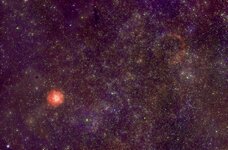
Messier 24 and 17 in the upper right. When you look down the center of the galaxy, the number of stars is just overwhelming. Messier didn’t realize that’s what he was looking at So he just named it his 24th object, but in reality it’s not really an object, just a huge number of stars in the field of view. I love the dark globules that block a lot of stars.

This is just 36 minutes of data. Same as before, 3 minute subs. I was going to do a full hour but had a meridian flip half way through and it ruined the next few photos so I switched to M8 and M20.

E00380AC-D11D-438F-8390-00F25AC9F7FF.jpeg
 
No red? We had lots of red in Akron. Granted, we didn't see it at the same time.
 
  • Like
Reactions: SLD
No red? We had lots of red in Akron. Granted, we didn't see it at the same time.
Exposing to record a good image of the corona causes the reddish prominences you saw to be “washed out”. They can be recorded with a separate, shorter exposure, and the two can be combined with some editing techniques.

I had hoped that the solar maximum would cause something like that to be visible to the naked eye. The ones in 2017 were too small. This one was huge, at least three times the diameter of Earth.
It isn't as clear as my bottom shot, but I have the red flare in my main eclipse exposure. In Akron, it was visually very prominent, at the base.
 
No red? We had lots of red in Akron. Granted, we didn't see it at the same time.
Exposing to record a good image of the corona causes the reddish prominences you saw to be “washed out”. They can be recorded with a separate, shorter exposure, and the two can be combined with some editing techniques.

I had hoped that the solar maximum would cause something like that to be visible to the naked eye. The ones in 2017 were too small. This one was huge, at least three times the diameter of Earth.
Indeed. I over exposed it. I shot a bunch at first, then just stopped and enjoyed the show. I could easily see the prominence naked eye. It was marvelous to just look at.
 
The Little Rosette and the Garlic Nebulas

This is in Cassiopeia. The little Rosette is on the left and the Garlic on the upper right. The Garlic is an interesting Supernova remnant, that is somewhere between 10,000 and 40,000 years old. I’m inclined to a younger number because it is so well defined compared to the famous veil nebula which is about 75,000 years old. Scientists have been able to find its original remnant pulsar by the trail it left as it was ejected from the area at 1,000 km/h. It left a trail of debris and emissions that point right to it. There’s a hole as you can see, which actually gives the nebula its name. In longer exposures it really looks like a garlic clove or a popped balloon. This exposure probably needs about 40 total hours to give it true justice, but I’m happy with it. The little Rosette is easier to capture because it has a higher surface brightness. But it’s a standard circular field of gas that has two tones to it. There is a central star cluster as well.

This was taken Saturday night at Chandler Mountain Alabama, Alabama. It was just above freezing but I stayed in my car a lot once I got everything going.

This is 99 subs at 3 minute a piece. I was trying for at least 5 hours of data, but alas, the clouds rolled in during my final shot. So I only got 4 hours and 57 minutes. Oh well.. Stacked and processed in Pixinsight. Telescope: William Optics GT-71. Camera: ZWO 2600MC. Mount: ioptron GT71.

IMG_8341.jpeg
 
Spectacular stuff!
About a week ago I lay myself down on a deck lounge and stared up at the sky, right after the sliver new moon had set.
at first it was great... saw a little meteor straight up as soon as I lay down. After my eyes began to adjust, and the high atmosphere above had lost the last oblique ray of sunlight, shit began popping. There's so much crap in orbit!
At first I was horrified, then (hangs head) I was wishing I could see a crash.
There were, at one point, four satellites at once converging (from my perspective) in the sky, so closely that for a fleeting instant I could have covered all four of them with my fist at arm's length, and two actually appeared to have woulda hit each other if they were both at the same altitude.
After a little while, even more became visible. Clear night, no wind (so fewer particulates) 7400' elevation, not near a big city...
I used to lay out under the stars and watch, from back at a time when a moving thing in the night sky was a meteor, and seeing an airplane was exciting. But it has been a few years, I guess.
That era is over, anyway. If you brought back some Mayan for a visit on a dark night, they'd definitely say "Told you so!"
If people stopped launching shit tomorrow, it would be hundreds or thousands of years before earth's skies would be devoid of naked eye visible trash.

 
Last edited:
The reason I recalled the above, was that there's a FB group of astrophotography, and much of the discussion is about software and different techniques for removing streaks.
 
Back
Top Bottom