
• Welcome to the Internet Infidels Discussion Board.

2026 Mid-Term Elections

It’s already been discussed that some uber wealthy do not draw income but live off of loans borrowed against their assets, there for owing no income taxes.
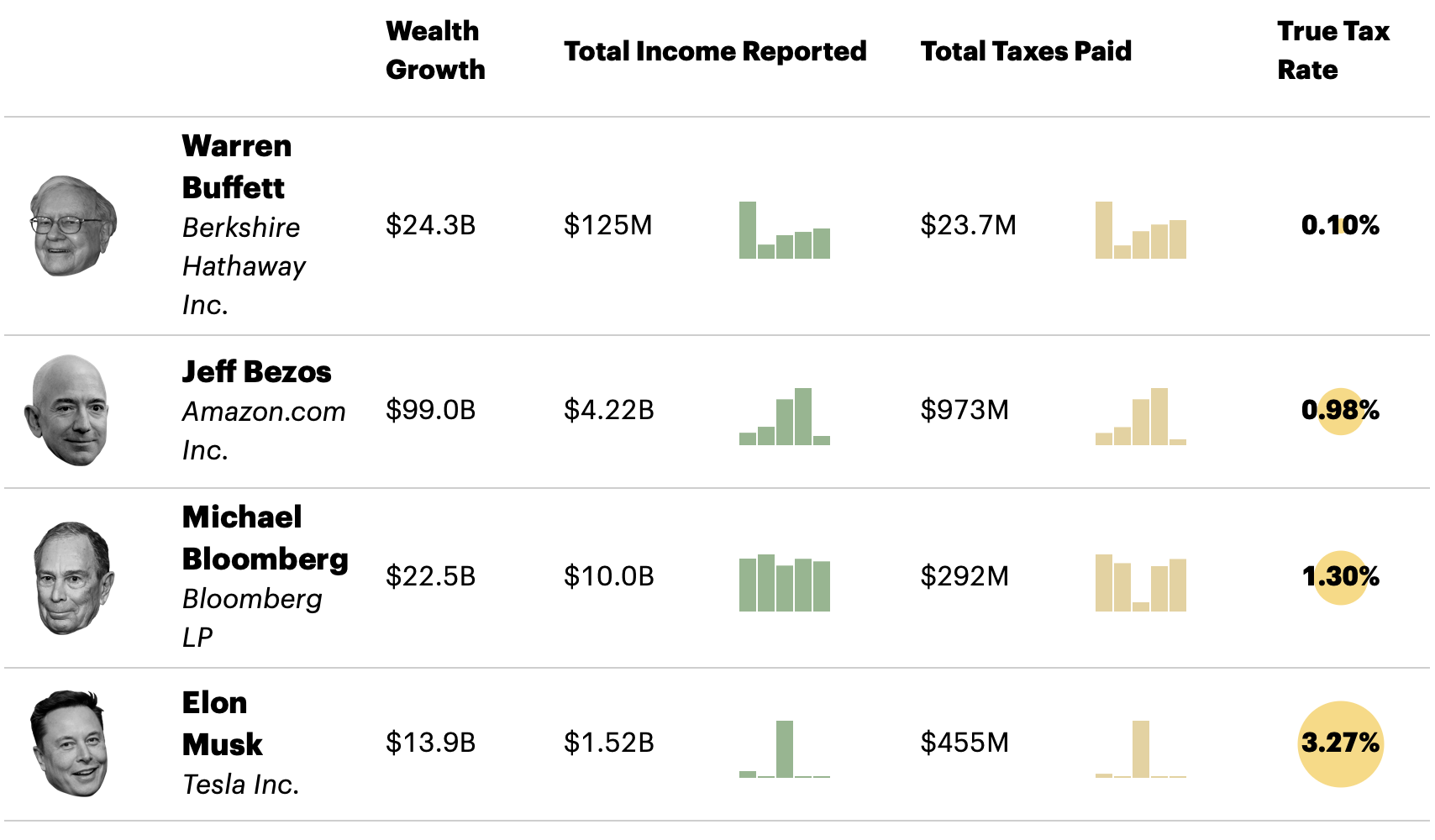
It has been vaguely claimed and handwaved, yes. I have shown upthread that because of interest, this strategy has limited utility in the long term. And indeed, even the polemical ProPublica piece shows that the billionaires they profiled declared high amounts of income and paid the appropriate amounts of federal income taxes.
Billionaire-tax-rates.png

The disconnect between "wealth growth" and "total income reported" is not that they borrowed the difference tax free, but that they did not use more than the reported income. This chart is for a five year period (2014-2018) which means that say Musk took out (and spent) ~$300M per year, while Bezos did ~$800M. That should be enough even for lavishly spending Jeff, don't you think? There is no reason to think they borrowed any more tax free. Even for Buffet, who "only" took out $25M per year, that is explainable more by his (relatively of couse) modest lifestyle rather than him borrowing against his paper gains.
And the so-called "true tax rate" is of course complete poppycock, since you can't use something that is not a basis for taxation as a denominator for any kind of tax rate.
Musk in some years has drawn no income from his assets and therefore owed no personal income taxes.
True, but what does that matter? He more than made up for it by drawing a bunch in other years, and paying the appropriate tax.
Warren Buffet famously remarked that his housekeeper paid more income taxes than he did.
It wasn't a housekeeper, but a secretary, and the details were kind of vague as to her income and taxation. We discussed that upthread. But it is interesting that she in the retelling became a housekeeper, a lower income profession than an executive secretary.

By the way, for laughing dog: I do not know what definition of "effectively nothing" you like, but $455M or $973M over a five year period is far from "effectively nothing" in my book.
 
The fallacious appeal to authority can oftentimes be seen in the wild as a parent says "because I'm your parent and I say so" with regards to some claim of fact like "why is bedtime 8:30?"
"Because some guy at Cornell Law said so".
The authority itself is usually levelled in terms of "power over" or "at the head of an organization" rather than "has respectable knowledge of the subject matter".
But in your example, it is true. Bedtime is a decree from an authority, just like say speed limits. Why are speed limits in the US so low, even on rural highways? Because the government said so.
The folks over at Cornell Law School at least have some argumentation which they present alongside their conclusions, and they will most surely give their reasons for holding a definition to some concept and then naming it such.
But Bomb wasn't discussing it with anybody from Cornell Law. He was discussing it with Zipr, who instead of engaging in a back-and-forth just pointed to that quote as if that ends any discussion.
To argue against such a definition as an argument from authority, without some practical and real objection to it and given it's assured underpinning in theory by Cornell, is to argue in clear bad faith
I think it's a matter of interpretation. But since the author is not participating here, we can't ask for clarification. All we can ask for is for Zipr to explain why he thinks that quote bolsters his case that unrealized gains are income. Referring to a quote like a mantra is a type of argument from authority.
images

Even if whoever wrote the text in question had proper knowledge, and was correct, that does not mean Mandy did not misunderstand, or that the text was in fact applicable to the discussion she was having with Brian.
 
With the successful Trump primarying of Sen. Cornyn, the GOP controlled Senate may no longer exist. Tillis, Cornyn, and Landry could join as much as Collins, Murkowski, and Paul (when the wind is blowing right), rendering a narrow majority from 53 to 47 to less than 50 to 47 to even 47 to 53! Something that would have been quite unthinkable in 2025.

It could put reconciliation at risk!

Sen. Cornyn lost by double digits after supporting almost all of Trump's policies. The cult driven support of Trump is getting to somewhat scary levels.
 
Bedtime is a decree from an authority, just like say speed limits.
No, that is not the reason for the decree.

An actual reason, as opposed to argument from authority, is "because you can't expect me to tolerate the shitty consequences of your decision to not sleep at a reasonable hour" or "because if you don't, I don't ever get to do anything I ever want to."

Please learn the difference between an "argument from authority" and an actual fucking reason.

There are fucking speed limits NOT because the government "says so" but because if there are not, people will both refuse to drive at a reasonable rate of speed largely because they will not know, or will think they know better than the suggestion when they do not.

Hell, people already begrudge it. You clearly begrudge it. I will withhold my opinions here about the folks that begrudge this.

But Bomb wasn't discussing it with anybody from Cornell Law. He was discussing it with Zipr, who instead of engaging in a back-and-forth just pointed to that quote as if that ends any discussion.
No, it just pushes the discussion into the theory behind the quote.

Rather, there are some nice, nifty links there about the basis of that definition.

Then YOU and BOMB pretended (quite disingenuously) as if that shuts off discussion.

Now, there has been a great deal of discussion that I have seen about people Kvetching over definitions. You might act as if this is my first "rodeo" but it is not. In fact, I've had to develop a great deal of philosophical understanding about the appropriateness of definitions.

The thing about definitions is that really, the best definitions are attached to actual observed phenomena and structures in functional models. If they don't attach to some structural element of a functional model, they are "wrong", and this is the only time a definition can ever actually BE wrong. Well, that and when the model element is actually a contradiction in disguise (see also "the set of all sets" Russel's Paradox, and how some definitions end up being "definitions of nonsense").

Definitions, ideally, merely describe the model element that they are attached to.

Because this is a model element of an economic reality (namely in the abstract concept of acquisition of leverage), there's nothing that can be really "wrong" about the definition.

Compare this to your definition that just carves out stock value from "acquisition of leverage"
arbitrarily, and we can see why cornell is correct on the subject and why your arbitrarily carved-out exception is silly.

I could go on, but that would be a waste of my morning.
 
The disconnect between "wealth growth" and "total income reported" is not that they borrowed the difference tax free, but that they did not use more than the reported income
Bolded is unsubstantiated by the figures. We have no idea what their cash flow was.
 
No,it's not. You are misinterpreting the argument from authority fallacy.
An argument from authority (or appeal to authority) is a claim where the opinion of an expert or authority figure is used as primary evidence. It becomes a logical fallacy when the cited source lacks expertise, is biased, or when the claim is contradicted by a broader consensus.
Broader consensus is that (almost) no country in the World considers unrealized increases of asset valuation as equivalent to "income".
Just because they don't declare it to be taxable does not mean they do not consider it to be income. It's either income, outgo, or stagnation. There are no other choices.
See this is why I prefer my simplified definition "acquisition of or increase in resource-based leverage".

Number goes up? Its an income. Number goes down? Outgo. Number stays same? Stagnation.

Its really just an aspect of the abstraction of that singular concept of leverage.

Thing discovered as more valuable? That increases leverage, ergo income.

Its not that hard of a concept really.

I can only imagine that attempting to carve out exemptions from this for personal reasons is going to consistently represent attempts at gaming the system (a system with an arbitrary carve-out in a concept is generally going to be heavily exploitable).

As we can see, this is borne out time and again by the fact that wealthy people are gaming the system so as to have leverage to keep accruing despite an absence of continued meaningful work.
 
Rents in my bumfuck town are not particularly low, except by comparison with say, NYC, Hawaii, LA or San Fran or Chicago or other very large metropolitan areas. But since it is a college town, that's not a surprise.
I would guess they are also lower than a MCOL city like Atlanta, despite being a college town.
But being a college town also makes it not a true Bumfuck area anyway. College kids bring in money, and thus businesses catering to them will spring up. Bars, restaurants, stores. Uber/taxis to drive those who don't have a car on campus or who went out drinking. And of course, the college itself will have employment opportunities for the locals.
A third is sharing an apartment with a significant other.
Snipped most of this for length, but yes, it can be expensive living by yourself, especially for young people starting out. But of course, sharing with a boy/girlfriend is easier than a random roommate or parents.
I know what childcare costs these days (think college tuition) and frankly, a child credit is a great idea and very necessary.
College students (prodigies like Young Sheldon notwithstanding) are usually not minors. Child tax credits do not apply to them anyway, but other programs like Pell Grants do.
Because childcare is so expensive, it is difficult for parents to be able to save up to help their kids afford college.
I understand that some child tax credits are a good idea, but there needs to be a balance. What we have now is a ratcheting where these child benefits get more and more generous at the expense of the rest of us.
I know that it is harder to swallow for those making $400K+--I agree. Unfortunately/fortunately such credits do not take into account whether one lives in a high cost of living area or a more modest cost of living area.
Maybe poverty levels should be different for different places, but it is not trivial to implement. But in any case, if you want to make the tax code more progressive, you can't subsidize upper middle class on the backs of the lower middle class.

Snipped a bunch because it is reiterating a lot of the points I do not contest. Yes, child rearing is expensive. But it is a choice, and thus the costs be primarily carried by the parents. And in the US we already have a lot of subsidies for parents from existing child tax credits to free K-12 education, often with free meals thrown in. I do not see why we should add to it like Biden and Kamala wanted to do, especially when it benefits the rich.

Again, my idea is that we should not have billionaires because at that level of wealth, they are not truly subject to the same rules that you and I are and that is completely wrong and anti-democratic. I think that everyone should pay their fair share on a progressive rate of taxation that should not have an upper cap.
I agree that we should make the tax code more progressives with added tax brackets for high incomes.
I disagree that the goal should be to do away with billionaires through onerous taxation, since it is in all of our best interests to encourage creation of successful companies. The internet boom created a lot of billionaires, yes, but it also created a lot of economic growth for all of us. That is also part of self-interest. I don't have to think that I will be rich as Bezos one day to think that taking away equity in successful businesses would harm economic growth.
I see college students in Target at the beginning of the semester and a few before Christmas break. Otherwise? No. They don’t really bring any retail to this town except perhaps more vape shops? There is very little retail in town aside from places like hardware stores. Restaurants? Not so much although I don’t go to pizza places ( hubby makes great pizza at home) or burger joints (ditto). Plenty of bars, some of which cater more to the college crowd and some which are definitely townie dive bars. A couple of recently opened high end cocktail bars, catering to the business class which, thankfully has started to eat at the couple of nice restaurants in town after decades of having nothing but gas food and ‘American family style’ restaurants. We actually now have some ethnic food places, and yes, I do see college aged kids there but mostly not.

The college kids and casual visitors believe that the universities are what brings so much money to town. Actually, this is a very working class town with a couple of colleges. Lots ( for our size) of factory/manufacturing places. They pay a bit better now since the pandemic which had the effect of driving wages up considerably.

Of my home owner kids, two purchased their own places after some early years of roommates —and escalating rents. One of these acquired a significant other a couple of years later. The other purchased with their significant other.

I did a quick google for average rents in Atlanta and they are comparable to rents here in my town ( minus Sec 8 housing) and also comparable to rents in/near my small bumfuck hometown which lacks any university or college presence. In my town, most college students live with roommates in old houses that have been converted to student rentals. Many are pretty rundown and the landlords still get $600-700/bedroom, minimum. Shared tiny bathroom, shared minimal kitchen that is old and tiny. 3-5 units in what was a single family home. The fact that this is a college town drives up rents considerably.

In my hometown, it is under 30 miles from a large city which helps drive rents. It that’s exactly all that it has going for it. Oh, the school system has become good, thanks to an influx of tax dollars from all of the warehouses and fulfillment centers that have taken over good farm land. That is an attraction.
 
The folks over at Cornell Law School at least have some argumentation which they present alongside their conclusions, and they will most surely give their reasons for holding a definition to some concept and then naming it such.
But Bomb wasn't discussing it with anybody from Cornell Law. He was discussing it with Zipr, who instead of engaging in a back-and-forth just pointed to that quote as if that ends any discussion.
This seems as good a place as any to point out that the Cornell Law School link ZH provided does not in fact contain the definition ZH presented.

Income is money or value received by an individual or business in exchange for goods, services, labor, or investments. It is the total consumption and saving opportunity gained within a specified timeframe, and serves as the foundation for measuring economic growth, assigning tax burdens, and evaluating wealth. [1, 2, 3, 4] - Legal Information Institute
It was a political decision to exempt stock gains from income.

"The folks over at Cornell Law School at least have some argumentation which they present alongside their conclusions" appears to be something Jarhyn just made up after not actually reading the link.

However, one of ZH's other links helpfully tells us "Yet we lack a shared conception of income, and a pure, rigorous definition of income is impossible."
 
Looks like Trump's endorsement of the corrupt Ken Paxton will give the Dems another senator. :cheer::cheer::cheer:
 
You appear to be putting your own interpretation to the words that I typed.to for your own special narrative.
I don't see what other interpretation is possible, and you aren't trying to explain one. Your option.

I’ve stated that I am neither an accountant nor a lawyer and I don’t have a specific number in mind. For a while, we had a 90% tax rate for the very highest tier.
Yes, it was 91% from 1945 until 1963. Three Americans became billionaires during that period, Howard Hughes and a couple of oil tycoons. It's a ton easier to become a billionaire now, with the economy so much bigger and the dollar so much smaller.
So the economy did not collapse when the tax rate was 91% and some people became billionaires anyway. So what’s the problem with a 91% tax now on billionaires and near billionaires?
Cherry picking.

There never was a real 91% bracket unless you were stupid.
Doesn't mean the bracket did not exist.
 
Passive income needs to be taxed higher than 15%. Earned income tax should be reduced. Corporate profit should be taxed higher. There, I'm done.
 
There are fucking speed limits NOT because the government "says so" but because if there are not, people will both refuse to drive at a reasonable rate of speed largely because they will not know, or will think they know better than the suggestion when they do not.
Nope.

There are speed limits because it is safer if everyone drives at approximately the same speed as everyone else.

A driver can assess how fast he can safely drive in given conditions; But he cannot assess, nor influence, how fast everyone else on the road can drive in those conditions.

Speed limits are a demonstration of why rugged individualism doesn't work for social species. Rules are required to get everyone "on the same page".

It is safe to drive at 80 when everyone is driving at 80. It is safe to drive at 30 when everyone else is driving at 30. But it is very unsafe for some folks to drive at 30 and some at 80 on the same road at the same time.

Speed limits are ideally set at a level most drivers can safely go, taking account of the different performance of both vehicles and drivers. A car that could safely go twice that speed, if the road was closed and reserved for them alone, cannot safely do so when sharing with others. Hence the need for speed limits.

Speed limits are a social necessity, which is why people who take the libertarian view that society is unimportant and/or nonexistent tend to struggle to grasp their importance.
 
“Effectively nothing “ is a vague term, so you couldn’t have shown anything unless and until there is an agreed upon definition.
In which case you should have the same objection over Toni's initial use of the term. So why didn't you object to her directly?
I have no objection with the use of the term. I pointed out that without a definition, it was not possible to show it was untrue.
 
No no no: loopholes are special rules that allow you to avoid paying tax if you are wealthy enough and hire a clever tax attorney
Most loopholes are unintended consequences from actions which were overall sensible. (X isn't really income, we shouldn't tax it. Someone comes along and figures out how to make Y look like X. Think of the picture of chair: 4 legs and you sit on it. Example: horse.)

It's just we hear about the ones that aren't.
 
I think we are fixated on tax rates instead of the midterms. I just read that the former mayor of ATL is leading in the Democratic primary. I hope not. She wasn't a popular mayor and despite the fact that she is a Black female, my closest Black female friends don't like her and haven't voted for her in the primaries.
Lance-Bottoms really bungled the response during the 2020 riots. In the initial riots, she allowed the rioters to trash the downtown area and then they moved pretty much unmolested to the Lenox Square Mall 8-9 miles away and looted stores there.
That's the MAGA position.

The reality is that for the most part the demonstrators and the looters were different groups, the latter taking advantage of the distraction of the former.
 
That's the MAGA position.
No, it isn't.
The reality is that for the most part the demonstrators and the looters were different groups, the latter taking advantage of the distraction of the former.
That's bullshit, used to pretend that the George Floyd riots were peaceful.
In reality there is a big overlap with protests becoming more violent during the night.
 

I have the incredibly naïve thought that districts should be, as much as is possible given the varying geography of each state, perfect squares. of uniform size. It's a fantasy, but it would be interesting to see.
You make electorates, districts based solely upon number of noses. Pick a number N and all districts need to be that size =/-%N.
The key is N is solely numeric. You do not concern yourself with what colour the noses are or how they voted large time. Just numeric.
It will not give you 'nice shaped' or equally sized districts but they will be geographically contiguous i.e. a continuous line can be drawn around the district, no gaps and no pieces elsewhere. The areas of the districts will vary according to population density but that does not matter. Number of noses, just number of noses.
Largest and smallest electorates in Australia based upon area
Yeah, I have suggested something like this.

1) Divide the state into a whole bunch of chunks. Things like every big street etc.

2) Draw districts made out of those chunks so as to minimize the total boundary length. State borders are considered to have zero length, as well as things like major rivers, impassible terrain etc. All districts must be within a defined percentage of equal.

Rules can't be changed for the next election, only for subsequent elections.
 
Back
Top Bottom