• Welcome to the Internet Infidels Discussion Board.

Christians - who convinced you of the truth of god/jesus?

Rhea

Cyborg with a Tiara
Staff member
Joined
Jan 31, 2001
Messages
15,887
Location
Recluse
Basic Beliefs
Humanist
I feel like there’s a kind of gap in the faith discussions, or proselytizing, of Christians. It feels like there’s a double standard? Or maybe I misunderstand. So I’d like to ask.

Who convinced you that your god exists and that your bible is true?
Was it god/jesus himself, speaking directly to you?
Or was it men? Your parents, your neighbors, your church people. Humans.

Because I feel like the answer I expect to hear is that you feel like God/Jesus himself convinced you —BUT— you expect me to be convinced by men; specifically you.

And so it leaves me surprised that
  1. You needed more convincing than by the words of mere men,
    yet simultaneously
  2. You think I should adopt something so mind-bending on simply the explanation typed by an anonymous internet account (you)

Weird, right?

So help me understand. Who convinced you to be a believer?
 
Well, obviously my parents. Of course I am no longer a Christian, but face it children listen to and adopt their parent’s general view. I’ve yet to meet a Christian who was logically convinced of the truth of Christianity. It’s always an emotional experience that they relate. A fundy once told me, “If you only knew the power of god and how he has revealed himself to me!” They emotionally feel God’s presence. Us unbelievers don’t. But I do recall having similar feelings.
 
I don't think we have more than 2 or 3 Christians left at this site and only one posts regularly about his beliefs. I agree with SLD that most people who are Christians or any other religion were indoctrinated by their parents, with few exceptions. My parents were exceptions. They weren't religious at all when I was under the age of 5, but my mom started going to Sunday school with us and she fell for the insane evangelicals hell and damnation version of Christianity. She preached to my father until he finally fell for it too. It was mostly based on fear of hell imo and the promise that Jesus saves. I could never understand how my otherwise sane mother fell for that stuff. She and I had so much in common when it came to politics and morality. my sister who died left religion and my living sister is still a Christian of some variety.

My sister and I were dragged to the Billy Graham Crusades in New York City in the late 1950s. My parents were even counselors for those we "came forward to be saved". I think it's primarily an emotional thing that some people are susceptible to. Luckily, while I feel for it as a young child, the hell part always bothered me and I left Christianity by the time I was around 18, investigated other religions and finally realized there were no gods and religion was as my son puts it, "fairy tales". I guess some people need some mythology in their life for one reason or another, but I sure don't. At least not the type fhat involves supernatural creatures and an afterlife.
 
Not only am I am atheist, but I was raised by atheists (as was my father). I have never believed in any gods. But I think I can see where such belief arises.

It comes from the endocrine system. That overwhelming feeling of belonging to a group, to something more powerful and overwhelming than you can stand; That passion (interesting word) that brings tears to the eyes.

In my case, the person who probably had the biggest influence on my decision to become a believer was Kenneth Wolstenholme. Despite his famous speech occuring a few years before my birth, it still brings tears to my eyes when I hear it.

I have seen grown men break down and cry, after hearing the good news*. It's real, and it's central to their entire identity and life. It's also entirely arbitrary, and ultimately meaningless, as Jerry Seinfeld noted:


* That their team won. Or the bad news that they lost.

 
I was raised by a devoutly Catholic mother and a father who couldn’t give a shit about religion at all. I guess I took after him.

Still, mom would drag us to Mass every Sunday and dad would go along with it, I guess just to appease her.

When I was little and could not even see over the heads of the people in the pew in front of us, I assumed that the voice of the priest whom I could not see was the voice of God.

Probably he was a child molester.

I got an illustrated bible as a kid. I dug it. I still recall the illustration of the blind Samson knocking down the temple. I thought that was cool. I also liked the illustrated book of Genesis, the story of Moses, and Noah’s ark. I thought they were great fairy-tale stories, cuz even then I was into fiction and especially fantasy fiction. I still am. One of my favorite writers is Borges.

Then I got Time/Life books about science. I liked the stuff about potential extraterrestrials the best. One showed an illustration of a potential Martian, extremely tall because of low gravity and with huge rib cage and lungs to suck up the sparse air. Jovian inhabitants were depicted as giant floating gas bags. I dug it so much. Still do.

Later I got books about dinosaurs and became a dinosaur fan for life.

Still later I began reading sci-fi, principally Asimov and Clarke. And I got ahold of a science book called One, Two, Three … Infinity, by George Gamow. By now I was sold on science for life.

One day mom dragged us to Mass and the priest said that we should all tithe to the church even if we could not afford to do so, that we should put church above family. Dad said, “That’s it, we’re out of here.” And out we went.

I have almost never went back to church since, except for reasons like funerals. Last year I went to a church service for a dead friend, and the priest babbled about how near-death experiences are like Moses crossing the Red Sea. Whatever.

I was sentenced to attend a Catholic high school, which required tuition. My parents figured I’d probably get a better education there than at the local high school that was filled with hooligans. They were probably right about that.

Some of my teachers were nuns and priests. They did not impress me. I was rebuked when at age 16 I expressed support for abortion rights. I still recall fellow students, and teachers, having a big freakout when Roe v. Wade came down.

There was a chapel we were expected, but not required, to periodically attend. I never went. Religion just never meant much of anything to me.

But on the other hand, when I came of age in the late 70s and in my high school, there was a big movement for liberal Christianity, the idea of following the alleged ethical teachings of Christ to succor the poor, etc. This later got superseded by evangelical nutbaggery.

And while I remain partial to ethical Christianity as interpreted by writers who were not contemporaneous with Christ, I have also read and appreciated writers like Nietzsche and Rand who disavowed even ethical Christianity. There is also Dostoevsky, who I believe was a Christian atheist.

In any case, there can be something beguiling about religion, or at least religious imagery and rhetoric. Lincoln’s Second Inaugural Address, suffused with religion, is one of the greatest speeches ever delivered, IMO. Elvis Presley’s music was molded by gospel music.

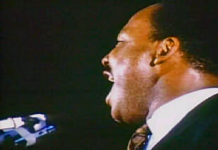
And then then there is Martin Luther King’s Mountaintop speech, delivered the day before he was killed. It too is suffused with religion. The peroration always gets me, to the point of tears:

And then I got into Memphis. And some began to say the threats, or talk about the threats that were out. What would happen to me from some of our sick white brothers?

Well, I don't know what will happen now. We've got some difficult days ahead. But it really doesn't matter with me now, because I've been to the mountaintop.

And I don't mind.

Like anybody, I would like to live a long life. Longevity has its place. But I'm not concerned about that now. I just want to do God's will. And He's allowed me to go up to the mountain. And I've looked over. And I've seen the Promised Land. I may not get there with you. But I want you to know tonight, that we, as a people, will get to the promised land!

pastedGraphic.png


And so I'm happy, tonight.

I'm not worried about anything.

I'm not fearing any man!

Mine eyes have seen the glory of the coming of the Lord!!

 
I was raised in a devout Baptist home.
But that of itself, as others will testify, does not guarantee the truth of God's existence.
There are many aspects to being convinced of the truth of God/Jesus.
There is historical - not every event in the Bible can be found via archaeology or written records but enough to convince me that it seems to have a good track record regarding accuracy.
There is of course what would be called the philosophical or theology aspects - what, why, how. The existence of ourselves and other humans. Why are we here? What do we do whilst we are here? Is there something after death? The meaning or not of life? Dow e have any significance? Etc?
Human nature - why do we behave, act the way we do? Individually? Collectively? Does good or evil exist?

I became convinced that there is a rhythm (of sorts. Hard to put into into words) to our existence, both individually and collectively, in the past, present and future.

Probably C. S. Lewis' quote "I believe in Christianity as I believe that the sun has risen: not only because I see it, but because by it I see everything else." best encapsulates my thinking.
 
I don't think we have more than 2 or 3 Christians left at this site and only one posts regularly about his beliefs. I agree with SLD that most people who are Christians or any other religion were indoctrinated by their parents, with few exceptions.
Were those raised as non-religious also indoctrinated by their parents or is it only one way?
It's only one way.

The way we know that physics is a collection of facts about reality is that everyone who learns it eventually agrees with all the other physicists about all of the central principles, and where there is disagreement, it is settled by reference to data collected experimentally. The absence of consensus is rare and ephemeral.

The way we know that religious belief is NOT a collection of facts about reality is that everyone who learns it agrees ONLY with the version they were taught, and violent disagreements about central principles are common. Where there is disagreement, it cannot be settled because the two camps each use their own separate scriptures as the reference point. The absence of consensus is common, and enduring.

Religion has schisms, and disagreements that are unable to be reconciled. Reality does not.

Many modern Western Christians try to resolve this by claiming that all religions and all sects are just looking at the same thing from different perspectives. This absurd claim doesn't bear a moment of scrutiny, and is (ironically) heretical to most other Christians and to pretty much every non-Christian religion.

Religion looks like something that is purely fictional, with different stories having different fanbases. It abjectly fails to look like a coherent and unified understanding of something real, which frankly is strong evidence that no supreme beings exist - if they did, any disagreement could readily be resolved by seeing who gets struck by lightning, and who doesn't.

If all of human knowledge were somehow destroyed, and our species were reduced to a pre-paleolithic state; And the survivors of this calamity were to rebuild over tens of thousands of years, the scientists in the new society that arose would produce a body of knowledge almost indistinguishable from our own.

Any monotheistic religions would be totally different. The polytheists would likely have some similar deities, but only insofar as they describe natural phenomena, such as having a god of thunder, or a god of fire; Or describe inevitable survival requirements, such as having a god of the harvest.

Anyone can discover how to make fire. Or wheels. Or flint axes. Or copper, bronze, steel, or aluminium. Or how to build a steam engine, or make paper, or harness oxen to a plough. Anyone can use the stars to track seasonal changes in weather. Cultures separated by uncrossable oceans independently built pyramids, not because they had some magical way to collaborate, but because it's obvious that if you pile up neatly shaped rocks in that way, you get an impressive structure that doesn't fall down for a long time.

Nobody can discover Christianity. The ONLY way to become a Christian is to be indoctrinated by the words of other Christians.

That's the difference between indoctrination and learning - learning is stuff you could have come up with in spite of never having heard it from anywhere else. Hearing it from others is more efficient than working it out from scratch, but it's not a prerequisite.

"Hey, maybe this religion stuff is just a scam!" is an idea that has independently arisen over and over again, even in societies that punish such ideas harshly.

"Hey, the ratio of a circle's circumference to its diameter cannot be expressed as the ratio of two integers!" is similarly available to be discovered independently by anyone.

"Hey, maybe some Jewish guy was executed and rose from the dead to save all mankind!" is an idea that never arises without being brought up by someone who already believes it. As is "Hey, maybe we should all go and walk seven times counterclockwise around a specific building in Mecca!".

Indoctrination is telling somebody a story, and expecting them to believe it. Refusing to tell stories and expect belief is not indoctrination, it is the absence of indoctrination.
 
J. Gould use to talk about re-running the "film" of evolution. He said that we would get something different each time because of random selection. I would hope what became the "top" species would invent science each time. Math and physics are universal.
 
I don't think we have more than 2 or 3 Christians left at this site and only one posts regularly about his beliefs. I agree with SLD that most people who are Christians or any other religion were indoctrinated by their parents, with few exceptions.
Were those raised as non-religious also indoctrinated by their parents or is it only one way?
I was raised non-religious (we did celebrate Passover but we weren't super serious about it, and the tradition always seemed odd to me). My parents never discussed politics with me. I just, y'know, read Orwell and stuff.
 
To be clear, I am unpersuaded that alien intelligences would describe the universe with the same maths or physics that we do, or even that their maths were match ours.
 
To be clear, I am unpersuaded that alien intelligences would describe the universe with the same maths or physics that we do, or even that their maths were match ours.
You think that their circles will have a ratiio of circumference to diameter that differs from pi? That their particles sould have energies not equal to their mass times the square of the speed of light?

That seems not just implausible, but impossible.

Sure, there will be differences in technique. Leibniz and Newton used very different notation and approached limits and infinitesimal values in different ways, but both variants of calculus are fundamentally similar. It would be hard to understand alien mathematics, but then, it's also hard to understand human mathematics, so...

The fundamentals must be the same, for aliens made of baryonic matter, living in our universe. Dimensionality, conservation laws, and the masses, spins, and charges of particles would remain the same, surely? How could it be otherwise?

Local rules tend to be discarded in favour of general ones; An alien race might never fall into the trap of thinking that "Nature abhors a vacuum", for example. But it remains true that a vacuum is difficult to sustain in a dense atmosphere at the bottom of a gravity well.
 
Last edited:
Were those raised as non-religious also indoctrinated by their parents or is it only one way?
Good question. I was asked - virtually forced- to read the Bible at a very young age. I was brought to services of at least a half dozen Christian churches plus a synagogue. But I was not introduced to Hinduism, Islam or atheism until much later.

When I pressured my mom for her own religious beliefs she claimed to be agnostic.
My father died while I was too young to ask. But I suppose I was indoctrinated to agnosticism, at least in the way you suggest.
I was left convinced that there was more to reality than meets the eye, but could never believe in Superman-type gods, no matter how popular they seemed to be. To this day I remain a true believer in the notion that not only more to reality than we imagine, but more than we CAN imagine. (Credit to whoever said that). I’d also bet the farm, if it was possible, that no entities such as the gods that humans have invented, exist in this universe.

So the answer to your yes/no question is yes. But what does that signify? Are our options for belief restricted by parental conditioning? Yes. Can conditioning be overcome? Also yes. But IMHO overcoming conditioning requires exercising a sort of volition that humans find unbearably uncomfortable.
 
I don't think we have more than 2 or 3 Christians left at this site and only one posts regularly about his beliefs. I agree with SLD that most people who are Christians or any other religion were indoctrinated by their parents, with few exceptions.
Were those raised as non-religious also indoctrinated by their parents or is it only one way?
I was an atheist by the time my only son was about 7. Prior to that time, after losing my Christian beliefs, I was searching for the one true religion. I never, ever told my son what to believe. I encouraged him to go with his father to Baha'i meetings. I read him Bible stories from a book for children about the Bible. I never told him I was an atheist when I finally realized there were no gods. I never told him that his step dad who treated him better than his biological father was an atheist. Then, when he was around 15, I asked him if he believed in god. He giggled and said, "NO". I laughed and said, "Neither do I". I refer to religion as mythology and he, now age 55, refers to it as fairy tales.

He is a good person, an excellent father and he puts up with a wife who has never appreciated all that he has done for her. He just refers to her as a challenge. I think she's agnostic or maybe has some Wiccan type beliefs. I don't really know because she and I have never discussed religion. I just do my best to keep the peace. I'm just glad that he seems content with his life.

My parents were evangelical converts, which made my childhood a lot more difficult. I was indoctrinated and told that all my Catholic friends would be tortured in hell if I didn't save them. How cruel is that!
 
To be clear, I am unpersuaded that alien intelligences would describe the universe with the same maths or physics that we do, or even that their maths were match ours.
You think that their circles will have a ratiio of circumference to diameter that differs from pi? That their particles sould have energies not equal to their mass times the square of the speed of light?

That seems not just implausible, but impossible.

Sure, there will be differences in technique. Leibniz and Newton used very different notation and approached limits and infinitesimal values in different ways, but both variants of calculus are fundamentally similar. It would be hard to understand alien mathematics, but then, it's also hard to understand human mathematics, so...

The fundamentals must be the same, for aliens made of baryonic matter, living in our universe. Dimensionality, conservation laws, and the masses, spins, and charges of particles would remain the same, surely? How could it be otherwise?

Local rules tend to be discarded in favour of general ones; An alien race might never fall into the trap of thinking that "Nature abhors a vacuum", for example. But it remains true that a vacuum is difficult to sustain in a dense atmosphere at the bottom of a gravity well.

This is entirely speculative, but here goes: I do not think there any “laws” of physics. I think there are descriptions of the way things seem to be that comport with our particular cognitive architecture. I suspect (but certainly do not know) that different cognitive architectures might come to very different conclusions about descriptions of how things are. More about this later, if so in a different thread.
 
Were those raised as non-religious also indoctrinated by their parents or is it only one way?
Good question. I was asked - virtually forced- to read the Bible at a very young age. I was brought to services of at least a half dozen Christian churches plus a synagogue. But I was not introduced to Hinduism, Islam or atheism until much later.

When I pressured my mom for her own religious beliefs she claimed to be agnostic.
My father died while I was too young to ask. But I suppose I was indoctrinated to agnosticism, at least in the way you suggest.
I was left convinced that there was more to reality than meets the eye, but could never believe in Superman-type gods, no matter how popular they seemed to be. To this day I remain a true believer in the notion that not only more to reality than we imagine, but more than we CAN imagine. (Credit to whoever said that). I’d also bet the farm, if it was possible, that no entities such as the gods that humans have invented, exist in this universe.
I have absolute no doubt that the universe or this world contains things that will continue to astound us and we could not have imagined that or other things.
So the answer to your yes/no question is yes. But what does that signify? Are our options for belief restricted by parental conditioning? Yes. Can conditioning be overcome? Also yes. But IMHO overcoming conditioning requires exercising a sort of volition that humans find unbearably uncomfortable.
It is indeed very hard.
 
I don't think we have more than 2 or 3 Christians left at this site and only one posts regularly about his beliefs. I agree with SLD that most people who are Christians or any other religion were indoctrinated by their parents, with few exceptions.
Were those raised as non-religious also indoctrinated by their parents or is it only one way?
It's only one way.
That is rather convenient
Indeed. The truth often is, unless you have a false agenda to push.
 
To be clear, I am unpersuaded that alien intelligences would describe the universe with the same maths or physics that we do, or even that their maths were match ours.
You think that their circles will have a ratiio of circumference to diameter that differs from pi? That their particles sould have energies not equal to their mass times the square of the speed of light?

That seems not just implausible, but impossible.

Sure, there will be differences in technique. Leibniz and Newton used very different notation and approached limits and infinitesimal values in different ways, but both variants of calculus are fundamentally similar. It would be hard to understand alien mathematics, but then, it's also hard to understand human mathematics, so...

The fundamentals must be the same, for aliens made of baryonic matter, living in our universe. Dimensionality, conservation laws, and the masses, spins, and charges of particles would remain the same, surely? How could it be otherwise?

Local rules tend to be discarded in favour of general ones; An alien race might never fall into the trap of thinking that "Nature abhors a vacuum", for example. But it remains true that a vacuum is difficult to sustain in a dense atmosphere at the bottom of a gravity well.

This is entirely speculative, but here goes: I do not think there any “laws” of physics. I think there are descriptions of the way things seem to be that comport with our particular cognitive architecture. I suspect (but certainly do not know) that different cognitive architectures might come to very different conclusions about descriptions of how things are. More about this later, if so in a different thread.
Physicists would agree that the laws of physics are simply descriptions.
 
Back
Top Bottom