steve_bank
Diabetic retinopathy and poor eyesight. Typos ...
In the morning news a chunk of a glacier broke off blockIng water flow and it quickly backed up.
Scientists spent the first weeks of the year on an expedition to Antarctica to study Thwaites Glacier, which is melting at an alarming rate. If it breaks apart entirely, it could push up global sea levels by two feet over the course of several decades, affecting tens of millions worldwide, according to a New York Times analysis.
The maps below show some of the coastal cities at risk and populated, low-lying areas that could be threatened if the glacier were to collapse today.
In city after city, the Times’s analysis found that heavily populated areas tend to be near the coasts, as opposed to higher, safer areas.
Shanghai, one of the major cities under threat, already has more than 600,000 residents living below sea level. If average sea levels rose two feet, an additional 4.7 million people would be affected.
These are just the minimum effects that Thwaites’s disintegration would be likely to have on the world’s coastlines. As the glacier breaks apart, global warming will raise sea levels even higher by melting the ice from Greenland and causing oceans to expand in volume. And Thwaites acts as a plug, holding back many of the Antarctic glaciers on land around it. If it collapses, they could break apart and spill into the sea as well.
“Eventually it would take out all of the West Antarctic,” said Richard Alley, a professor of geosciences at Penn State.
Seaside cities all over the world are at risk, but the threat is especially acute in Asia, and includes some of the world’s fastest-growing urban areas, as the map below shows:
Jokulhlaup. Icelandic for this. My old hometown, Juneau has been getting one every August for the last several years.It has been reported before in the Himalayas. Villages swept away
Ice melts creating a lake on or under the ice. Ice dam breaks creating a flood.
Leaned a new term today.
A glacial lake outburst flood (GLOF) is a sudden and catastrophic release of a large volume of water stored in a glacial lake.
I hear the mosquitos up there can drain a moose of blood. They grab a moose and fly away with it.Jokulhlaup. Icelandic for this. My old hometown, Juneau has been getting one every August for the last several years.It has been reported before in the Himalayas. Villages swept away
Ice melts creating a lake on or under the ice. Ice dam breaks creating a flood.
Leaned a new term today.
A glacial lake outburst flood (GLOF) is a sudden and catastrophic release of a large volume of water stored in a glacial lake.
That's mainly in the interior. Juneau is in the Southeast pan handle." No see ms" are a bigger problem. Alaska is A Very Large place. Lots of different climates.I hear the mosquitos up there can drain a moose of blood. They grab a moose and fly away with it.Jokulhlaup. Icelandic for this. My old hometown, Juneau has been getting one every August for the last several years.It has been reported before in the Himalayas. Villages swept away
Ice melts creating a lake on or under the ice. Ice dam breaks creating a flood.
Leaned a new term today.
A glacial lake outburst flood (GLOF) is a sudden and catastrophic release of a large volume of water stored in a glacial lake.
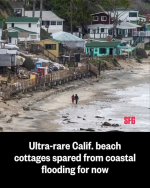
The article I'm going to link was from earlier this year, but it does describe the large risk of flooding in coastal areas, including some in Southern California.
AI Overview
The average elevation of Long Island, New York, is about 138 feet (42 meters) above sea level, though most of the terrain sits between 100 and 300 feet.
Long Island is not literally a sandbar, but it is a glacial landform made mostly of sand, gravel, and rock.
Texas.Long Island will not completely go under water in the near future, but low-lying coastal areas and parts of the South Shore face severe permanent flooding and erosion by the end of the century (around 2100).
Several coastal Washington Native American tribes are actively moving their villages and infrastructure to higher ground to escape rising sea levels, severe storms, and tsunami risks.
The Port of Los Angeles faces rising sea levels through increased risks of coastal flooding, high tides, and storm surges that threaten local infrastructure.
Melting land ice and thermal expansion are the two primary drivers of global sea level rise, collectively accounting for roughly two-thirds of the total rise in recent decades.

It had like, a mile of ice on it not too long ago.AI Overview
The average elevation of Long Island, New York, is about 138 feet (42 meters) above sea level, though most of the terrain sits between 100 and 300 feet.
I have relatives in Mastic Beach. Before sea level rise the Long Island Atlantic coast had a problem with flooding and erosion. Hurricanes.
Long Island is not literally a sandbar, but it is a glacial landform made mostly of sand, gravel, and rock.
I hope the data centers survive all these changes!
Texas.Long Island will not completely go under water in the near future, but low-lying coastal areas and parts of the South Shore face severe permanent flooding and erosion by the end of the century (around 2100).
Several coastal Washington Native American tribes are actively moving their villages and infrastructure to higher ground to escape rising sea levels, severe storms, and tsunami risks.
Same in Alaska.
You may quibble over cause, it is upon us now.
The Port of Los Angeles faces rising sea levels through increased risks of coastal flooding, high tides, and storm surges that threaten local infrastructure.
Same with Seattle and Tacoma.
It ain't rocket science. A degree increase in ocean water temperature causes tehermall expansion, volume increases.
Basic physics.
Melting land ice and thermal expansion are the two primary drivers of global sea level rise, collectively accounting for roughly two-thirds of the total rise in recent decades.
The environment is warming, it is mensurable. You can again argue causation but it is happening.
The earth warms and cools, Steve.
It was a catastrophic 80f in Santa Monica earlier.


If Steve cautioned you against jumping from the top of the Empire State Building, would you mock his caution on the basis that loads of people have descended from that location to street level with no injuries at all; Or might you consider that descending in the elevator is substantively different from jumping off the building, because the descent speed (and thus the street-level deceleration rate) is significantly higher in the latter case, despite the distance and direction being identical?The earth warms and cools, Steve.
We've tried to explain this to him many times, but he's hopeless. Then again, what can we expect from someone who voted for the cruel, mentally deranged felon who is president of the US?If Steve cautioned you against jumping from the top of the Empire State Building, would you mock his caution on the basis that loads of people have descended from that location to street level with no injuries at all; Or might you consider that descending in the elevator is substantively different from jumping off the building, because the descent speed (and thus the street-level deceleration rate) is significantly higher in the latter case, despite the distance and direction being identical?The earth warms and cools, Steve.
In all of human history, the world has never warmed this FAST.
On those much more distant occasions in the past where temperature has changed this fast, that rapid change has been accompanied by the extinction of all land animals larger than rats.
Are you larger than a rat? If so, you probably shouldn't be so dismissive of this very real threat.
Mr TSwizzle, if not climate science exactly what makes you think climate has always changed?


The article I'm going to link was from earlier this year, but it does describe the large risk of flooding in coastal areas, including some in Southern California.
lol, beach front property in SoCal goes for millions of dollars. More property was lost in the Palisades fire than has ever been lost to the boogeyman sea level rise.
I wish I could afford a property on the coast, I’d buy it in a heartbeat.
One of the great things about Oregun is you can't own a beach. There are setbacks for structures. Some of this comes from what happened in the 1964 storm. And if you own property near a beach, you must give access to the beach.
In the 70's the saying was "don't Californicate Oregon"
The ice caps aren't in places to do this kind of damage.It's very sad and I also read this morning that it's likely there will be more of this type of flooding due to the ice caps melting. I'll see if I can find that article.Looks like someone beat me to this article.
This flood was quite something else. Not quite biblical, but a catastrophic flash flood in which reaction for some wasn't even an option. The glacier incident resulted in a 4.4 scaled earthquake. When I saw the video, my first presumption was a dam failed.
The thing is nobody lives right at sea level anyway. The danger is how far the storm surge comes--and that will be amplified by the water being warmer, meaning more powerful storms. And an awful lot of people live just above that storm surge limit. We already have some mega engineering projects to close off coastal cities when the storms come--and those are in the places lucky enough to provide terrain that permits such things.The article I'm going to link was from earlier this year, but it does describe the large risk of flooding in coastal areas, including some in Southern California.
lol, beach front property in SoCal goes for millions of dollars. More property was lost in the Palisades fire than has ever been lost to the boogeyman sea level rise.
I wish I could afford a property on the coast, I’d buy it in a heartbeat.