• Welcome to the Internet Infidels Discussion Board.

MCATs, Affirmative Action, and DEI, Oh My

My argument further is that most of the fees for visits to physicians do not go into the pockets of physicians but are used to defray the costs of the practice, including debt, staff salaries and benefits, equipment t and supplies, etc.
Nobody has disagreed with you about this. It is still a fact, however, that AFTER all of those other costs of the practice, facilities, equipment, staff... they STILL take home ~$200K a year in income.

If they can't manage to pay their own loans with that level of income, that's a problem with their budgeting skills.
So? So do a lot of people, without doing nearly as important service to society.

AFAIK, physicians do not default on student loans.

It is my considered belief that NO ONE should graduate with enormous student loans debt.
 
Education is a public good. It benefits all of society to have an educated populace who are able to contribute more to society abd who are able to make better more reasoned decisions.
Education is, in general, a public good. That does not mean that there are not some big problems with the educational system in the US, some of which I addressed above. But that is an issue for another thread.

More narrowly though, I do not think taxpayers should pay off student loans for physicians who are already an extremely well compensated profession.
 
  • Like
Reactions: WAB
What is this thread about? :unsure:

Since it's all over the place, let me add a bit. First of all, I looked up the average age for when a doctor starts to practice and it's between 25 and 29, hardly middle age.
What do you mean by "practice"? That age range suggests finishing med school and entering residency. It is still 3-7 years before a physician can practice independently - three for primary care specialties like family and internal medicine, seven years for something like plastic or neurosurgery.
Of course that varies as I read about an NP recently who wanted to become an MD and she was just accepted to medical school at age 70.
Kind of a waste of resources, if true. Med school is four years, shortest residencies are three. She'd be 77 by the time she's done.
I despise most doctors. I prefer an NP for primary care and I've only known two who weren't very competent.
NPs and other noctors get far less education in medicine though. Not even close.
Also, doctors don't heal anyone. They give advice and write prescriptions.
Depends on the problem. But yes, unfortunately, many medical problems are treatable, but not curable. Take HIV. Modern medicines can give people decades of normal lives, and drive their viral load down to undetectable, but they cannot cure the infection because of how HIV and other retroviruses work. Same with DNA viruses like herpes; you can't cure them, although herpes is luckily far less serious.
And it's not like NPs or, I don't know, shamans, can cure those conditions either.

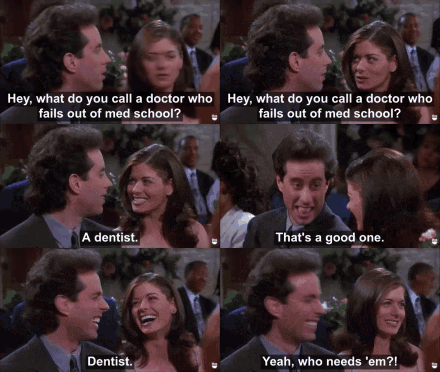
My bro in law is a dentist and he's not that smart, despite taking all those science courses required for his dental degree from Emory. He voted for Trump twice. Is that enough evidence to support my claim that's he's not that bright?
What are you? An antidentite?
antidentite-seinfeld.gif
 
Last edited:
Education as a concept has value, but degree inflation is a problem. Tuition has far outpaced the value of a degree, and many degrees aren’t in and of themselves valuable.
This idea of "degree inflation" is an important one, and I addressed it above. In the US we have this idea that everybody should be able to go to college, no matter their prior academic achievement or general aptitude. But that would lead to most students failing out, so many colleges have greatly watered down the rigor of their programs.
 
A $100,000 loan at the standard interest rate and at the required 8 year term comes out to over $1,400 per month. $200,000 is over $2,800. Both figures are way more than most people's house payments.
Standard repayment is 10 years, not 8. And with income driven repayment, residents do not pay nearly the full repayment amount until they finish and become attendings with high salaries. That can also extend the repayment schedule a few years.
 
Last edited:
Adding to this:
AI slop aside:
  1. Fresh out of residency physicians do not usually start practices, but get jobs at established practices, or increasingly, large systems like Emory.
  2. If they want to establish a private practice a few years later, I do not think I have ever seen a true solo practice. More realistic is a small group practice with a few physicians. Most of the costs your AI tool spat out can thus be shared, and doctors can take days off and vacations without the practice being closed.
 
I don’t think anyone should have to take out any loans in order to pursue a university or college degree.
Just public universities, or also private ones?
That's what AOC wants: AOC: Everyone should have student loans canceled—including Harvard and Yale grads

And as I already wrote, everything is a tradeoff. Countries where tuition is free or low also have higher requirements to enter university. Take Germany. No tuition for a normal course of university study, but you either have to do well enough in 4th grade to go to the Gymnasium and graduate with an Abitur, or you go to Realschule and then Fachoberschule. Contrast with the US, where many colleges will take you while being functionally illiterate and/or innumerate and offer you remedial classes, like sub-algebra math.
Also, campuses at German universities tend to be less fancy than those at their US counterparts.
 
I don’t think anyone should have to take out any loans in order to pursue a university or college degree.
Just public universities, or also private ones?
That's what AOC wants: AOC: Everyone should have student loans canceled—including Harvard and Yale grads
The GI Bill that paid for college did not distinguish between private and public institutions.

There is a distinct difference between thinking no one should have to take out loans and canceling student debt.
 
I don’t think anyone should have to take out any loans in order to pursue a university or college degree.
Just public universities, or also private ones?
That's what AOC wants: AOC: Everyone should have student loans canceled—including Harvard and Yale grads

And as I already wrote, everything is a tradeoff. Countries where tuition is free or low also have higher requirements to enter university. Take Germany. No tuition for a normal course of university study, but you either have to do well enough in 4th grade to go to the Gymnasium and graduate with an Abitur, or you go to Realschule and then Fachoberschule. Contrast with the US, where many colleges will take you while being functionally illiterate and/or innumerate and offer you remedial classes, like sub-algebra math.
Also, campuses at German universities tend to be less fancy than those at their US counterparts.
IMO, private universities already get enough government t subsidies.

My hesitation is that it would further put Harvard, etc. out of reach of students from more modest backgrounds.

FWIW, I don’t think that the Ivies truly provide a superior education. However they do provide invaluable contacts among the elite. And a certain eclat that dues not necessarily prove advantageous everywhere.
 
A $100,000 loan at the standard interest rate and at the required 8 year term comes out to over $1,400 per month. $200,000 is over $2,800. Both figures are way more than most people's house payments.
Standard repayment is 10 years, not 8. And with income driven repayment, residents do not pay nearly the full repayment amount until they finish and become attendings with high salaries. That can also extend the repayment schedule a few years.
And those student debts affect credit scores and the ability to obtain a mortgage or car loan.
 
A $100,000 loan at the standard interest rate and at the required 8 year term comes out to over $1,400 per month. $200,000 is over $2,800. Both figures are way more than most people's house payments.
Standard repayment is 10 years, not 8. And with income driven repayment, residents do not pay nearly the full repayment amount until they finish and become attendings with high salaries. That can also extend the repayment schedule a few years.
Yes, you are correct. That was changed early this year.
 
I see education as a public good, just as police and fire departments and hospitals and highways and streets and the maintenance of such. Not just public good but a public necessity.
Here we need to back up a little, as terms such as "public good" have a specific definition. A defining feature of a "public good" is that it is non-excludable and non-rivalrous. An educational institution, even a public one, has a limited number of spots and also has admissions criteria, so by definition is it not a public good.

That said, I agree that education as well as things like healthcare and roads/transportation are necessary for a society to function. That does not mean that any way to implement is automatically good. For example, roads/bridges "to nowhere" are not a good allocation of finite public resources. Law enforcement and judiciary are likewise necessary, but entrapping consenting adults with prostitution stings is a waste of both police and court resources, as well as highly damaging to people ensnared in those useless stings/prosecutions.

As such, I support funding education much better than we do currently.
US does not even spend little on tertiary education.
screen-shot-2019-04-26-at-125649-pm.png

From here. We spend a little more than countries like France, Germany and even Canada. And most of the countries that spend more do not spend that much more. The issue is more of how the money is spent. I do not think colleges should take in pretty much anyone and then offer remedial math and English classes to people who do not belong in higher education. That's also a waste of resources.

Again, Germany may offer tuition-free university, but they are also more restrictive in who gets to go to university.
As for student loans: I’d like to see them become less necessary and interest free.
How about some kind of interest rate subsidy or cap?
 
Last edited:
And those student debts affect credit scores and the ability to obtain a mortgage or car loan.
I never heard of a physician not qualify for a car loan or mortgage just because they had a student loan.
What's important is debt to income ratio. Also, different loans are looked at differently by credit bureaus. $200k in student loans is looked at differently than even a much smaller amount of credit card debt.
 
It sounds to me like you are making the exact error that led to the planned economies of Eastern Europe in the C20th -
It's not like governments forgo planning even in capitalist countries. For example a road network, or public transit have to be planned long term.
When it comes to tertiary education, if we do not want it to be completely market based (through private loans or some kind of income share agreement with a funder) there needs to be some kind of planning. Because the alternative is just giving student loans blindly without considering the likely ability to pay it back. Even if you want to go tuition-free, there also needs to be planning. You don't think Germany plans how many seats they want to offer for different courses of study? German universities are not free-for-alls. Far from it.
I think Emily is right that there should be restrictions. A medical degree should have a much higher borrowing limit (Trump administration restricted in way too much) for federal loans than pursuing a graduate degree in something that does not have a good earning outlook. Those interested in the less lucrative fields can do whatever they can to limit their education expenses - for example by not going to that expensive private liberal arts college - and take jobs like TAing and GTAing.
It does not mean that people seeking a PhD in English Lit should not get any student loans, but there should be some consideration of likely career paths and income.
 
Last edited:
No, not at all. You are the person who thinks only certain degrees should be funded by the state.
I don't think she is. I think her concern is about the number of certain degrees.

We need some English Lit PhDs. But probably significantly fewer than universities are graduating at the moment.
A few years ago we had a thread about PhDs working poorly paid adjunct professor jobs. A big reason for it is the oversupply - all those people got their PhD in the hope of using them to teach in college. Except there are too many of them, so universities hire them as adjuncts teaching a few courses each.

Do you not think that oversupply of any major should be discouraged?
 
Back
Top Bottom