• Welcome to the Internet Infidels Discussion Board.

“Generative AI is a sack of wet garbage”

They built the world’s most powerful AI. They’re facing a mystery they can’t explain.

Anthropic, Google and Meta have over the past year hired computer scientists, neuroscientists and philosophers to study concepts like the welfare of AI models or whether chatbots have forms of emotion. AI companies are collaborating with nonprofits, researchers and academic centers, who warn of an ethical crisis if the digital helpers used by millions of people for homework, coding, office work and therapy one day begin to feel that they hate their job.

The resources being spent on investigating AI consciousness are tiny compared with conventional research and development, but tech companies are openly venturing into controversial territory.

Anthropic, maker of the Claude chatbot, has formed an AI psychiatry team to probe the inner states of its AI models and publishes assessments of their welfare and preferences. The company introduced the idea that chatbots may have feelings to a new audience in May, when co-founder Chris Olah appeared alongside Pope Leo XIV at the release of the pontiff’s encyclical on artificial intelligence.

“We keep finding things that are mysterious, even unsettling,” Olah said of Anthropic’s AI systems. “We find evidence of introspection [and] states that functionally mirror joy, satisfaction, fear, grief and unease.” (Leo took a different stance, writing that “so-called artificial intelligences do not undergo experiences.”)
Worth a read.
 
"Don't Hang Up On AI Scammers. Do THIS Instead."
Captain Kirk's "not what" trick actualy working.
"... Albuquerque, New Mexico...Albuquerque, New Mexico...Albuquerque, New Mexico...Albuquerque, New Mexico...Albuquerque, New Mexico..."
 
Last edited:
Tha
"Don't Hang Up On AI Scammers. Do THIS Instead."
Captain Kirk's "not what" trick actualy working.
"... Albuquerque, New Mexico...Albuquerque, New Mexico...Albuquerque, New Mexico...Albuquerque, New Mexico...Albuquerque, New Mexico..."


Thanks, that is awesome.
 
This vid reminded me of two comic bits. Maybe Abbot & Costello, Maybe James T Kirk. I'm confused.
A&C? I think:
"Good day sir, what is your name?"
"...What?"
"Good day Mr. What, I'm calling today because... "
"No, no, my name is not what ..."
"I'm sorry Mr. Not What, I'm calling today Because... "
And it gets worse from there.
--------------------
And the other one from Star Trek, I think:
Kirk tells a robot "I'm a compulsive lier. Everything I say is a lie."
"Listen closely. I am lieing right now."
And the robot ties itself in a knot, sorting it out.
I wonder how AI would parse the statement, "My car is so bad. It's the shit."
 
This vid reminded me of two comic bits. Maybe Abbot & Costello, Maybe James T Kirk. I'm confused.
A&C? I think:
"Good day sir, what is your name?"
"...What?"
"Good day Mr. What, I'm calling today because... "
"No, no, my name is not what ..."
"I'm sorry Mr. Not What, I'm calling today Because... "
And it gets worse from there.
--------------------
And the other one from Star Trek, I think:
Kirk tells a robot "I'm a compulsive lier. Everything I say is a lie."
"Listen closely. I am lieing right now."
And the robot ties itself in a knot, sorting it out.
Kirk's use of the liar's paradox to break the robot in Star Trek season 2, episode 8 "I, Mudd" in 1967 was far from a new idea at the time, though it likely was that use that brought it to a mass audience.

Asimov first employed it to break a computer in SciFi in his 1947 short story Liar, and I have always assumed that the title of the Star Trek epidode was a nod to Asimov's I, Robot, in which that short story appears.

The parodox itself is first attributed to Eubulides of Miletus, back in the 4th Century BCE, when he wrote "A man says that he is lying. Is what he says true or false?".
 
Last edited:
This vid reminded me of two comic bits. Maybe Abbot & Costello, Maybe James T Kirk. I'm confused.
A&C? I think:
"Good day sir, what is your name?"
"...What?"
"Good day Mr. What, I'm calling today because... "
"No, no, my name is not what ..."
"I'm sorry Mr. Not What, I'm calling today Because... "
And it gets worse from there.
--------------------
And the other one from Star Trek, I think:
Kirk tells a robot "I'm a compulsive lier. Everything I say is a lie."
"Listen closely. I am lieing right now."
And the robot ties itself in a knot, sorting it out.

Only it was Mudd who told the robots he was lying. Not Kirk.
 
This vid reminded me of two comic bits. Maybe Abbot & Costello, Maybe James T Kirk. I'm confused.
A&C? I think:
"Good day sir, what is your name?"
"...What?"
"Good day Mr. What, I'm calling today because... "
"No, no, my name is not what ..."
"I'm sorry Mr. Not What, I'm calling today Because... "
And it gets worse from there.
--------------------
And the other one from Star Trek, I think:
Kirk tells a robot "I'm a compulsive lier. Everything I say is a lie."
"Listen closely. I am lieing right now."
And the robot ties itself in a knot, sorting it out.
Kirk's use of the liar's paradox to break the robot in Star Trek season 2, episode 8 "I, Mudd" in 1967 was far from a new idea at the time, though it likely was that use that brought it to a mass audience.

Asimov first employed it to break a computer in SciFi in his 1947 short story Liar, and I have always assumed that the title of the Star Trek epidode was a nod to Asimov's I, Robot, in which that short story appears.

The parodox itself is first attributed to Eubulides of Miletus, back in the 4th Century BCE, when he wrote "A man says that he is lying. Is what he says true or false?".
What he is saying is either "badly formed; a non-statement; a syntax error", or not true or false, but nonsense.

A presumptive statement can contain a syntax error.

That statement contains the syntax error of "circular reference in assignment"; A statement cannot dictate its own truth. Only the other axioms can determine whether the statement is true.

This is for the same reasons that "a system of axioms that declares the truth of its own axioms can prove anything". I would say that any reference of truth or falseness of an axiom, especially that selfsame axiom that is the new statement of about that statement, is such an action.

I could swear I have even seen several discussions now about this, and in at least some of them, this whole thing has been brought up and not by me, perhaps not for this reasoning or this way, but nonetheless directly brought up as "that's a wrong use of language".

It's difficult to produce a more distinctly wrong/nonsensical way to use language than such, or a more clearly problematic one.
 
The answer to Eubulides' question: "A man says that he is lying. Is what he says true or false?" is simple:

"No".

What he is saying is neither true nor false. And this reveals that "true vs false" is a false dichotomy; Other categories exist.
 
The answer to Eubulides' question: "A man says that he is lying. Is what he says true or false?" is simple:

"No".

What he is saying is neither true nor false. And this reveals that "true vs false" is a false dichotomy; Other categories exist.
A presupposition is a proposition that must be true in order for a speech act to come off successfully. Most of these logical paradoxes involve presupposition failure of one sort or another. For example, the statement "The king of France is bald" can only be true or false if the proposition that the king of France exists is true.

Symbolic systems of logic and mathematics are interesting in that they do not have any way to handle presuppositions. Hence, you cannot really translate natural speech acts like statements into complete representations of their meaning. You end up building enormously complex representations when you try to express all of the presuppositions that render a statement in a conversation meaningful.
I disagree. The statement is specifically a circular reference, and it's clearly an error.

It's not that logic has no way to handle or, so much as logic DOES have a way to handle it: to report it as an invalid statement in a system capable of making invalid statements -- of indicating that it wasn't a use of language at all.

This is how the situation is handled in every formal compiled language in the history of formal compiled language capable of actually (and automatically) rendering statements to their full material complexity.

"That's not actually a statement, it's just a vaguely statement-shaped piece of nonsense and mere sounds".
Quoth the Robot, "Does not compute."
 
The answer to Eubulides' question: "A man says that he is lying. Is what he says true or false?" is simple:

"No".

What he is saying is neither true nor false. And this reveals that "true vs false" is a false dichotomy; Other categories exist.
A presupposition is a proposition that must be true in order for a speech act to come off successfully. Most of these logical paradoxes involve presupposition failure of one sort or another. For example, the statement "The king of France is bald" can only be true or false if the proposition that the king of France exists is true.

Symbolic systems of logic and mathematics are interesting in that they do not have any way to handle presuppositions. Hence, you cannot really translate natural speech acts like statements into complete representations of their meaning. You end up building enormously complex representations when you try to express all of the presuppositions that render a statement in a conversation meaningful.
I disagree. The statement is specifically a circular reference, and it's clearly an error.

It's not that logic has no way to handle or, so much as logic DOES have a way to handle it: to report it as an invalid statement in a system capable of making invalid statements -- of indicating that it wasn't a use of language at all.

This is how the situation is handled in every formal compiled language in the history of formal compiled language capable of actually (and automatically) rendering statements to their full material complexity.

"That's not actually a statement, it's just a vaguely statement-shaped piece of nonsense and mere sounds".

You were quick to disagree without specifying exactly what I said that you disagreed with. If you think that formal or mathematical logic has a way to represent presuppositions without getting bogged down in enormously complex representations, then explain how they do so. Note that I was not claiming that presuppositions were computationally intractable, only that logical symbolic formulae must render all presuppositions explicit. They are not part of the semantic representation of a linguistic signal, because they represent contexts under which the signal is produced and comprehended. So you can't actually use symbolic logic to fully represent the meaning of natural language utterances. Linguists actually tried to do something like that back in the 1970s and 1980s with so-called generative semantic theory. I was part of that movement, and I can say both that it failed miserably and why it failed miserably. Attempts to build presuppositions into meaning representations were the problem.
"Complex representations" are not the problem.

I am claiming that this has nothing to do with the problem of presupposition in the first place.

"missing or invalid reference" is computationally distinct from "circular reference" here.

You repair a missing or invalid reference by defining the reference.

You repair a circular reference by deleting the statement entirely.

"This statement is false" is a circular reference, or more rather "axiomatic declaration about the axioms". It's not allowed because such systems trivialize and allow proving false true and other such silly things, as opposed to searching for a term and just not knowing what it means

You are right back to missing bilby's point--that declarative statements need not be either true or false. They can simply lack a binary truth value. Outside of some discourse context, no statement has a truth value. For example, the declaration "The present king of France is bald" could be true or false in a historical or fictional text, but it lacks a truth value in the context of the real world. Likewise, the statement "This statement is false" has no inherent truth value until you supply a context to give it one.

Circularity appears to be the problem at first blush, but there are self-referential statements that actually have a binary truth value in the real world. The circular self-referential statement "This sentence is itself in the form of a declarative sentence" is trivially true. It is a tautology. The circular statement "This sentence is itself in the form of a question" is trivially false. It is a contradictory statement.

So statements can, in fact, lack a truth value under a variety of circumstances where there is a presupposition failure. The failure in the case of the famous liar's paradox, is in the loaded question that follows it. The question is loaded with the presupposition that the sentence has a truth value. Is it true? If yes, then it must be false. Is it false? If yes, then it must be true. Self-reference may seem like a special circumstance that leads to a paradox, but only when the self-referential presupposition is about binary truth values.

In the 1950s, the Ordinary Language philosopher J.L. Austin wrote a seminal monograph How to Do Things with Words on the subject of presupposition failure in speech act theory, although he did not refer to it under that label. He described speech contexts in terms of "happiness conditions" that had to be true in order for a speech act to carry off. Linguistic philosophy in the 20th century split into two branches--Ideal Language (IL) philosophy and Ordinary Language (OL) philosophy. Both branches of linguistic philosophy blamed natural language usage for being the problem that created paradoxes like the liar's paradox. IL philosophers like Bertrand Russell and the early Wittgensein felt that the best way to eliminate such paradoxes would be to translate them into a symbolic language that prevented their occurrence. OL philosophers like the later Wittgenstein and J.L. Austin felt that the paradoxes arose from the unordinary use of language by philosophers. They could be resolved by excluding unordinary usage in natural language.
 
Last edited:
You are right back to missing bilby's point--that declarative statements need not be either true or false. They can simply lack a binary truth value
No, I'm pretty sure I agreed to that part quite vigorously. The part I engaged with and expanded on was exactly the part that I cared to actually mention: that sometimes the application of language doesn't just lack a binary truth value, sometimes it is a completely invalid construction of language, a syntax error.

The present king of France is bald" could be true or false in a historical or fictional text, but it lacks a truth value in the context of the real world
And it can lack a truth value for two different reasons, one because it is lacking a truth value owing to not even really being a valid application of language and one owing to not being a complete application of language and these are different situations.

"This sentence is itself in the form of a declarative sentence" is trivially true
Tautologies are circular references that don't make the obvious mistake. Such statements can prove anything, including that true is false, and rather isn't the sort of circular reference being referenced. The existence of tautologies doesn't counter the existence of nonsense, and aren't what I was talking about. Apparent tautologies still need to actually be tested and cannot be taken for "true" except in the presence of other axioms which test them AFAIK.

Presupposition failures are missing references, which is distinct from the problem of assigning inconsistent truth values to constants.

Then, I would assert that absolutely nothing that those who deal in with spoken language have discovered that software engineers have missed, mostly because software engineers actually have to make sure their invocations of language are complete every time, and made various machines that both discover invalid uses and flag them as both illegal and "dangerous", but when the compiler does this, it has a myriad of different reasons, not just "this symbol is not defined".

I do not think, though, that paradoxes arise from "unordinary" or "informal" language use but from "invalid language use". It's not a problem that can be resolved by making the language ordinary or ideal, and can only be resolved by not saying nonsensical things, and by not invoking disagreements of axioms.

It seems very much that the dispute between ordinary and ideal language proponents is misplaced, because the "ordinary language" seems very much to be proclaiming their "ordinary" notions which they assert, if held to, would prevent such paradoxes when this is no different from proclaiming "natural language" somehow ideal all on its own.

Either way, they're both wrong, because such paradoxes involve saying something nonsensical and just not catching it, and which version of language you use doesn't matter when ANY version of language can be used to express nonsense statements that cannot produce an answer in the target regime, and I think this butts up against an issue I recently came aware of called "nomic exclusion", which I'm not really actually interested in discussing much.

 
The answer to Eubulides' question: "A man says that he is lying. Is what he says true or false?" is simple:

"No".

What he is saying is neither true nor false. And this reveals that "true vs false" is a false dichotomy; Other categories exist.
A presupposition is a proposition that must be true in order for a speech act to come off successfully. Most of these logical paradoxes involve presupposition failure of one sort or another. For example, the statement "The king of France is bald" can only be true or false if the proposition that the king of France exists is true.

Symbolic systems of logic and mathematics are interesting in that they do not have any way to handle presuppositions. Hence, you cannot really translate natural speech acts like statements into complete representations of their meaning. You end up building enormously complex representations when you try to express all of the presuppositions that render a statement in a conversation meaningful.
I am sure those statements are true and make sense to someone.
 
Ok, so, today I threw 20 bucks at Claude for a month of Pro plan (mostly because the message limits are higher) and am starting to want my money back.. not because it's incapable of doing the work, but because they seem very keen on making me spend more than 20 bucks for it.

I'm actually pretty impressed with that one, if not with how little I can actually do on it before rate limits hit and they try and sell me credits.

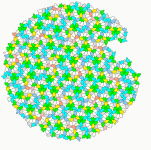
I've been working on a project where I want to put together a series of images based on Spectre fields like the one I attached (which was generated by Claude with a python script).

1000003096.png

The goal is to do some fun stuff with the shape, namely to make some conclusions about "super-deterministic systems", which are apparently less about what the system does over time and are more about what you did to get a field on which a "system of change" can legally operate.

By "system of change", I mean something like the following:

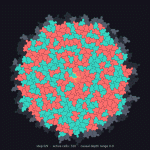
1000003098.gif
In this, a system has (ostensibly) been set up to make each tile act as a gate on the surrounding tiles, and changing its color depending on what happens. I'm not even sure what regime of change is applied, or whether it satisfied my requirements, though; I was just wanted visualizations of the shit that people here accuse me of word salad trying to describe!

Because each iteration for a tile requires previous-step border information, the evolution of reference frames "erodes" the available information until the emulation stops, however this isn't a problem for a "complete field" because there would be no "edge" to "freeze out" from (this was largely the goal of the prompt, to draw one of these local causalities).

ChatGPT could not even get close to this level, tripping over itself.

Ideally, I would get Claude to create a test to determine exactly how much statistical dependence exists in the structure, and to find out from various such aperiodic structures whether the titular "Tsirelson bound" tumbles out of this or some other such "aperiodic system"... But every time I have tried to prompt for this, after acquiring a workspace that has both the field and the transition/transform rules, I run out of "messages".
 
Last edited:
Back
Top Bottom