• Welcome to the Internet Infidels Discussion Board.

MCATs, Affirmative Action, and DEI, Oh My

Leftist fantasy. Doesn't make it work. Dropping students from inferior schools into superior schools doesn't help. Even as early as grade school.

I don't know how we fix early education (because so much of it is parents and community), but that's where any fix has to be. Anything done later is painting over the rust.
Really.

I know quite a number of people who attended ‘mediocre schools’ who were National Merit scholars.
A good student can be in a poor situation and can benefit from being put in a better one. But rarely were they not a good student in the poor situation.
But that’s not what you said. You said that it’s useless to take a student from a bad school and place them in a good school.

Seems to me that if a school is actually any good, it can help all students, including those who came from ‘poor’ schools. After all, children don’t choose their parents, much less their neighborhood or circumstances. Nor did their parents before them.

You are correct that early education is key. Yet we know that adults, when given opportunities to learn that they did not have as children still can learn many things. Human beings can be quite resilient.

My observation is that a great deal of how good a student someone is can be quite dependent upon expectations of that person’s abilities and talents. People often rise —or sink to meet expectations.

Often, those who are presumed to be not worth much are really only waiting for someone to see and help their promise bloom.
 
I believe the point was that the pot was calling the kettle black. That you missed the point is not ironic, even given your post 788.
You're using a racist metaphor -- it's implying there's something wrong with being black. For shame! [/Politesse]
This one's racially based?? I thought "black" in this case was dirty with soot from fire.
It was a joke -- I was making fun of Poli seeing a racist lurking behind every curtain.
Only the racist ones.
 
The one thing that's a little baffling is they chose to erase the Hispanic guy, rather than the White guy in the middle. Did Hispanic males drop below even White males on the progressive stack? Or maybe they thought the Hispanic guy was also White?!

Altering the Asian girl's face had to sting a little for her. I guess AI (or the photo editor) wasn't too fond of her chubby cheeks. I kinda liked her better the original way.
How is what you describe "DEI" in any way?
That's about making things look different than they are. You've heard of the token black guy? Looks like we have a token white guy here.
How is misrepresenting the racial composition of their school expanding diversity, equity, or inclusion? In no definition of equity is "putting students in digital blackface to appease Marketing" a recommended practice. Indeed, Stanford's own ethnic studies faculty are furious about this incident. While white nationalist assholes are clearly delighted and amused. What should that tell you?
 
Bomb#20 said:
You're missing the point. It's not that the institutional mission and/or specific public-need criteria are discriminatory; it's that the schools are not measuring candidates on mission fitness and fulfilling public-need criteria. The schools are not lowering the MCAT standard a student needs to meet because he's going to work in an underserved area. They don't know if he is; this isn't Minority Report and they aren't precogs. They're using a proxy. Ability to do well in school is an important quality in medical students, so what say we check "how the demographic groups actually rank" in that characteristic, observe that it's f(school success) = { 3 if NA; 5 if Black or Hispanic; 7 if White; 9 if Asian }, and then use that to judge applicants instead of, you know, actually looking at their GPAs? You'd agree assuming an Asian has a high GPA and a NA has a lower one, as a proxy, instead of actually measuring, would be racial discrimination, yes?

The claim that evaluating mission fitness requires "precognition" or serves as a blind substitute for GPA creates a false dichotomy. Admissions committees do not throw out transcripts to use race as a proxy; they evaluate a multivariate set of inputs where GPA, MCAT, essays, interviews, (and state residency or this can be a factor) are weighed concurrently. Claiming that non-numerical evaluation is invalid because committees aren't "precogs" would logically invalidate every job interview, letter of recommendation, or holistic assessment in higher education. Furthermore, we know non-MCAT structural factors heavily influence these weights: states like West Virginia, Mississippi, and North Dakota have resident acceptance rates between 48% and 58% despite lower average MCAT scores. These schools explicitly weigh state residency and public-need missions heavily to address regional physician shortages, proving that non-MCAT criteria routinely drive acceptance rates independently of racial proxies. They do so without throwing out MCATs or GPAs.
I didn't say they do -- I was making an analogy to a hypothetical practice. My point was that you're talking about using a proxy instead of actually measuring what they want to select for, and using a racial proxy is still racial discrimination even if the thing you're trying to select for isn't.

Bomb#20 said:
No doubt you'll argue that "essays and interviews assessing a candidate's commitment to working in underserved areas" isn't a racial proxy, but what evidence is there that that's true? What do those essays and interviews actually measure? Do they measure actual mission fitness, or do they just measure race? That's something that's testable retrospectively. If in fact schools aren't racially discriminating and the MCAT discrepancy results from relying on essays and interviews to forecast mission fitness, and if that allegedly nonracial proxy accurately predicts working in underserved areas, then that implies we could take a random sample of minority doctors who work in underserved areas, and a random control group of minority doctors who don't work in underserved areas, and check what their MCAT scores were back when they were accepted into medical school -- and the control group who don't work in underserved areas should turn out to have had MCAT scores similar to those of Asian and white matriculants. Only the group working in underserved areas would have statistically gotten the benefit of the relaxed MCAT requirements.

Your proposed retrospective experiment contains a fundamental flaw regarding base-rate distributions and multivariate confounding. You cannot isolate the MCAT in a vacuum after the fact, because every doctor in that admitted cohort was accepted based on a combined threshold of GPA, MCAT, interview scores, school, geography, etc. Because the starting applicant pool for any demographic has its own baseline distribution, splitting that admitted group retroactively based on practice location will yield similar average MCATs across both subgroups.
If that's true then the proxy they use to assess mission-fitness must correlate poorly with doctors ultimately actually working in underserved areas. If we can see a systematic difference in matriculants' MCAT/GPA by race, but we can't see a systematic difference by practice location, that would seem to imply the proxy predicts race better than practice location.

I apologize for the confusion I caused by mentioning a "proxy" in my earlier posts. I was merely spitballing theoretical adcom behaviors, but I completely agree with you: using a racial proxy to predict commitment to underserved areas would be unfair and discriminatory. However, that isn't how "mission fitness" is actually implemented. I am not saying there is never discrimination. I am saying that is not what I had meant by mission fitness. Schools typically use essays, secondary applications, clinical work and interviews to directly examine a candidate's career goals and commitment to specific communities. We can see that the result of doing this holistic assessment yields a result of different MCAT means across demographics. So, it seems like it would be absurd to also have a massive national conspiracy to throw out those direct, individualized assessments in favor of a racial proxy that would be producing the same result anyway.

Regarding practice location vs racial proxy: There is a study I linked. It went through all practice locations, all race assignments from AAMC for graduates from the year ranges, and a geographic map of all 3 types of underserved areas across the US. This is how significant differences in frequencies for demographics were computed.

And regarding the formula or correlation I observed earlier with a mission fitness variable, I actually do not believe there is some universal formula applicable to each school, but rather it is something you may observe in the aggregate. Not every school has the same mission and while many mention diversity, there are specific schools with mission statements including tribal areas, rural areas, etc.

Additionally, this experiment ignores massive geographical confounders. Demographic groups do not reside evenly across the country; for example, a high concentration of Asian premed applicants reside in California, where intense in-state competition drops the overall acceptance rate to ~40.6% despite high average stats. Conversely, state schools in rural regions accept residents at much higher rates to fill local needs. Because state-level capacity and regional bottlenecking create acceptance rates that sit both well above and well below national racial averages, treating national MCAT variances as a pure function of racial preferences misses a broader structural picture that is heavily driven by public need.
That's a fair point; to properly account for it we'd need data broken down school by school. The schools typically don't release it, which is exactly what we'd expect if the state variances were the function of racial preferences that the national variances look like.

The reason schools don't publicly release all their granular data to prove this is because they are tightly bound by FERPA and liability concerns. This enforced silence unfortunately creates a vacuum where one-sided political narratives and conspiracy theories easily take root. That doesn't mean that some schools aren't hiding things, but that there is a general reason for it.

There are other things to consider besides a hypothesis of racial preferences: National racial acceptance rates are heavily distorted by regional bottlenecks and state-specific policies. For example, states with no medical schools (like Maine, Alaska, Wyoming, and some others) actually buy seats ahead of time at out-of-state schools based purely on projected need, resulting in massive variance in acceptance rates in those states.

If you compare California and Texas, the structural noise becomes obvious. In California, the in-state acceptance rate is a brutal 16.4% (7,216 applicants for 1,184 public in-state matriculants). Texas, conversely, mandates by state law that 90% of its public medical school seats go to residents and they have many more state medical school seats available, resulting in an in-state acceptance rate of 31.4%.
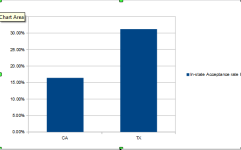
1790309496561.png

Because CA has relatively few public seats for its massive population, its residents are forced to apply to highly competitive private schools. As a result, the MCAT mean of all matriculants in CA is pushed up to 513.9, compared to TX at 512.7. Since a massive concentration of the nation's Asian applicants reside in CA, this regional bottleneck artificially depresses the national Asian acceptance rate (41.74% in CA vs. 45.17% in the rest of the US) and drives up their required MCAT mean. Throw in localized factors--like a small HBCU in California that attracts a distinct, self-selected applicant pool--and it becomes clear how easily state-level structural quirks can be both misread and impactful.

Can you post the code?

To test this mathematically, I ran a simulation of a medical school similar to the Medical College of Georgia (MCG). Interestingly, this school accepts very few non-residents (~98% are in-state), which underscores the point again about geographic enrollment constraints. Using recent data, we have about 1,821 in-state US citizen and permanent resident applicants competing for roughly 304 enrollment spots.

Even assuming every medical school applicant in Georgia applies to this school, we can use the national MCAT and GPA means and standard deviations for each racial cohort to accurately represent the baseline applicant pool.

Then, I ran a holistic admissions committee scoring algorithm on that simulated pool. I made it 100% race-blind, and to your favor, I completely excluded any "mission fitness" variables or simulated questions about SES/economic adversity. The algorithm simply uses MCAT and GPA (accounting for the fact that the two are correlated, so they aren't completely independent) and adds three other completely race-blind metrics--it doesn't matter if they represent transcripts, recommendations, clinical work, community service, secondary essays, or interviews. That is 5 metrics weighted equally. ZERO "mission fitness," meaning no evaluations about where someone's career might take them (which would naturally give a fair aggregate advantage to Black and Hispanic applicants over White and Asian applicants). Just a pure, strictly race-blind holistic score.

The result? Black applicants still get accepted. Hispanic applicants still get accepted. And a significant gap between their MCAT means still naturally emerges. For example, Asian matriculants can still have a 7.0+ higher MCAT mean over Black matriculants even under a strictly race-blind admissions algorithm.
... It is ultimately why Bomb#20 doesn't even need my source code--he could write this simulation himself in five minutes. Let's look at the math here. We have a number of parameters (p1, p2, ... pn) normalized to decimals between 0 and 1, weighted evenly into an average:
Score = 1/n*(p1 + p2 + p3 + ... + pn)

If p1 is the MCAT, adding more parameters ( n ) mathematically dilutes the correlation between p1 and the final score. As n approaches infinity, the correlation between the MCAT and the final score approaches zero. ...
I did write a simulation myself in five minutes, and then I tuned its parameters until it approximated the applicant and matriculant statistics in the table linked upthread, at which point it clearly showed Asian students needed higher MCATs than NA students to have the same chance of admission*. It sounds like your simulation by construction makes that impossible, so I asked for your code to see if your model also reproduces the statistics in the table. If you don't want to post it I can work from your description, no worries. Three questions then: How did you account for MCAT and GPA being correlated? What were the standard deviations of your other simulated parameters? And did you also use normal distributions for your other simulated parameters? (The AAMC constructs the MCAT to be normally distributed.)

Here's the thing. What you said makes sense -- as n goes to infinity, the difference in mean MCAT scores between Asian and Black matriculants will naturally approach the difference in mean MCAT scores between Asian and Black applicants, so if you saw 7.0+ that's just what's to be expected given the data in the table. But another thing also happens as n goes to infinity: the difference in mean MCAT scores between Asian matriculants and Asian applicants will naturally approach zero; and likewise the difference in mean MCAT scores between Black matriculants and Black applicants. Based on the table, that doesn't happen in real life. So in the asymptotic limit your model can't be correct. But of course we aren't at the asymptotic limit. So we need to check what happens when n=5, using your model's actual distributions for your other simulated parameters.

(* My upthread example of an Asian and NA student with 509 MCAT scores turned out to only show a slight difference in admission probability -- the difference is much more pronounced at lower scores.)

So far as American Indians, a good portion apply to a handful of schools because the schools have low MCAT minima and missions related to tribal or underserved areas. We are only discussing 33 AI/AN matriculants. If there are 3 matriculated NA medical students at the Duluth campus in Minnesota, that is 10% of the whole cohort.

Also, it sounds like our simulations had different goals. I wasn't attempting to perfectly reproduce the entire national AAMC table, because, as I noted above with the CA/TX comparison, national statistics are a muddy amalgamation of 50 different states' geographic constraints and unique school missions, not to mention different school requirements, sometimes minima and sometimes residency requirements.

My goal was simply to look at a highly insular school (like the Medical College of Georgia, which is ~98% in-state) and prove a mathematical concept: that a strictly race-blind, holistic algorithm can still naturally produce a significant MCAT gap between demographic cohorts. Without applying any further tuning, the simulation consistently output plausible* enrollment rates for that specific school while maintaining a pronounced MCAT gap. *I only ran it a few times and 2 of 3 it had slightly lower enrollment rates but not by much and 1 time it was approximately the same as published for the groups I was looking at.

I will try to answer these:
How did you account for MCAT and GPA being correlated?

I sent you a PM.

What were the standard deviations of your other simulated parameters? And did you also use normal distributions for your other simulated parameters? (The AAMC constructs the MCAT to be normally distributed.)

I simply generated them as uniform pseudorandom variables between 0 and 1. As we both noted, as you increase the number of these holistic variables, the predictive weight of the MCAT naturally dilutes.

 
If noting that people engage in tribal thinking - which you 100% know means in-group assumed morally right, out-group cast as bad - is "racist", then you, sir, are not very smart.
Yes. That is exactly what I mean. Using loaded and historically racialized terms as a stand in the general concept of anri-social behavior is racist. Your Colonislism-shaped beliefs about what "tribes" are like is wrong, prejudicial, and speaks volumes about how you see the world. It is also, given the cause you are supposedly championing, incredibly ironic.
I don't think you understand the point.

We are saying what tribe (in this case race) someone is from is irrelevant and should have no basis in decision making. I am sure that's what he's referring to about "tribal" thinking.
Let's assume for the sake of argument that I believe you are earnest here, and truly want to reduce inter-group prejudice: in that case, how is using slurs conducive to that goal? It cannot be denied that words like "tribal", "primitive", "savage" and so forth are common terms among people of a certain race, class, and education. This is a post-colonial world. But being common does not make a word neutral. If you know that your choice of words upsets people, and there are plenty of alternatives available, why use it? If your goal is truly to mend fences, setting the field on fire is a weird first step.
Dude, you're nutty. The term "tribal" in the context of thinking processes isn't a slur.

Especially since the various native american groups in the US are all federally identified as tribes... and many of them refer to themselves as tribes.

You're being a very stereotypical progressive social justice warrior, taking offense on behalf of someone else who isn't actually offended in the first place... then picking up your placard and torch to campaign for people who don't want or need your interference in the first place. It's performative virtue signalling on your part.
I do believe you are impervious to irony. While the word "tribal" is not offensive in isolation, context matters.
 
Here's the thing. What you said makes sense -- as n goes to infinity, the difference in mean MCAT scores between Asian and Black matriculants will naturally approach the difference in mean MCAT scores between Asian and Black applicants, so if you saw 7.0+ that's just what's to be expected given the data in the table. But another thing also happens as n goes to infinity: the difference in mean MCAT scores between Asian matriculants and Asian applicants will naturally approach zero; and likewise the difference in mean MCAT scores between Black matriculants and Black applicants. Based on the table, that doesn't happen in real life. So in the asymptotic limit your model can't be correct. But of course we aren't at the asymptotic limit. So we need to check what happens when n=5, using your model's actual distributions for your other simulated parameters.

(* My upthread example of an Asian and NA student with 509 MCAT scores turned out to only show a slight difference in admission probability -- the difference is much more pronounced at lower scores.)

Bomb#20, I don't think I addressed this specific framing completely in my previous replies, though the dynamics I’ve been discussing answer it.

For the record, I went back to your earlier post to get a bigger picture of the question and issue as you see it:
Bomb#20 said:
Quite so. But by itself, pointing out additional criteria is utterly incapable of accounting for any systematic difference in odds of getting accepted between two students with the same scores but different ethnicities. To account for that, you'd also need a reason to think one ethnicity systematically does better on that criterion.

For example, if someone says "They reject Asians and accept Native Americans with 509 MCATs; that sure looks like racial discrimination.", then to reply, "But they look at recommendation letters too." explains nothing. It isn't a counterargument. It's immaterial. It's noise. It's no different from saying "But they also flip a coin and give extra points if it comes up heads". Adding a random factor cannot cause a systematic discrepancy. Schools can throw in as many random factors as they please but if after all of them are added in they still reject Asians and accept Native Americans with the same MCATs, then it still looks like racial discrimination. To get an explanation, a counterargument, a material consideration, you need a nonrandom factor. You need to reply, "But they look at recommendation letters too, and Native Americans come with systematically better recommendation letters than Asians.". That last part is a vital component of any refutation of the racial discrimination hypothesis.

So you tell me. You posted a long list of additional criteria. Is there something on that list you think Native Americans do a lot better on than Asians?

You seem to have discovered that the difference wasn't quite as pronounced as you originally thought when examining holistic admissions, but you are still looking for a systematic, non-random factor to account for the remaining difference. Your core premise is that a 509 Asian applicant and a 509 American Indian applicant are competing in the exact same applicant pool for the exact same seats, and therefore any difference in acceptance rates must be race-based.

That is partly incorrect. There are some systematic, non-random demographic and geographic variables at play:

(1) Aggregate differences in mission-fitness: We should expect that when topics such as underserved communities come up, there would be aggregate, systematic differences in community service, clinical work, and essays where certain under-represented minorities score higher than Asians (and Whites). As the study I already linked demonstrated, NAs actually do work in these communities at the highest rates, and Asians at the lowest and so we should expect to see this in some ways in the admission package. That is a plausible systematic, data-backed difference in a non-random variable where Asians (and Whites) are expected to perform less than under-represented minorities.

(2) Disproportionate geographic and school-specific competition: This is the massive confounder. Across the country, there are major geographic bottlenecks and mission-specific schools where Asians and American Indians (or Blacks and Asians) are not directly competing with each other anywhere near the "average" proportions based on national statistics. Your model assumes a uniform distribution of applicants but reality is often highly clustered. Not an exhaustive list, but some examples:
  • Native American Isolation: The Duluth campus of Minnesota is designed to train rural/tribal doctors. It has a low minimum MCAT and recruits for its mission. Few Asians apply there, so American Indians are mostly competing against each other and mission-aligned Whites. As noted before, with only 33 AI/AN matriculants nationally, a school like Duluth matriculating 3 American Indian students accounts for 10% of the entire national cohort. Those American Indian applicants with lower MCATs are disproportionately applying to medical schools like this one. Some then get accepted to schools that Asian applicants aren't applying at the same rate. A 509 is a great score at this campus.
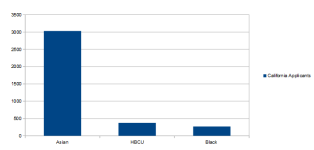
  • The California Asian Bottleneck: California is the ultimate "Asian bottleneck." Asians hyper-compete against each other for a very limited number of seats. There are 3031 Asian medical school applicants out of 7216. In California, a 509 for an Asian applicant is not that competitive simply because of the sheer volume of 510+ applicants in their immediate geographic pool.
  • Puerto Rico: In PR, Hispanic applicants are almost exclusively competing against other Hispanic applicants. If a Hispanic applicant gets accepted with a 509 in PR, they didn't "steal" that seat from an Asian applicant in New York. A 509 is also a great score in PR.
  • HBCUs: Roughly 13% to 20% of all Black medical school matriculants attend an HBCU medical school. While these schools are legally open to all races, the applicant pool is disproportionately Black, meaning Black applicants are largely competing against other Black applicants for those seats. So again, a 509 is much more competitive in this context than it is in others.
This brings me to a perfect example that ties the California bottleneck and the HBCU dynamic together. In California, there is the Charles R. Drew University (CDU), an HBCU medical school. It has a lower MCAT minimum for admission consideration. 72% of its matriculants are from California, yet it only receives around 374 in-state applicants (at least in a recent year where I have available stats).

In contrast, there were 3031 Asian medical school applicants in California. We can plainly see that CA Asians largely do not apply to this school. Conversely, there were only about 270 Black medical school applicants in CA total, meaning it's highly probable that most of them applied there. There is massive self-selection happening.

1790554892526.png

This is a school where students looking for prestige, high-paying specialties, or suburban practices simply do not apply. It is heavily self-selected by Black and Hispanic Californians who want to serve in underserved communities in LA county. The end result was an inaugural MD class (2 years ago) that was roughly 50% Black and 25% Hispanic. There were some Asian and Whites, but the resulting proportions are very different than the state applicant pool.

At CDU, a 509 is a highly competitive, acceptable score. At UCLA, a 509 is much riskier for acceptance. If the Asian applicant with a 509 only applied to the UC schools and got rejected, and the Black applicant with a 509 applied to CDU and got accepted, the aggregate national data will show a disparity. But it's not racial discrimination--it is two different applicants applying to two completely different schools with different applicant pools and different missions.
 
I do believe you are impervious to irony. While the word "tribal" is not offensive in isolation, context matters.
The context here is "tribal thinking", in which it's only offensive to people who are itching to be offended by anything and everything.
I go through most of my life without being "offended" by anything. You ever wonder if its maybe you who has a thin skin? If I completely lost my head every time someone accused me of bias, I'd hardly be able to do my job at all. Responding to criticism maturely used to be considered simply an normal aspect of adult life, before all this Trump madness reduced a third of the country to gibbering toddlers.
 
You sure sound like you're offended all the damned time. Just usually second-hand offense on behalf of some group who never asked for you to advocate on their behalf.
 
tribal - whether it is perjorative depends on context
tribal council - not perjorative
tribal thinking - perjorative
tribal affiliation - not perjorative
tribal-ism - perjorative
tribal jurisdiction - not perjorative

It seems like the pattern is when the term or phrase describes a concrete functional, often necessary, it is not perjorative. When it stems from an idea, perhaps a stereotype, about priorities or thinking, it is perjorative.
 
^
Like the song says, "sometimes words have two meanings".
 
You sure sound like you're offended all the damned time. Just usually second-hand offense on behalf of some group who never asked for you to advocate on their behalf.
Racism hurts all citizens, and we should all be concerned about racial bias in political life. Just because the nozzle is turned against someone else today, doesn't mean it won't be pointed at you tomorrow. As for bad science and inaccurate cultural education, those aren't issues disconnected from me in any sense whatsoever, teaching people scientific analysis is both my job and my vocation. If anthropologists like myself shouldn't be permitted to speak up about the definitions of (and misuses of) terms like tribe, chiefdom, state, and other political classifiers originally popularized by our own discipline, who should be? TV personalities? Radio preachers? You? Pull me another one. If you want me to shut up about the analytical terms employed by my own discipline for fuck's sake, you're going to need to use actual duct tape.
 
Last edited:
I do believe you are impervious to irony. While the word "tribal" is not offensive in isolation, context matters.
The context here is "tribal thinking", in which it's only offensive to people who are itching to be offended by anything and everything.
More irony.
Nah. I get angry when people misrepresent what I've said, make up shit about my views based on nothing but their own imagination, or are just repeated assholes. I don't really get offended very often, and virtually never on behalf of other groups of people.

I think your irony meter needs to be recalibrated.
 
tribal - whether it is perjorative depends on context
tribal council - not perjorative
tribal thinking - perjorative
tribal affiliation - not perjorative
tribal-ism - perjorative
tribal jurisdiction - not perjorative

It seems like the pattern is when the term or phrase describes a concrete functional, often necessary, it is not perjorative. When it stems from an idea, perhaps a stereotype, about priorities or thinking, it is perjorative.
Why do you think it's pejorative (not peRjorative) when it's "tribal thinking"? What specifically makes it pejorative in your view?

I ask, because it's a fairly well established term for in-group bias and out-group denigration, motivated reasoning, and often the pressure to conform one's thinking to that of the in-group... the "tribe".

I feel like some of you have romanticized the term "tribe" and only think of it as a reference to "savages" or otherwise undeveloped indigenous groups. But it's been commonly used to mean a group of people with a shared interest that creates cammeraderie and closeness for a very long time.

The fact that some of you hear "tribe" and can only think "savages" is your own issue, I think.
 
You sure sound like you're offended all the damned time. Just usually second-hand offense on behalf of some group who never asked for you to advocate on their behalf.
Racism hurts all citizens, and we should all be concerned about racial bias in political life. Just because the nozzle is turned against someone else today, doesn't mean it won't be pointed at you tomorrow. As for bad science and inaccurate cultural education, those aren't issues disconnected from me in any sense whatsoever, teaching people scientific analysis is both my job and my vocation. If anthropologists like myself shouldn't be permitted to speak up about the definitions of (and misuses of) terms like tribe, chiefdom, state, and other political classifiers originally popularized by our own discipline, who should be? TV personalities? Radio preachers? You? Pull me another one. If you want me to shut up about the analytical terms employed by my own discipline for fuck's sake, you're going to need to use actual duct tape.
JFC, you hear "tribe" and can only think racism? That's a limit you've placed on yourself, and it serves as rather stark evidence that you lack nuance and flexibility in your thinking and your interactions.
 
tribal - whether it is perjorative depends on context
tribal council - not perjorative
tribal thinking - perjorative
tribal affiliation - not perjorative
tribal-ism - perjorative
tribal jurisdiction - not perjorative

It seems like the pattern is when the term or phrase describes a concrete functional, often necessary, it is not perjorative. When it stems from an idea, perhaps a stereotype, about priorities or thinking, it is perjorative.
Why do you think it's pejorative (not peRjorative) when it's "tribal thinking"? What specifically makes it pejorative in your view?

I ask, because it's a fairly well established term for in-group bias and out-group denigration, motivated reasoning, and often the pressure to conform one's thinking to that of the in-group... the "tribe".

I feel like some of you have romanticized the term "tribe" and only think of it as a reference to "savages" or otherwise undeveloped indigenous groups. But it's been commonly used to mean a group of people with a shared interest that creates cammeraderie and closeness for a very long time.

The fact that some of you hear "tribe" and can only think "savages" is your own issue, I think.

I was pointing out a contextual pattern in how the word is used because I do not think in absolutist terms, so your guesses about my personal worldview are way off-base. It is kind of funny, though, that the way you treat the notion of tribalism makes its near cure D.E.I.
 
Last edited:
Back
Top Bottom